Earth is about to get a rare, almost straight-line view of a visitor from another star system. In late January, the interstellar object 3I/ATLAS will slide into an almost perfect alignment with the Sun and our planet, giving astronomers a brief chance to read its true nature from the way it shines.
Is it simply an icy comet from very far away, or something stranger, as a few voices have suggested? The answer will come from light itself.
A cosmic “full moon” for 3I/ATLAS
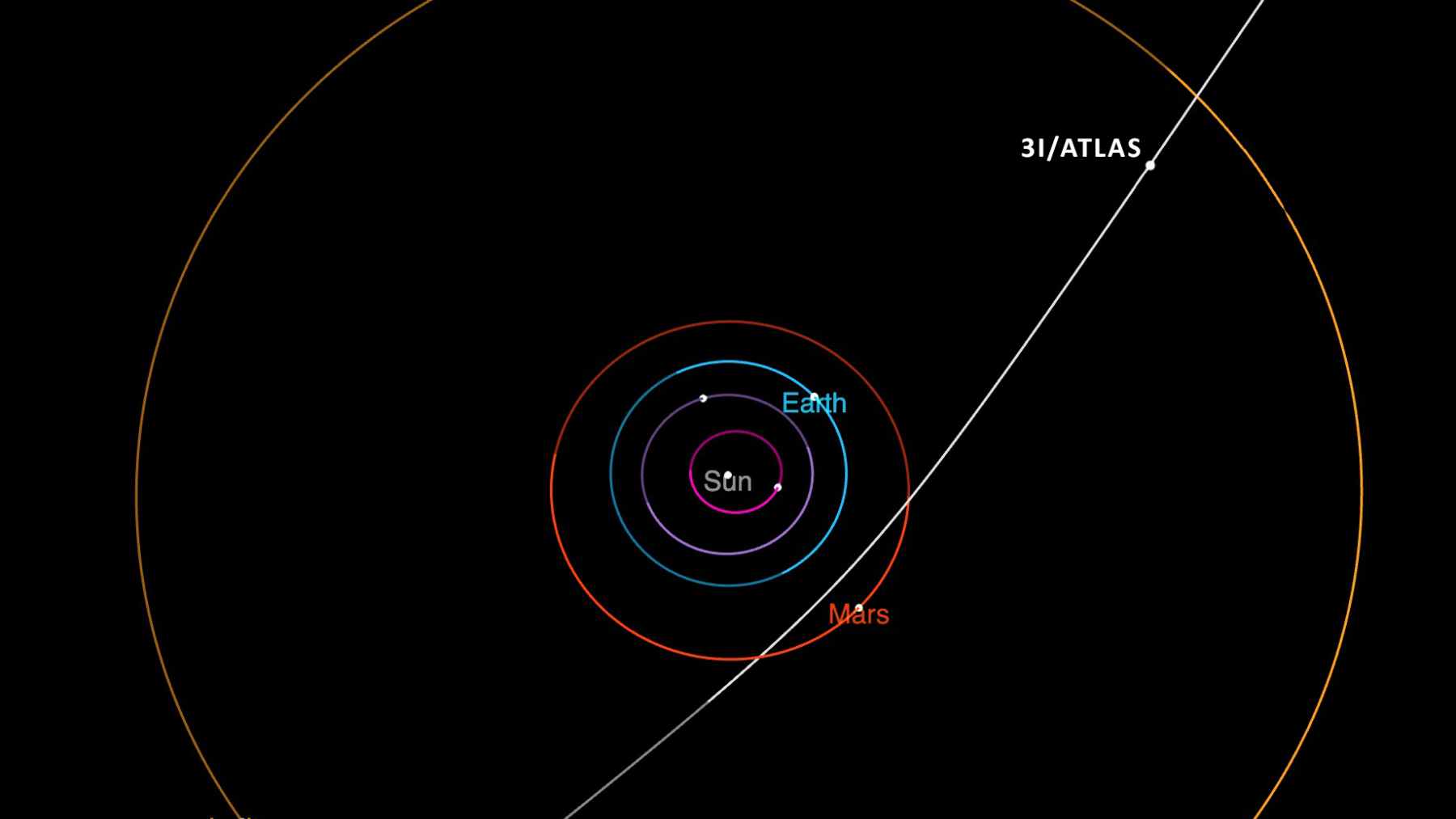
3I/ATLAS was discovered in July 2025 by NASA’s ATLAS survey telescope in Chile and quickly flagged as only the third known object ever seen passing through our solar system from interstellar space. Its path is hyperbolic, which means it is moving too fast to settle into orbit around the Sun and will never return once it leaves.
On 22 January 2026 the object reached what some astronomers have nicknamed its “full moon phase”. A new research note by Mauro Barbieri and Avi Loeb shows that 3I/ATLAS will line up with the Sun and Earth to within less than one degree, a geometry called near opposition. For about a week around that date, the Sun, Earth, and comet will be almost perfectly in a row.
In that special configuration, sunlight hits the dust around the comet from directly behind us. Tiny grains stop casting visible shadows on one another and the returning light can interfere in a very particular way. Together these effects create what physicists call an opposition surge, a sudden nonlinear jump in brightness at very small phase angles.
If you have ever caught a cat’s eyes glowing when your car headlights line up just right, you have already seen a simple version of this trick.
From weird visitor to fully awake comet
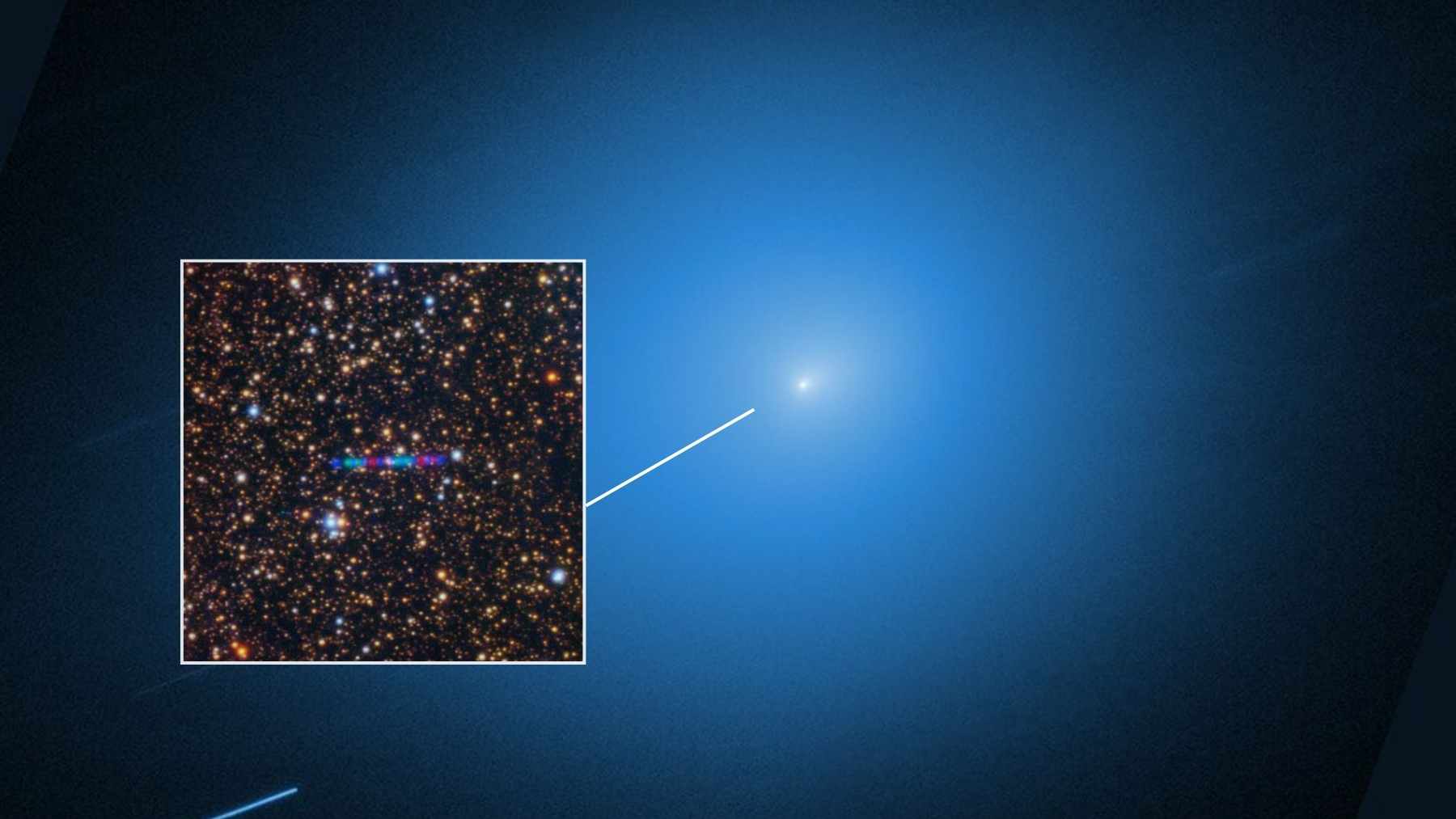
Since its discovery, 3I/ATLAS has looked a bit odd. Hubble and ground based telescopes revealed a rare “anti tail”, a streak of dust that seemed to point toward the Sun instead of away from it. Later work showed that this feature can appear when larger dust grains lag behind along the comet’s orbit, creating a sunward-looking structure from our perspective.
Recent images also uncovered a set of wobbling jets and a rotation period of about seven hours. That behavior may sound exotic, yet similar jet systems and spin rates are known in comets from our own solar system.
The most decisive change came after 3I/ATLAS swept past the Sun in late October 2025. In December, NASA’s SPHEREx mission observed the object again and found that it had “woken up” as a fully active comet.
Infrared spectra showed strong emissions from water, carbon dioxide, carbon monoxide, cyanide and organic molecules mixed with a cloud of warm dust. The water and carbon monoxide signals were about twenty times stronger than before perihelion, and the overall composition now looks very similar to that of familiar solar system comets.
In other words, there is now robust evidence that this interstellar traveler is venting normal comet chemistry.
Weighing natural ice against exotic ideas
Not everyone is ready to close the book. Harvard astrophysicist Avi Loeb has argued that some details, such as the anti-tail geometry and unusual polarization of reflected light, justify keeping an eye on more speculative possibilities including alien technology.
Most comet specialists disagree. NASA’s own overview bluntly classifies 3I/ATLAS as a comet with an icy nucleus, a dusty coma, and non gravitational accelerations that match what outgassing would produce.
A separate analysis that used tiny changes in its trajectory to estimate mass loss found accelerations and a nucleus size entirely in line with a small, active comet, leading the authors to describe it as “exotic and wonderful” yet still a comet.
At the end of the day, the opposition-surge campaign is a tie breaker of sorts. If the brightness spike and its color follow patterns seen in other comets, that will strengthen the case for a natural icy body. If the surge is unusually sharp, bright or tinted, it could hint that the dust grains are coated in darker material or even partly free of ice, which would raise new questions.
Why this faint speck matters for life
For backyard observers, the story is more about science than spectacle. Even at opposition, 3I/ATLAS is expected to hover around magnitude 13, far too dim for the naked eye and challenging for small amateur telescopes. Professional observatories and projects like the Virtual Telescope will do most of the watching while the rest of us follow along on screens between dinner and the evening news.
What they are measuring, though, could carry lessons for our own planet. Spectra suggest that 3I/ATLAS is packed with water ice and organic material that may have formed billions of years before the Sun, in some distant planetary system in the Milky Way.
Comets like this are thought to deliver water and carbon-rich molecules to young rocky worlds. Studying one that did not originate here offers a rare peek at how common those building blocks might be across the galaxy.
Within a few months, this tiny visitor will fade and head back into deep space. Before it goes, the near-opposition alignment gives astronomers one concentrated week to learn as much as physics will allow about dust from another star.
The study was published in Research Notes of the AAS.