
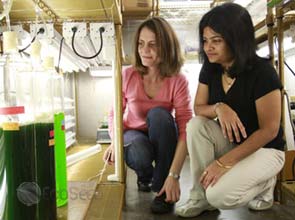
Scientists at Washington University in St. Louis are training a new strain of cyanobacteria to produce increased amounts of hydrogen by keeping them up all night.
Cyanothece 51142 is a recently discovered strain of cyanobacteria, which have existed on earth for at least 2.5 billion years. The Cyanothece strain was discovered in the Gulf of Mexico and was only sequenced in 2008 at the Genome Sequencing Center at the university.
The new strain produces copious amounts of hydrogen gas as a byproduct of nitrogen fixation. Himadri Pakrasi, Ph.D., a professor of engineering in the university’s School of Engineering and Applied Science, developed a method to increase the organism’s capacity to produce hydrogen gas at around 10 times that of similar microorganisms.
Cyanothece undergoes photosynthesis and uses light and carbon dioxide to produce glucose and release oxygen during the day. During the night, it releases nitrogenase, an enzyme that uses the stored glucose to convert the nitrogen into ammonia.
While all cyanobacteria strains undergo photosynthesis, the new strain is one of the few that fixes nitrogen to convert it to ammonia, producing hydrogen in the process. For every nitrogen molecule fixed, another hydrogen molecule is produced.
Mr. Pakrasi describes the microbes as biobatteries because each half of the two cycles store energy that powers the other. The glucose produced during the day is used to fix the nitrogen at night, while the nitrogen produced at night is used to create nitrogen-containing proteins used during the day.
The scientist experimented with manipulating these cycles in an attempt to understand the Cyanothece’s ability and enable to create even more hydrogen from the microbes.
Mr. Pakrasi and his team kept lights on growing cultures of Cyanothece, keeping them “awake” all night. They found that Cyanothece incubated under continuous light produced more hydrogen that those still following the day and night cycle. This was likely because the energy in light somehow fueled the energy-intensive nitrogenase reaction, although the scientists will continue to study this phenomenon.
The team also discovered hydrogen production increased if the Cyanothece was grown in cultures that contained glycerol. The glycerol powers more nitrogenase for a more intensive nitrogen fixing cycle.
The scientists recommend further research to determine the extent to which the organisms can produce hydrogen to a commercially viable level. They also believe the new strain’s unique metabolism also disposes carbon dioxide and glycerol while producing hydrogen.