
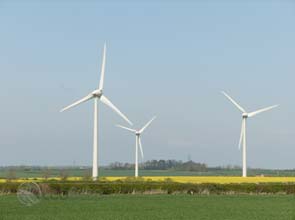
Wind turbines not only generate electricity but may also prove to be advantageous to crops, according to researchers at the United States Department of Energy’s Ames Laboratory and the University of Colorado at Boulder.
Results of a new study show wind turbines produce measurable effects on the microclimate near crops, said Gene Takle, an agricultural expert in Ames. Wind turbine turbulence, in particular, has a positive impact on the crops below through the increased airflow it produces.
“The turbulence resulting from wind turbines may speed up natural exchange processes between crop plants and the lower atmosphere,” Mr. Takle said.
Wind turbines have an impact on the temperatures near the ground which affects crop growth. Wind turbine turbulence both warms and cools nearby ground depending upon the time of day, with temperature change varying between 0.4oCelsius and 1.5oCelsius.
Extra air turbulence likely speeds up the heat exchange between crops and the atmosphere, so crops stay lightly cooler during hot days. On evenings, turbulence stirs the lower atmosphere and keeps temperatures around the crops warmer during the night.
“In this case, we anticipate turbines’ effects are good in the spring and fall because they would keep the crop a little warmer and help prevent a frost,” Mr. Takle noted. “Wind turbines could possibly ward off early fall frosts and extend the growing season.”
Wind turbines also help dry the dew on plants quickly, minimizing the amount of fungi growth on the leaves. Additionally, drier crops at harvest will reduce the cost of artificially dry corn or soybeans.
Wind turbulence will also improve the ability of corn and soybean crops to extract atmospheric carbon dioxide and pump the extra carbon dioxide into the soil, allowing the crops to perform photosynthesis more effectively.
However, Mr. Takle and Julie Lundquist, an assistant professor in the department of atmospheric and oceanic sciences at the university, said their early findings have yet to definitely establish whether or not wind turbines are in fact beneficial to the health and yield potential of soybean and corn. Still, the new study suggests it is a realistic possibility.
“We anticipate the impact of wind turbines to be subtle. But in certain years and under certain circumstances the effects could be significant,” Mr. Takle said.
“When you think about a summer with a string of 105-degree days, extra wind turbulence from wind turbines might be helpful. If turbines can bring the temperature down below 100 degrees that could be a big help for crops,” he said.
The Ames Laboratory’s royalty income seed funding program supported the initial work, while the Energy Department’s Office of Energy Efficiency and Renewable Energy provided additional funding.