Europe has already achieved – even surpassed – its Kyoto Protocol target nine years early, claimed a Britain-based climate change think tank Sandbag.
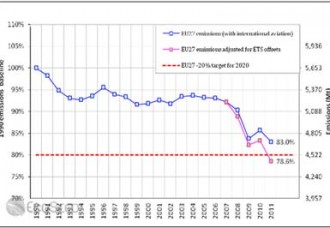
Under the Kyoto Protocol (see related story), in 2008, the European Union committed to reduce its greenhouse gas emissions by 20 percent below 1990 levels by 2020. Analyzing figures recently released by the European Environment Agency, Sandbag argues that the region has now fulfilled this commitment.
Latest E.E.A. data showed Europe had cut its emissions by 18.4 percent below 1990 levels in 2011, and Sandberg points out that adding surrendered carbon offsets – estimated at 252 million – would result in the actual reduction figure reaching 21.4 percent reduction.
“What the Environment Agency doesn’t show is the emissions reductions that Europe has bought in from other countries as carbon offsets to count towards its 2020 target,” said Damien Morris, Sandbag’s Senior Policy Adviser.
According to Jacqueline McGlade, E.E.A.’s executive director, greenhouse gases fell by 3.3.percent in Europe in 2011, the lowest level of emissions reported since 1990. The notable decline was also the third largest over this period reported to the United Nations Framework Convention on Climate Change.
Since the E.U. set their emissions reduction target in 2008, policymakers have been debating whether to cut emissions more aggressively to 30 percent, with analysis from the European Commission showing that it would be a “more cost-effective pathway” towards the region’s 80 to 95 percent decarbonization goal by 2050.
To this end, some member countries including Germany, France, Denmark, Belgium, Italy, Slovenia and Britain are urging Europe to raise its target, while others such as Poland have strongly opposed the move.
Britain argued that an emission-wide target of 50 percent by 2030 is possible for the bloc by 2030, saying that such target is ambitious but achievable and fundamental to limit climate change to manageable levels (see related story).
“Europe has until Spring next year to increase the target it has pledged under the Kyoto Protocol. As the world’s nations prepare to agree a new international climate deal in 2015, this would be a powerful gesture, encouraging other countries to adopt the ambitious targets we desperately need if we are to avoid dangerous climate change. Failing to revise the target, on the other hand, will leave Europe doing nothing to fight climate change for most of the next decade,” warned Mr. Morris.
Kyoto Protocol is an international treaty that set binding obligations to reduce emissions, particularly of industrialized countries like all European Union member countries.
Recognizing these nations’ significant contribution to the current high levels of greenhouse gas emissions as a result of their industrialization activities, the Protocol has put a bigger responsibility to them to cut emissions in a given commitment period. – C. Dominguez