What if the quietest place in the solar neighborhood became the best place to pick up a cosmic whisper? A new project aims to place a gravitational-wave detector on the Moon, using the lunar surface itself as part of the instrument.
According to a February 2026 press release, the Gran Sasso Science Institute (GSSI) is leading preparatory studies for the Lunar Gravitational-wave Antenna (LGWA), with support from the University of Camerino and funding from the Italian Space Agency, after the idea was selected for a European Space Agency lunar science program.
On Earth, gravitational-wave astronomy has moved fast. The Laser Interferometer Gravitational-Wave Observatory, known as LIGO, now spots roughly one black hole merger every three days, and that steady pace is pushing researchers to hunt for even fainter signals in even quieter places.
Why the Moon is tempting
The Moon has no atmosphere, and it avoids many of the constant shakes and rumbles that come with oceans, weather, and dense human activity. A 2023 review notes that lunar sites may have far lower levels of seismic disturbance than Earth in key frequency ranges, which is exactly what sensitive detectors need.
In everyday terms, it is like trying to hear a whisper in a busy cafeteria versus an empty hallway. The Moon is not perfectly silent, but the background is different, and that difference could make certain signals stand out.
Gravitational waves in plain English
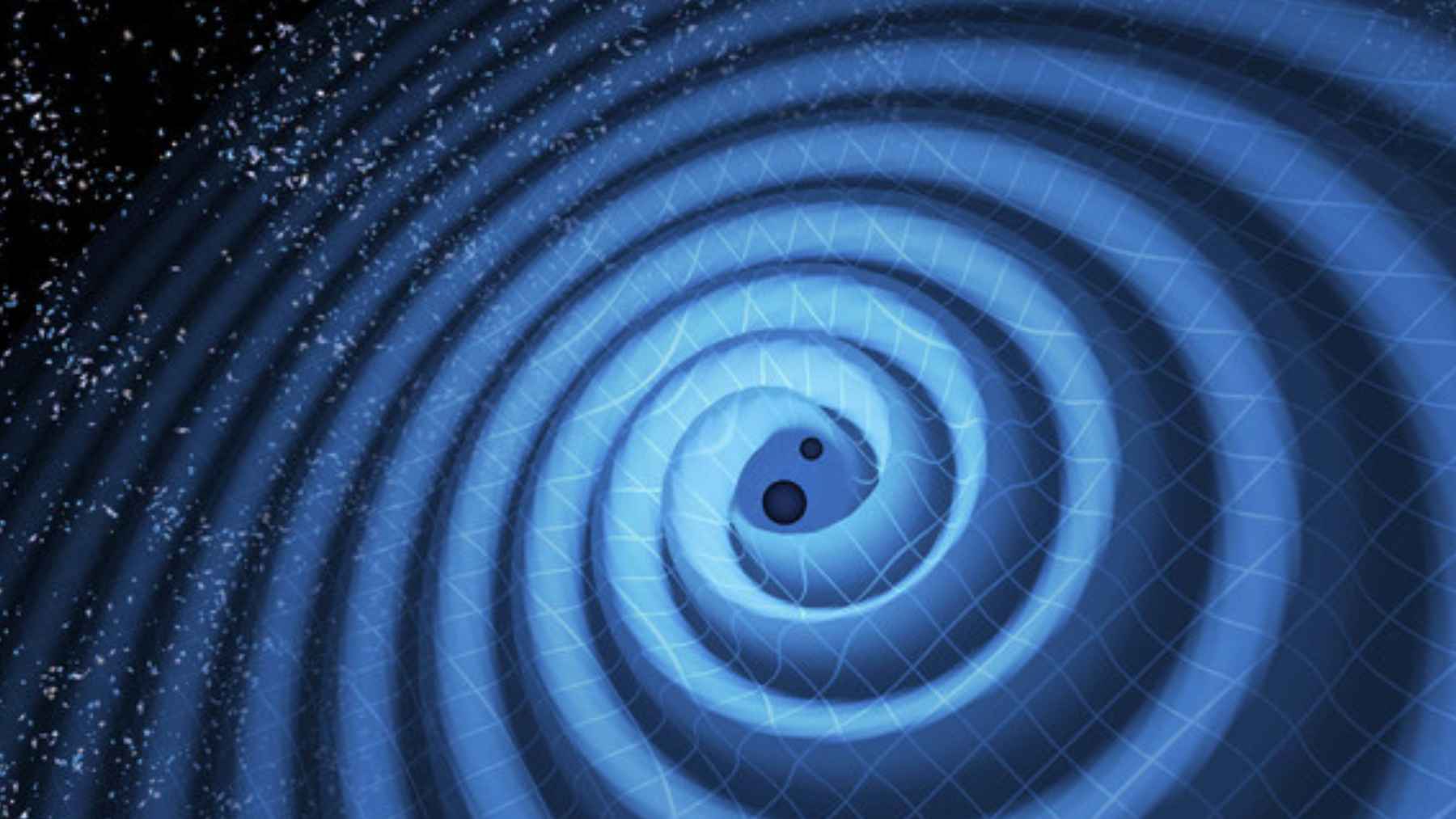
Gravitational waves are ripples in space-time, triggered when very massive objects speed up or change direction, such as pairs of black holes circling each other. Albert Einstein predicted they should exist in 1916, long before anyone had instruments quiet enough to notice them.
The first direct detection was recorded on September 14, 2015, when two U.S. detectors registered a tiny, matching pattern from a distant black hole collision. The result was announced in February 2016 and marked a turning point, because it confirmed that these ripples can be measured, not just calculated.
That is the key idea behind the new push. If today’s detectors are like extremely sensitive microphones, the next step is finding a better recording studio, and space offers a lot of options.
How a Moon detector would work
LGWA is built around a simple but bold concept. It would measure the Moon’s own tiny vibrations as gravitational waves pass through. A 2021 proposal described making the Moon part of the detector, an approach that traces back to physicist Joseph Weber and a gravimeter placed during Apollo 17 in 1972 that could not complete its goals because of an instrument flaw.
Project coordinator Jan Harms has described the idea bluntly, saying, “Building something as complex as a gravitational-wave detector on the Moon is an extremely challenging undertaking.” Getting it right means dealing with lunar dust, sharp temperature swings, and long stretches where hardware must run without hands-on fixes.
The current plan is not to land a full observatory tomorrow. A February 2026 collaboration agreement describes two years of preparatory studies, with a possible extension beyond 2027, focused on payload development and on modeling how vibrations move through lunar soil.
What scientists hope to learn
Today’s best detectors cover different parts of the gravitational-wave “dial,” and there is a gap in the middle. An LGWA mission study says a lunar antenna could listen to waves that cycle as slowly as about once every 15 minutes and as quickly as about once per second, a range that sits between planned space missions and future ground instruments.
That middle range matters because some systems spend months slowly spiraling before they finally smash together. In a 2025 analysis, researchers estimated that a lunar detector could provide early alerts and could pick up on the order of dozens of black hole systems per year that later merge in the higher-frequency band used by Earth observatories.
It would not only be about black holes. The same mission concept points to other targets, including pairs of white dwarfs, which are dense “dead” stars, and it also notes that the sensors would double as a new kind of lunar geophysical station.
Where it fits in the bigger picture
The lunar concept is arriving as other projects move forward too. The space mission LISA received official approval in January 2024, aiming to measure lower-frequency gravitational waves from space rather than from the ground.
On the ground, planners are also designing next-generation observatories with longer arms and better sensitivity, including the Einstein Telescope, which an observatory roadmap describes as targeting the start of operations around 2035. Those plans are still in development, but the direction is toward catching more events and pulling out more detail from each one.
Put together, the idea is less about replacing today’s instruments and more about building a full sound system for the universe. If one detector misses a faint note, another might catch it, and that is how the picture gets sharper over time.
What happens next
One near-term step is a smaller pathfinder effort. A 2023 project workshop page describes a concept with four stations placed in a permanently shadowed region near the lunar south pole, meaning craters that never see sunlight, and notes that a pathfinder mission called “Soundcheck” was selected for a lunar science reserve pool.
The same update says the international collaboration has grown to nearly 200 members.
For now, LGWA remains a proposal and a set of funded studies, not a piece of hardware sitting on the Moon. But the direction is clear: scientists want to use the Moon’s silence as a tool, and they hope it will let them listen to black hole collisions that would otherwise blend into the noise.
The main press release has been published by the National Institute for Nuclear Physics.