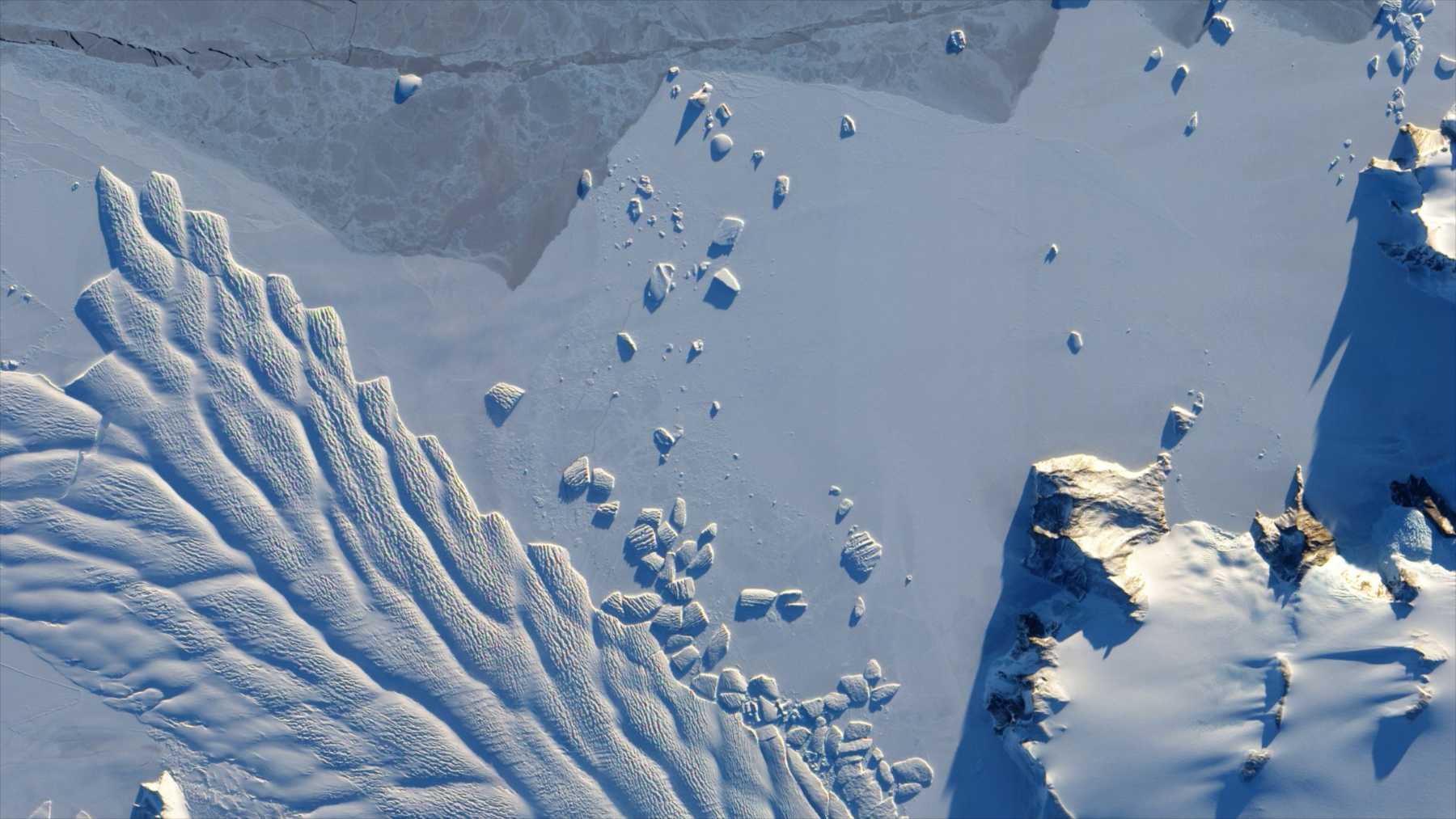
Antarctica briefly gained an extraordinary amount of ice while its longer decline continued. Between July 2021 and April 2023, the ice sheet added about 695 billion metric tons of mass, the largest gain in the satellite record examined by researchers, as unusually heavy snowfall piled up in the east.
A study published in August 2026 links that surge to persistent warmth in the tropical western Pacific and eastern Indian oceans. The distant warming changed atmospheric circulation and sent more moisture toward Antarctica, temporarily offsetting ice losses elsewhere without reversing the continent’s long-term decline.
Where the extra ice accumulated
Much of the increase occurred across Queen Mary Land and Wilkes Land in East Antarctica. Together, these regions gained roughly 470 billion metric tons, accounting for about 68% of the continent’s total increase, while West Antarctica continued losing ice.
That uneven picture matters when reading headlines about Antarctica “growing.” Snowfall can add mass across a vast area even as glaciers keep losing ice along the coast, so a continental total can conceal very different regional stories.
The figures also describe mass, rather than an expansion of the continent’s boundaries. The researchers used observations from gravity-measuring satellites alongside snow accumulation records to investigate what changed during this unusually snowy period.
How tropical warmth changed Antarctic weather
The trigger lay thousands of miles away in the tropical warm pool, the ocean region spanning the western Pacific and eastern Indian Ocean. Surface waters there stayed unusually warm during 2021–2023 compared with the previous two decades, setting off changes that reached far into the Southern Hemisphere.
How could tropical water affect snow near the South Pole? The researchers identified a Rossby-wave train, a sequence of large atmospheric disturbances that altered pressure patterns as its influence spread southward, eventually helping establish unusually high pressure over East Antarctica.
Lower pressure developed farther north, south of Australia, creating a pattern that redirected moist air toward the ice sheet. More moisture arrived through atmospheric rivers, concentrated corridors of water vapor, and fell as snow when conditions favored precipitation over the cold continent.
Following the water back to its source
To investigate the connection, the international team combined satellite measurements, ice-core records, and atmospheric simulations. Researchers from the Chinese Academy of Sciences worked with colleagues in the United States and other countries to connect the ice gain with changes in winds and moisture transport.
One approach involved computationally tracking water vapor, allowing researchers to follow its journey through the atmosphere. The analysis identified the midlatitude Indian Ocean as a major source of the moisture reaching East Antarctica, separating the location of the tropical trigger from the water’s source.
The key was the route the moisture took. Changed circulation delivered more water vapor to the region, and model experiments reproduced the circulation and snowfall response when researchers warmed the tropical pool, strengthening the case for that distant ocean influence.
What the study says about climate change
A warmer atmosphere can hold more moisture, which helps explain why scientists expect warming to increase snowfall in some polar regions. But this particular episode was dominated by a circulation pattern associated with climate variability, and the team tested how much longer-term human influence could explain.
Their model estimate for the additional regional snowfall attributable to human-caused warming was equivalent to only about 9% of the observed snowfall anomaly. That percentage applies to the precipitation increase over Queen Mary Land and Wilkes Land, rather than the entire Antarctic ice gain.
Historical evidence also suggests that comparable multiyear warm-pool events recur roughly once a decade, although that does not promise an identical snowfall response each time. “This is most likely a short-lived phenomenon,” said study co-author Eric Steig, a professor at the University of Washington.
Why a snowy pause still matters
Across the longer 2003–2024 record, Antarctica lost mass at an average rate of about 140.5 billion metric tons annually. The temporary increase sits within that broader decline, making the length of the measurement period essential to understanding what the numbers mean.
Warm ocean water can still melt ice shelves from below and accelerate the movement of glacier ice toward the sea. Extra snowfall can offset those losses for a time, but it does not establish that the processes driving them have stopped.
For coastal communities, understanding both effects helps scientists improve projections of sea-level rise and the flooding that threatens homes and roads.
The study was published in Nature on August 19, 2026.