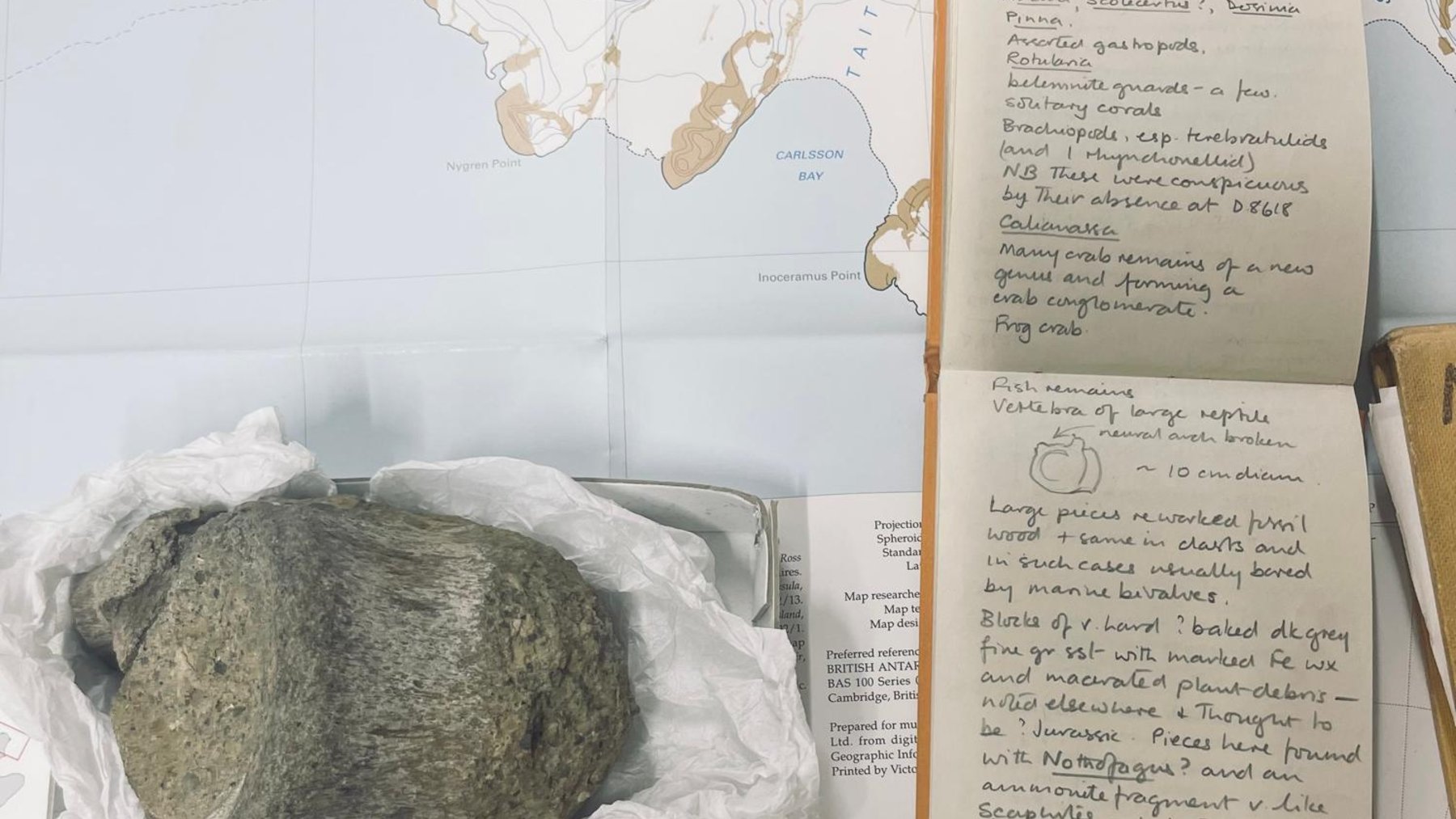
How does the first dinosaur bone ever collected in Antarctica spend four decades inside a museum drawer? A roughly 82-million-year-old tail vertebra, picked up on James Ross Island in 1985 and initially treated as the remains of a marine reptile, has now been identified as belonging to a titanosaur.
The modest fossil changes more than a label in a collection. It confirms that long-necked sauropods lived in Antarctica’s Late Cretaceous forests and strengthens the idea that the Antarctic Peninsula may have helped dinosaurs move between South America and ancient Zealandia, the landmass that includes modern New Zealand.
A dinosaur fossil hiding in plain sight
British Antarctic Survey geologist Mike Thomson collected the bone while his team was mapping rock layers on James Ross Island. The expedition recovered many marine fossils, so the weathered specimen was packed up, taken to the United Kingdom, and stored with material believed to have come from a large sea reptile.
Years later, paleontologist and collections manager Mark Evans noticed that the unusual tail bone did not quite fit that description. He contacted Natural History Museum dinosaur specialist Paul Barrett, who recognized its hollowed end and rounded projection as features of a titanosaur vertebra. “Believe it or not, this is the first bit of dinosaur ever discovered on Antarctica,” Barrett said.
That distinction matters. Other Antarctic dinosaurs have been described, but this was the earliest dinosaur bone physically collected from the continent, even though nobody understood its identity at the time.
What one small vertebra revealed
The fossil is an anterior caudal vertebra, meaning it came from the front portion of the animal’s tail. Its ends formed part of a ball-and-socket arrangement, and that distinctive construction allowed researchers to place it within the titanosaur family tree even though the fragment is too incomplete to identify a species.
Size adds another mystery. The researchers estimate that the dinosaur was only about 20 to 23 feet long, small by titanosaur standards, but they cannot tell whether it was a juvenile or a naturally small adult. One little bone can answer a big question and create several new ones.
The vertebra was found in marine rock beside ammonite fossils, which allowed scientists to date its geological setting precisely. The most likely explanation is surprisingly simple. After the dinosaur died on land, its body may have washed out to sea, floated for a time, and eventually sunk into sediment on the ocean floor.
Antarctica once looked nothing like today
Picture Antarctica without its vast white ice sheet. During the Late Cretaceous, the region supported temperate forests filled with ferns, palms, and conifers, even though plants and animals still faced extreme seasonal changes in daylight.
Titanosaurs were four-legged plant eaters with long necks and heavy tails, and the group included the largest land animals known. This Antarctic individual was much smaller, but its presence shows that sauropods were part of a surprisingly varied polar ecosystem that also included armored dinosaurs, small herbivores, predators, and early birds.
Antarctic dinosaur fossils remain exceptionally rare, and the new study describes the continent’s Mesozoic dinosaur record as meager. That makes a roughly four-inch bone far more valuable than its size might suggest.
A possible dinosaur route across Gondwana
The vertebra also helps researchers revisit an old geographical puzzle. Titanosaurs are abundant in South America and have been reported from New Zealand, yet none has been securely identified in Australia, even though other sauropods lived there.
Back then, the southern continents were arranged very differently as Gondwana continued to break apart. New Zealand was closer to southern South America and the Antarctic Peninsula than it was to Australia, raising the possibility that titanosaurs traveled through western Antarctica on their way toward Zealandia.
That idea is promising, not proven. The fossil record is still too fragmentary to map a definite migration route, and the researchers say more evidence will be needed. Still, this overlooked vertebra places the right dinosaur in a crucial region at the right time.
Why museum drawers still hold discoveries
Scientific breakthroughs do not always begin with a fresh excavation. Museums and research collections preserve specimens until new specialists, comparisons, and analytical methods can ask questions that were not possible when the objects first arrived.
A museum label can look final, but in science it is often a working hypothesis. This case shows why careful curation is part of discovery itself, since a fossil can sit quietly for decades and then reshape a chapter of natural history when someone brings new knowledge to it.
That lesson matters far beyond Antarctica, because collections around the world may contain fossils still waiting for a second look.
The study was published in Acta Palaeontologica Polonica.