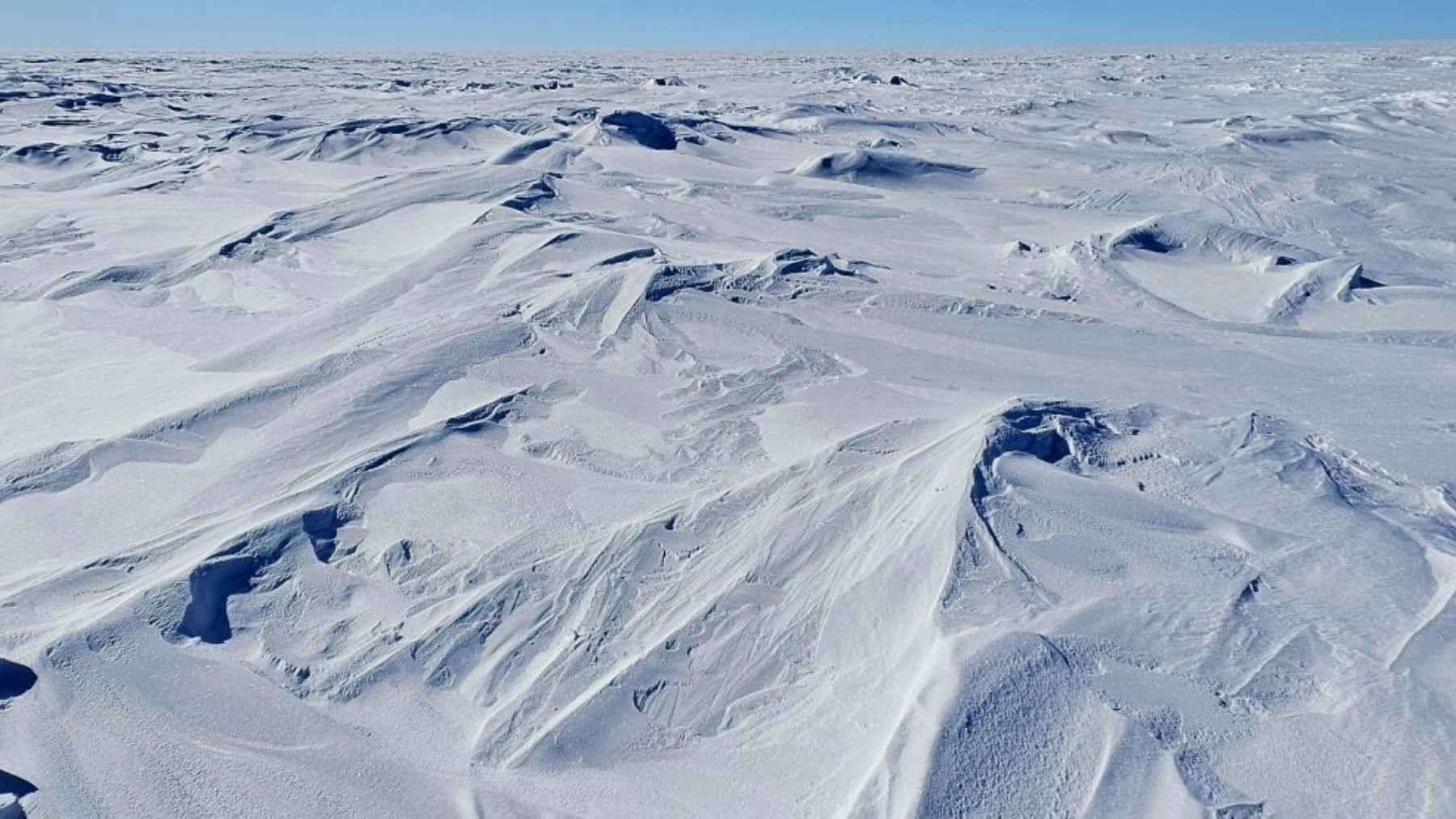
Satellite measurements have revealed snow temperatures of roughly −144°F (−98°C) in shallow hollows high on the East Antarctic Plateau. Published in 2018, the finding showed how extraordinarily cold Earth’s surface can become when darkness, dry air, and calm weather line up.
But there is an important distinction behind that number. It describes the snow surface, not the air someone would breathe, so it does not replace the official air-temperature record or establish what one unprotected breath would do to a person.
What the satellites actually measured
Led by Ted Scambos at the National Snow and Ice Data Center, researchers analyzed Antarctic winter satellite observations from 2004 through 2016. Their work identified about 100 locations where snow-surface temperatures reached approximately −98°C.
Instruments aboard NASA’s Terra and Aqua satellites measured thermal radiation emitted by the surface. Recalibrated data lowered an earlier estimate of about −135°F (−93°C), meaning the revision reflected improved measurements rather than proof that Antarctica had suddenly grown colder.
The World Meteorological Organization lists Earth’s lowest measured air temperature as −128.6°F (−89.2°C), recorded at Vostok Station on July 21, 1983. The satellite study estimated air temperatures above the coldest snow at around −94°C, with uncertainty of approximately 4°C, but that was an estimate rather than a direct weather-station reading.
Why tiny hollows become deep freezes
How can a shallow dip make such a difference? During the polar night, snow loses heat to space, chilling the air immediately above it. That dense air can collect in hollows only about 6 to 10 feet deep, provided winds do not mix it with warmer air.
“In this area, we see periods of incredibly dry air,” Scambos explained in the research announcement. With very little water vapor to intercept outgoing heat, the snow can keep cooling under clear skies for days.
The result is a temperature inversion, with colder air sitting beneath warmer air. What looks like a nearly flat white landscape can therefore contain pockets substantially colder than their surroundings.
Would one breath really freeze your lungs?
The claim that one breath would freeze human lungs goes beyond what the satellite research establishes. Measuring the temperature of snow is not the same as testing how a person responds to breathing exceptionally cold air.
Mayo Clinic Health System explains that the body warms and humidifies incoming air before it reaches the lungs, which are protected inside the chest. Cold, dry air can still irritate the airways and trigger bronchospasm, a narrowing that makes breathing uncomfortable or difficult. That is a genuine concern, but it does not justify a precise prediction of injury from a single breath at the satellite-measured temperature.
The people living near this extreme
Concordia, a French-Italian research station on Dome C, offers a glimpse of life on the plateau. On July 18, 2026, it recorded −119.4°F (−84.1°C), according to station data supplied by the French Polar Institute to Live Science. Even there, the reading remained above the station’s documented 2010 minimum of −84.7°C.
The cold is only part of the challenge. The European Space Agency describes months of darkness and winter isolation without access by aircraft, conditions that make Concordia useful for studying sleep, mood, teamwork, and physical health during long missions. Its nickname, “White Mars,” reflects that connection to human space exploration.
Extreme cold does not cancel global warming
A bitterly cold night in Antarctica cannot, by itself, tell us whether the planet is warming. Climate concerns long-term patterns, while local weather can still produce exceptional cold, a distinction Concordia station leader Gabriele Carugati emphasized in his interview with Live Science.
The broader ice record tells a different story from an isolated temperature reading. NASA’s satellite analysis shows that Antarctica lost approximately 135 billion metric tons of ice per year on average between 2002 and 2025, despite gains in some eastern areas. A continent can contain intensely cold places while losing ice overall.
Is −98°C close to the limit?
The researchers found that widely separated hollows approached remarkably similar minimum temperatures, suggesting a practical limit under those conditions. Scambos explained that slightly lower temperatures might be possible if clear, extremely dry weather persisted for weeks, but considered that unlikely.
For readers, the distinction is simple but important. The finding reveals an extraordinary snow-surface extreme, not a new thermometer record or a demonstrated threshold for human breathing.
The original satellite-temperature study was published in Geophysical Research Letters.