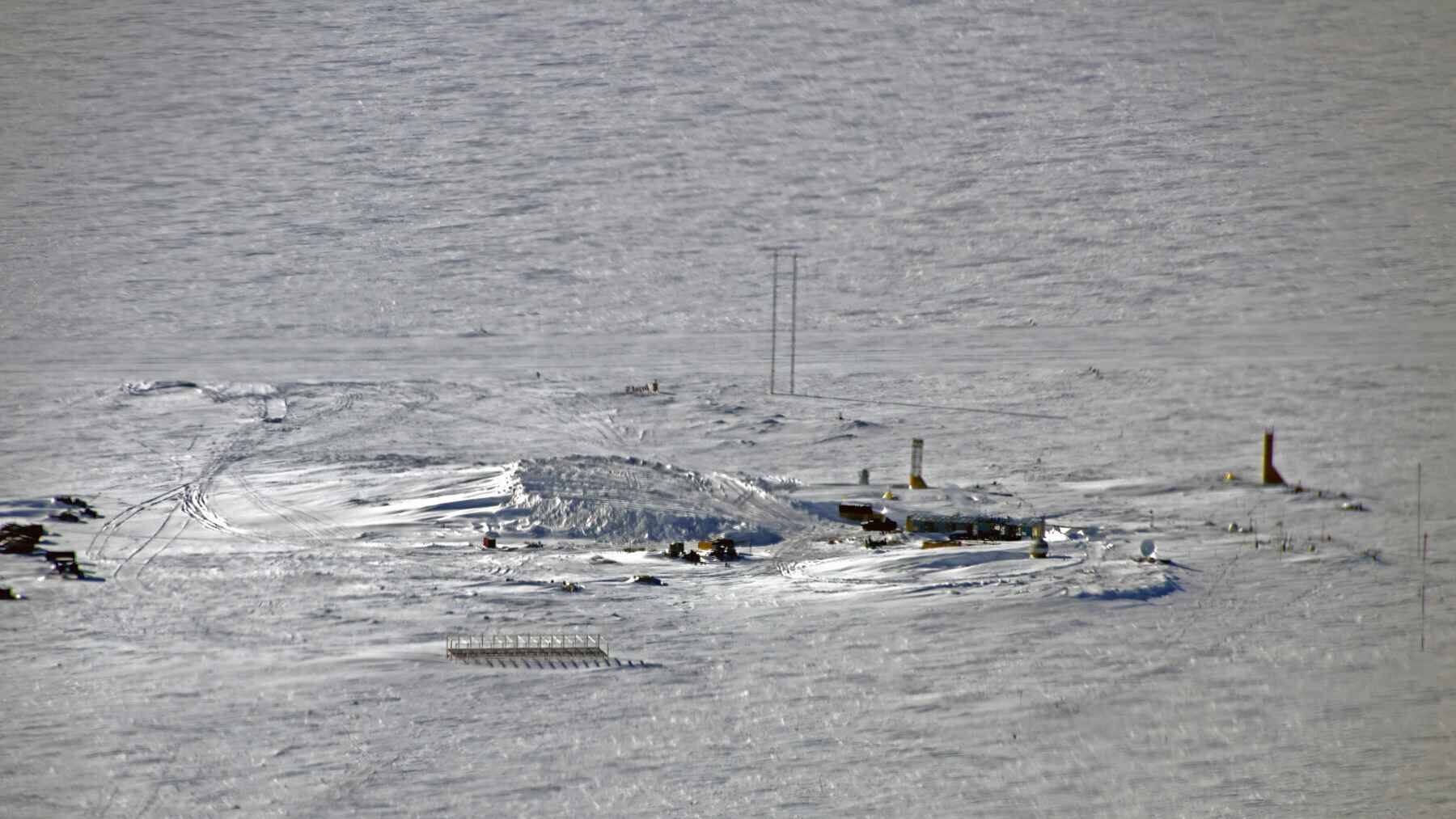
Nearly 2.5 miles beneath the frozen expanse of East Antarctica sits a liquid body of water the size of Lake Ontario. At first glance, Lake Vostok should be frozen solid — yet crushed under 350 atmospheres of pressure and insulated by a massive ice blanket, this giant subglacial reservoir refuses to freeze.
The explanation is less exotic, and more remarkable, than any natural antifreeze. Thick ice slows heat loss, pressure pushes freshwater’s melting point below its usual 32°F (0°C), and a small but persistent supply of energy from Earth helps keep the lake near -3°C.
A lake mapped without a view
Scientists did not discover Lake Vostok by looking into open water. Airborne radio-echo surveys in 1974 and 1975 detected a broad, flat reflector beneath roughly four kilometers of ice, while satellite altimetry and later seismic and radar analysis established that a deep freshwater lake occupied the basin.
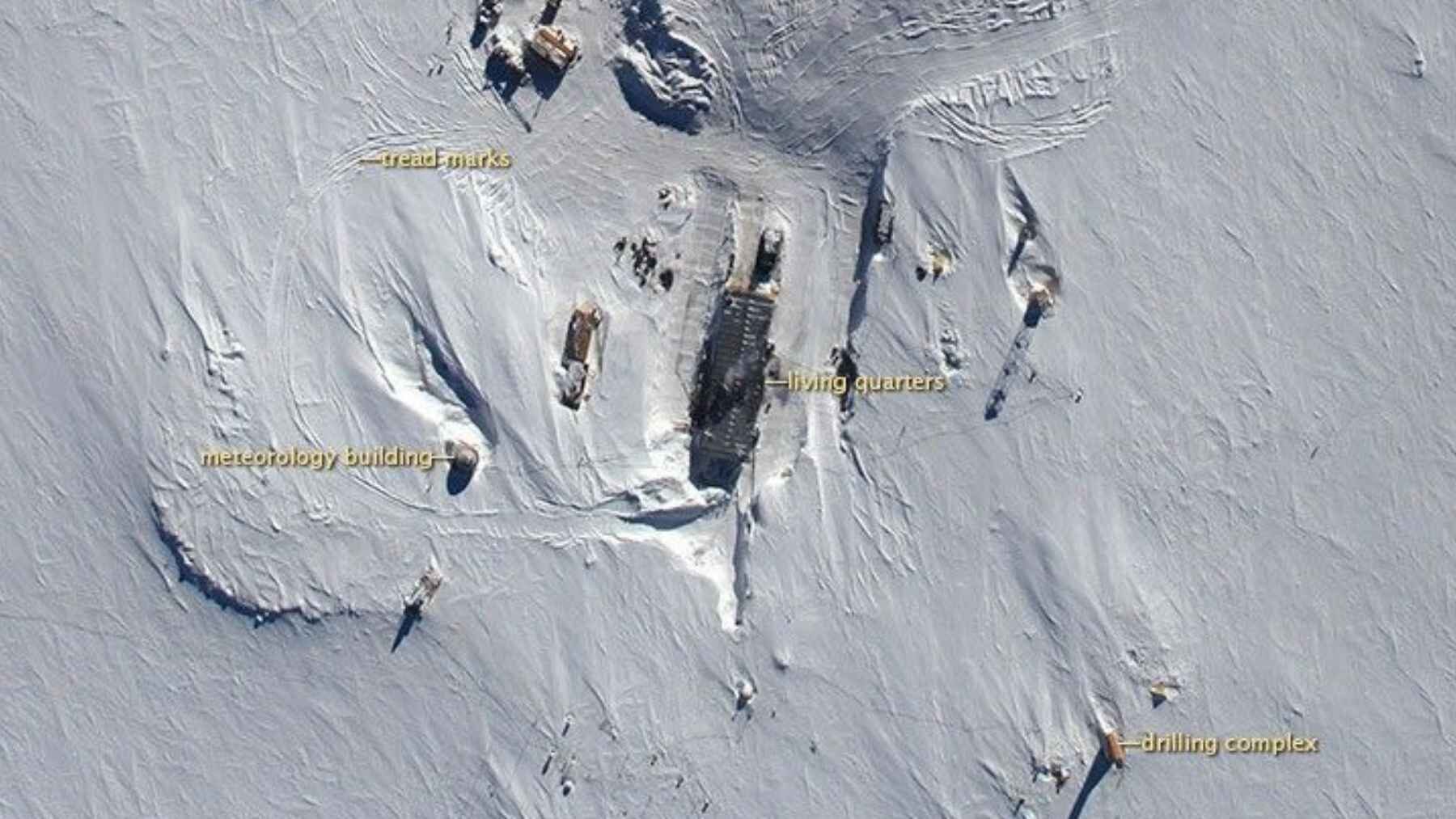
The National Academies estimated its surface area at about 5,400 square miles, compared with Lake Ontario’s 7,320 square miles. The likeness is therefore a useful scale comparison rather than a perfect match, although Vostok is far deeper in places and a major review reported water reaching at least 3,280 ft. in its southern basin.
The ice works like a blanket
Four kilometers of ice sounds like four kilometers of cold, but cold does not simply seep downward. The thick ice sheet slows the escape of energy from below, while steady geothermal heat from Earth helps bring the base of the ice to its local melting point.
That heat supply is weak, yet it does not need to make Lake Vostok comfortable or even remotely warm. It only has to help maintain a boundary that is insulated from Antarctic air and already sitting close to a finely balanced phase change.
Pressure changes the rules
At the Vostok borehole, researchers reached the lake at a depth of 12,366 ft., where the water is under roughly 350 atmospheres of pressure. Using the published pressure-melting relationship, that load lowers the local melting point by about 2.5°C, allowing freshwater and ice to coexist at temperatures close to -3°C.
Pressure does not create heat. It changes the temperature at which solid ice and liquid water can coexist, leaving insulation and heat flow to determine whether melting or freezing actually occurs.
The roof melts and refreezes
The underside of the ice sheet slopes, so the pressure and melting point are not identical from one end of the lake to the other. Researchers calculated a difference of about 0.3°C across Lake Vostok, with basal melting occurring in the north and freezing taking place in the south.
This creates a slow-moving conveyor. Meltwater enters beneath thicker ice, lake water circulates, and some of it later freezes onto the roof as accretion ice — refrozen lake water that slowly clings to the underside of the glacier like frost inside a deep freezer. Scientists identified more than 656 ft. of this ice at the bottom of the Vostok core.
An ancient lake with moving water
Lake Vostok may have been sealed from free exchange with the atmosphere for more than 15 million years, but that does not mean every drop has been sitting still since then. Ice flows over the basin, melts into the lake, and carries refrozen lake water away again.
A 2002 Nature study estimated that water remains in the lake for about 13,300 years on average, while ice takes roughly 16,000 to 20,000 years to cross it. Crucially, the setting is ancient, but its water belongs to a remarkably slow recycling system.
Life remains an open question
No sunlight reaches the lake, so any ecosystem would have to rely on chemical energy from interactions among water, ice, gases, minerals, and sediments. Small quantities of microbes have been reported in accretion ice, which makes life plausible, but that is not the same as finding a confirmed community in a clean sample from the main water column.
That distinction matters because refrozen water recovered from Lake Vostok mixed extensively with borehole drilling fluid, preventing an unequivocal biological analysis. The lake may be habitable, but scientists still cannot say with confidence what lives there.
Ancient geology built the basin
A Nature Geoscience study published in June 2026 places the Lake Vostok trough along a major geological boundary within a newly defined, fan-shaped province of hidden East Antarctic basins. The researchers link that landscape to rotational extension before the breakup of Gondwana, helping explain how such a deep container formed beneath the ice.
The tectonic finding does not replace the lake’s thermal explanation. Ancient geology made the basin, while ice, pressure, circulation, and heat maintain the liquid water inside it.
A lesson for icy worlds
Lake Vostok shows that water can persist in permanent darkness below a frozen shell, which is why Antarctic subglacial lakes are useful test grounds for future exploration of Europa and Enceladus. They also deliver a humbling warning, since finding hidden water can be easier than reaching it without contaminating the evidence.
Ultimately, Lake Vostok is not kept liquid by one dramatic trick. It survives through a delicate, long-running balance.
The latest study discussed here was published in Nature Geoscience.