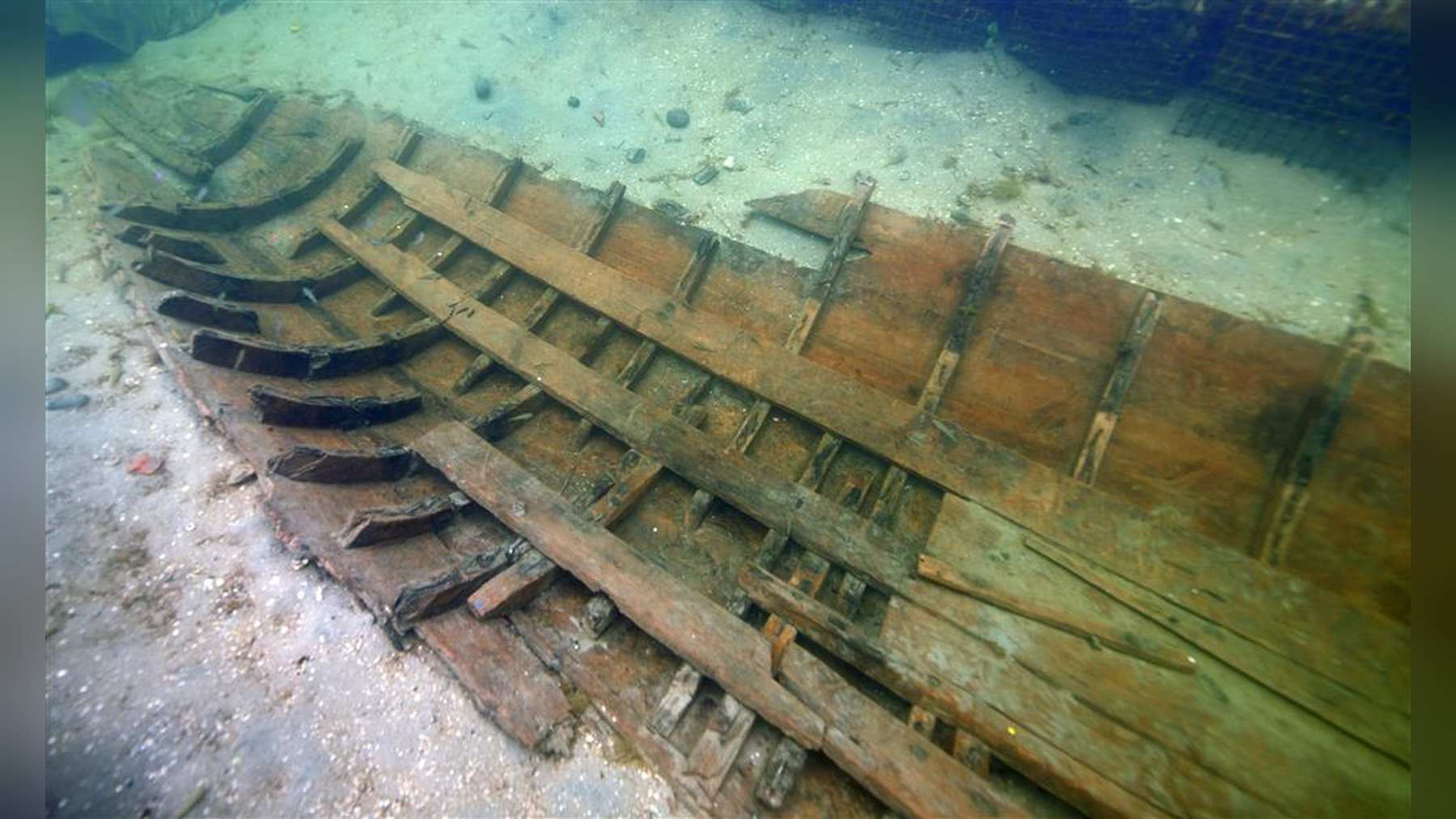
The Mithridates warship turned up in 2012 in Taman Bay, under more than 5 feet (1.5 meters) of sand, silt and shells off the old Greek port of Phanagoria. Two years on, divers found a bronze ram about 5 feet (1.5 meters) from the bow. Crescent and five-rayed star in relief. That emblem is tied to King Mithridates VI Eupator.
“Our luck was that this ram carries signs, the royal sign of Mithridates VI Eupator, this crescent and star here,” said Vladimir Kuznetsov, head of the Phanagoria archaeological expedition, in a 2014 special report published by the regional broadcaster Kuban 24. He was speaking Russian. “This is a warship from the fleet of Mithridates VI, one of the ships that were sent from Panticapaeum to protect his own children.”
This year a Moscow lab went after the metal. Twenty-two nails or bits of nails, one small strip, the ram. Its answer is that the shipwrights paid for copper when iron was cheaper, because they wanted the boat to last.
A lucky exception in warm salt water
Kuznetsov, Sergey Olkhovsky of the Institute of Archaeology in Moscow and M. O. Zhukovsky of the nonprofit Contemporary Technologies in Archaeology and History described the first find in English, in a 2013 conference paper.
“Warm salty water is a hazardous environment for any organic remains and in most cases ancient shipwrecks are marked solely by their ceramic or stone loads and, occasionally, metal anchors,” they wrote.
“The Phanagorian ship is one of the lucky exceptions,” they went on. In their reading, “the accumulation of silt sediments covering the find was very fast, probably as a result of a heavy storm, and preserved the wooden hull of the ship from dissolution.”
There was no cargo to date it by. “The Phanagorian ship had no cargo on board at the moment of its wreckage,” the paper says, and only a few ceramic vessels were found inside.
When the hull first appeared, archaeologists took it for a much later merchant shipwreck. Olkhovsky, who led the underwater team, had his own guess.
“Its modest size made us assume that the vessel was most likely a dispatch type, an auxiliary dispatch vessel,” he said in the same Kuban 24 report, also in Russian. “Some kind of fast boat that went between one capital of the Asian Bosporus, Phanagoria, and, for example, Panticapaeum.”
Then the ram.
“Nobody expected that such small vessels could be fitted with real combat rams. That is where the sensation lies,” Olkhovsky said. “If we had found some 40-meter trireme, everything could have been explained much more simply than what we have found now.”
Rome’s enemy, and a town in revolt
The Volnoe Delo Oleg Deripaska Foundation, which was funding the excavations, put out the news in 2014. Its release called Mithridates “the most powerful king in Anatolia during the 1st century B.C.” and said he was “often called Rome’s greatest enemy.” He was king of Pontus. About 25 years of war with Rome, three wars in all, against Sulla, then Lucullus, then Pompey.
“However, the newly-found ram dismisses the previous version and proves that the ship was a bireme, an ancient oared warship with two decks of oars that Mithradates used to quell unrest,” the foundation’s 2014 announcement said.
“Phanagoria reveals its secrets year by year, showing us the hidden sides of the Black Sea region’s history,” Kuznetsov, a doctor of historical sciences, said in that release. “Our task is to gradually, step by step, go deeper into the ancient times in order to study the circumstances under which people lived thousands of years ago in a thorough and precise way.”
Phanagoria, the largest Greek colony on the Taman Peninsula, rose against the king in 63 BC. Appian, a Roman historian, and Plutarch, a Greek one, both describe the uprising. The Institute of Archaeology of the Russian Academy of Sciences lists the vessel as a warship from the king’s fleet that burned about 394 feet (120 meters) from shore during the revolt.
Kuznetsov put it more bluntly years later. “You can find grand stone cities anywhere on the Mediterranean,” he told The Moscow Times in 2021. “But what we have at Phanagoria is different.”
Fast, light, and probably a scout
Radiocarbon dating puts the hull timbers around the middle of the first century BC. What survives is about 52 feet (15.82 meters) long. It lay on its port side, so that side is preserved almost to the top rail.
Pierre Poveda and Giulia Boetto of Aix-Marseille University’s Centre Camille Jullian worked on it with Olkhovsky. Their reconstruction: about 63 feet (19.35 meters) long, 9 feet (2.8 meters) wide. Length to width close to 7 to 1, typical of oared longships. Room for an estimated 20 to 22 rowers.
“Based on the shape and structure of the hull, the presence of both the bronze blunt-faced casing and the proembolion, we identified the Phanagoria wreck as the remains of a light sailing and rowing military ship, which must have proven to be very fast and manoeuvrable,” the three wrote in their 2024 reconstruction study. A proembolion, or fore-ram, was here a V-shaped pair of oak timbers nailed to the outside of the bow.
“Given its limited size, it does not fit into the category of the larger ships of the line,” they added. “Instead, it must have been employed in minor war activities as a scout, or as a patrol ship.”
Olkhovsky now heads the Center for Underwater Archaeological Heritage at the Institute of Archaeology. “Our best find is the ship of King Mithridates VI Eupator, which sank in the port of Phanagoria in the first century BC,” he told the portal Scientific Russia in February 2025, in Russian. “We realized the value of this find in time and studied it very carefully, even though it took more than ten years.”
“Unlike amateurs, we control our grabbing reflex,” he said.
Twenty-two nails
The new paper is from the Kurchatov Institute National Research Center in Moscow, first author E. A. Greshnikov, with Olkhovsky among the co-authors. They had 23 metal samples, 22 of them nails or nail fragments and one a small gray strip with a nail through it, plus the ram.
Methods first. Scanning electron microscopy, which images surfaces at very high magnification; X-ray fluorescence; X-ray diffraction; and neutron activation analysis, which reads a sample’s chemical makeup from the radiation it gives off after exposure to neutrons. One nail had swollen with corrosion to almost three times its original diameter, and the neutron data gave back its true size.
“The nails were made of copper and copper alloys, the ram of lead-tin bronze, and the plate of lead,” the authors write in the Russian-language abstract, in an English translation.
Some of the nails were close to pure copper, and in others there was lead, antimony or zinc, copper-lead-antimony here, copper-zinc-antimony there, but the samples were small and the team says exact alloys are hard to pin down. The smiths may have added some of it on purpose. Nickel, cobalt, iron and silver in traces could be from the ore, or from old copper that went back into the pot.
Iron nails existed and were cheaper, and the builders still used copper, which the researchers, looking also at the careful repairs, read as an investment in a long working life. The results show that “effective and diverse materials and technologies were used to build and repair the military fleet of the Bosporus, which ensured a long period of operation of these ships,” the abstract says.
Nails held the ram on too. “Two nails, whose holes are visible on the slightly curved arm, or cowl, attached it to the stem-post,” Poveda, Boetto and Olkhovsky wrote of the bronze casing in 2024. “A single nail secured the lower right arm to the keel.”
Red paint, clay and lead
An earlier study by the same group went after the coatings. Inside, “the internal wooden part of the ship was treated with a ‘mastic,’ based on clay mixed with wool and down,” the authors wrote in 2024. “The outer surface of the ship’s sheathing board was coated by realgar mixed with wax and pine resin.” Realgar is an arsenic-bearing red mineral.
“Such a coating, due to the high sulfur content in realgar, not only slowed down the fouling of ship hulls by marine mollusks, but also prevented damage to wood by shipworms Teredo navalis,” they wrote. Shipworms still threaten exposed wooden wrecks today, as Dutch heritage officials warn about the 17th-century Palmhout wreck off Texel.
The same paper notes that “Vitruvius mentions that the best orpiment (also known as realgar) in the 1st century BC was mined in the Pontic Kingdom, on the Black Sea coast of Asia Minor.”
The clay inside may have had a second job. “It is highly likely that an additional function of the coating was to prevent fires on ships, either accidental or as a result of being fired upon with incendiary shells,” the authors wrote. The Phanagoria ship did burn, by the institute’s account of the revolt.
Taken together, they wrote, the work presents “the recipes used for the waterproofing, fireproofing, and bioprotection of warships used by sailors of the Pontic Kingdom more than 2000 years ago.”
The gray strip from the new study is lead. Patches like it were found outside the planking at the bow and on the inner bottom planking, where wooden parts join. On the parts of the hull divers can reach there is no continuous lead sheathing of the sort some Greek and Roman ships had.
“Undoubtedly, Pontus had the technologies and resources to maintain its navy in good condition for decades,” the 2024 paper concludes.
The ram
The ram is about 35 inches (89 centimeters) long and 17 inches (44 centimeters) high and weighs about 34 pounds (15.6 kilograms), roughly 91 percent copper, 4.7 percent tin and 4.3 percent lead. Bronze like that could take impacts, the Kurchatov team argues, and protect the keel if the ship struck an obstacle or ran aground.
Poveda, Boetto and Olkhovsky set it beside the three-finned rams found off Athlit in Israel and off Sicily. “Its simple bronze casing was completely different,” they wrote. “We do not think it was intended to deliver a pounding blow to the enemy ships, but was placed to reinforce the cutwater.” The cutwater is the leading edge of the bow, the part that splits the water.
What the wreck cannot tell us
The tie to the 63 BC revolt rests on historical sources and archaeological interpretation. The 2024 reconstruction study says the crescent-and-star symbol, “well attested in coins minted during the Kingdom of Pontus, especially during the reign of Mithridates VI Eupator (120-63 BCE), offered important chronological information which, together with the other data collected, places the wrecking event within the first half of the 1st century BCE.”
Radiocarbon gives a date range rather than a single year, and in 2013 the team already wrote that “C14 dating is able to provide only a wide confidence interval.” The bireme label from 2014 has not been repeated in the later scientific papers.
The nail samples were small, and one wreck cannot show how every ship in Mithridates’ fleet was built. Nor do the metals give a service record or an exact lifespan, only repairs and material choices, much as modern work on corrosion-resistant coatings measures how long materials last rather than how a vessel was used.
The full study was published in Rossiiskie Nanotekhnologii (Russian Nanotechnologies).
“The Phanagoria ship fully justified the effort and time invested in studying it,” Olkhovsky told Scientific Russia.
Photo: Institute of Archaeology, Russian Academy of Sciences