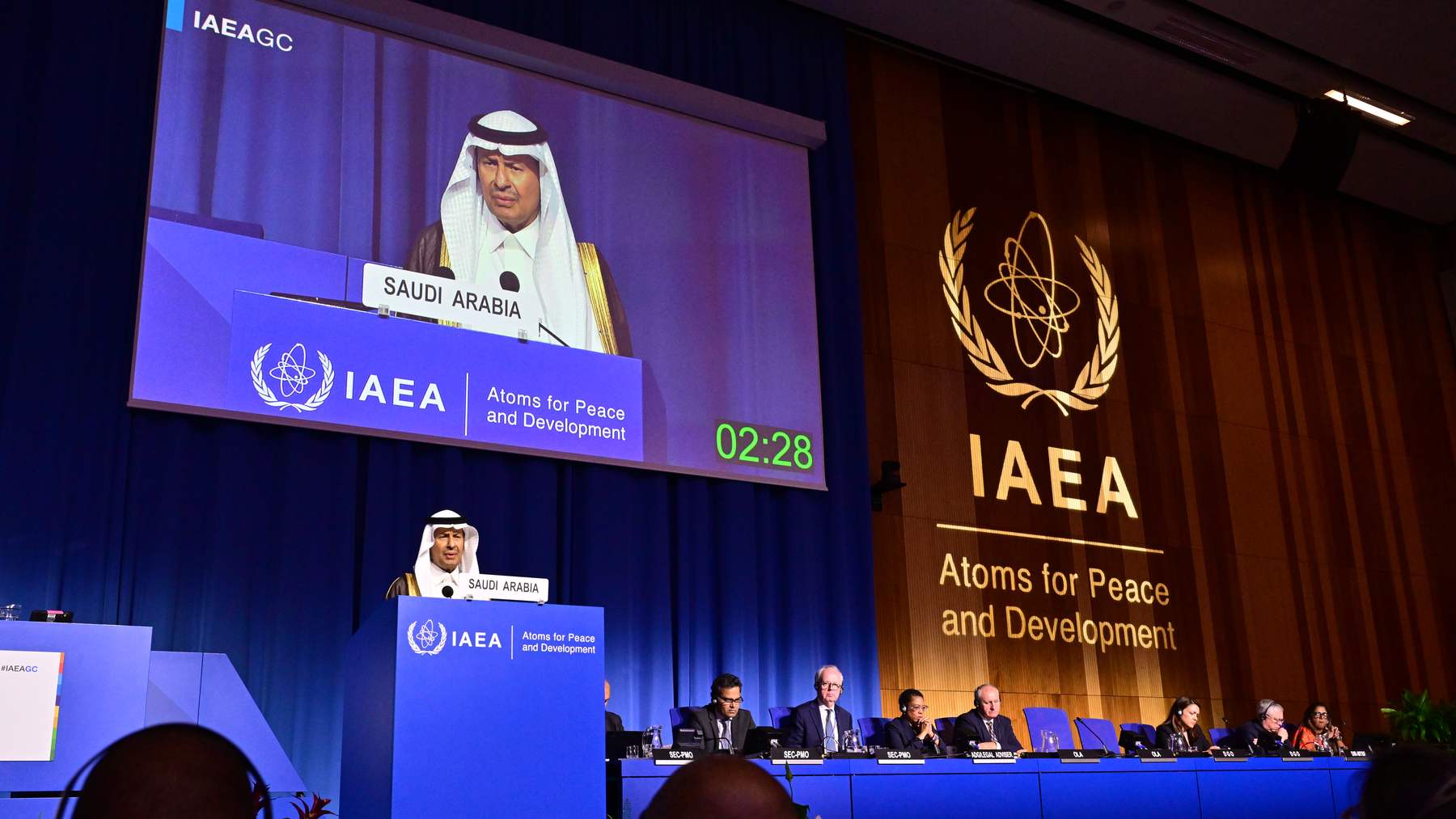
Saudi Arabia has told the International Atomic Energy Agency (IAEA) that exploration at Jabal Sayid, in the Madinah Region, has found about 114 million metric tons (126 million short tons) of ore holding rare earth elements and uranium. The figure is in the kingdom’s written statement to the IAEA’s 70th General Conference in Vienna, and it measures ore, not uranium.
Ore is not the same as uranium
The kingdom’s written statement speaks of “approximately 114 million tonnes of ore containing high concentrations of rare earth elements, particularly heavy rare earth elements, alongside promising concentrations of uranium.” It gives no uranium grade and no tonnage for the uranium itself.
In November 2025, Gracelin Baskaran, director of the Critical Minerals Security Program at the Center for Strategic and International Studies (CSIS), wrote that “Saudi Arabia’s rare earth deposits occur in tandem with its uranium resources. Jabal Sayid alone has approximately 31,000 tons of uranium.” CSIS gives no source for the 31,000 tons. The analysis is ten months older than the 114-million-ton figure, so those tons are not the uranium in this ore.
“Those uranium reserves uniquely position the kingdom to develop the nuclear fuel cycle, supporting its domestic energy strategy while opening the door to potential exports to the United States,” Baskaran wrote in that CSIS analysis.
“Although Riyadh appears optimistic about mining the ore,” writes Kelsey Davenport, director for nonproliferation policy at the Arms Control Association, the joint IAEA and Nuclear Energy Agency report Uranium 2022 “reported that uranium ore deposits in Saudi Arabia would be ‘severely uneconomic’ to mine and that other deposits are only ‘inferred.'”
A rare earth deposit first
The statement itself puts rare earths at the center. “This places the project among the most significant rare earth resource sites currently under development globally,” it says.
Jabal Sayid sits about 217 miles (350 kilometers) northeast of Jeddah, and CSIS, citing estimates it received from the Ministry of Industry and Mineral Resources, says it “boasts an estimated 552,000 tons of heavy rare earths, including dysprosium and terbium, and an additional 355,000 tons of light rare earths such as neodymium and praseodymium.” Those are magnet metals, and the hunt for them keeps turning up new rare earth deposits in odd places.
Ma’aden, the Saudi Arabian Mining Company, is building the processing side with the American company MP Materials. According to the statement, that partnership is meant “to develop capabilities for the processing and separation of rare earth elements and the production of associated uranium.”
Phosphate plants could yield uranium too
Jabal Sayid is one of three tracks. The first, according to the statement, “involves recovering uranium associated with phosphoric acid produced in phosphate fertilizer operations in the north of the Kingdom, taking into account Saudi Arabia’s position as the world’s second-largest exporter of phosphate fertilizers.”
“Pilot work carried out in cooperation with the French company Orano has yielded promising economic indicators for uranium recovery from these operations,” it continues. A third effort, the Sedimentary Cover Survey Initiative, is looking for conventional uranium ore.
The kingdom’s ambition “does not stop at producing raw materials or exporting concentrates,” the statement says. It reaches to “the recovery and purification of associated uranium; the production of yellowcake and its value chain, subject to economic feasibility.” Yellowcake is the uranium concentrate that later gets converted and enriched into reactor fuel.
An oil giant that burns oil for power
Why would the world’s best known oil exporter want reactors? The U.S. Energy Information Administration says Saudi Arabia generated an estimated 453 terawatt-hours of electricity in 2023, 62 percent from natural gas and 38 percent from oil, and that summer peaks “have led to greater oil-fired power generation.”
The U.S. deal came first
On July 22, 2026, about eight weeks before the speech, the U.S. Department of Energy announced a peaceful nuclear cooperation agreement with Riyadh, a so-called 123 agreement, plus a bilateral safeguards agreement. “Together, these two agreements lay the legal foundation for a decades-long, multi-billion-dollar partnership,” the department said.
CSIS notes that the two countries’ joint declaration affirms that “the United States and U.S. firms will be Saudi Arabia’s preferred partners for its civilian nuclear program.” Reactor builders such as Westinghouse are already eyeing projects in several countries.
In Vienna, the kingdom also addressed proliferation fears. It “does not seek to develop its peaceful nuclear programme in isolation from the international community, nor through activities conducted in secrecy or facilities concealed deep within mountains,” the statement says.
The waste problem
“Regardless of how uranium is extracted from rock, the processes leave behind radioactive waste,” says the U.S. Environmental Protection Agency, and mill tailings “remain radioactive and contain hazardous chemicals from the recovery process.” In Germany, researchers are still testing ways to clean up abandoned uranium mines.
What we still don’t know
Nobody has published a grade, a recovery rate or a cost for Jabal Sayid uranium so far, and the 31,000-ton figure comes from a think tank that names no source for it.
Davenport also flags a blind spot in the bilateral safeguards text. “The document suggests that fuel cycle activities, such as uranium mining and milling, would not be covered if conducted solely by Saudi Arabia,” she writes. The IAEA also “may not get information about any previous work conducted by Saudi Arabia on mining and milling,” which “could create gaps in the agency’s understanding of Saudi stockpiles of uranium ore.”
Saudi Arabia’s full statement to the 70th IAEA General Conference is published on the IAEA website.
Photo: Dean Calma / IAEA, CC BY 4.0