
Psychology says suppressing thoughts may work better than its most famous experiment suggests. Aneta Niczyporuk of the University of Bialystok in Poland retested the classic white bear task. Her study, published online on September 22, 2026, found no sign that pushed-away thoughts came back stronger.
The paper in Consciousness and Cognition reports that suppression worked while people were doing it. A Bayesian analysis weighs how well data support rival explanations. Here it gave strong evidence that the later rebound never happened.
Five minutes with a bell
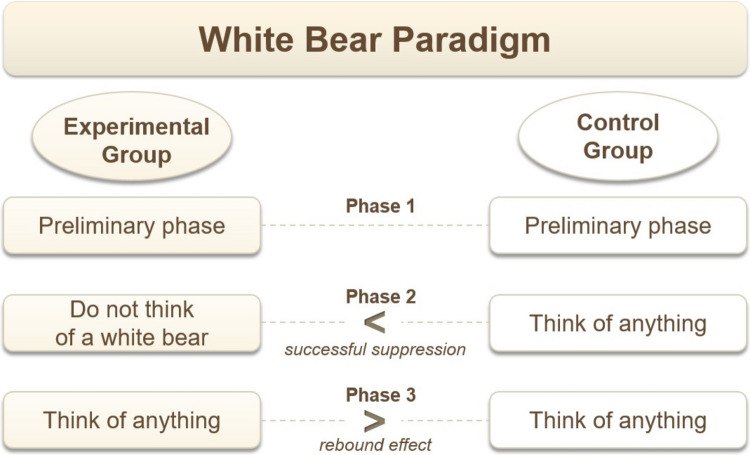
The idea goes back to a 1987 paper by psychologist Daniel Wegner and three colleagues. Volunteers spoke their stream of consciousness aloud for five minutes. All the while, they tried not to think of a white bear.
Each time the animal slipped into mind, they rang a bell. Both the bell rings and the spoken mentions told the same story. According to the paper, people “were unable to suppress the thought as instructed.”
Then came the twist that made the study famous. When the same volunteers were asked to think about the bear for five minutes, they produced more bear thoughts than people told to think about it from the start. A second experiment gave some volunteers a specific distracter thought, and they were less likely to dwell on the bear later.
Psychologists gave that later jump a name, the rebound effect. Wegner’s team wrote that suppression might even produce “the very obsession or preoccupation that it is directed against.” Many people know that struggle from replaying a conversation in their head.
Wegner explains the bear
The bear itself came from a novelist. Niczyporuk’s review traces it to Fyodor Dostoevsky, who described trying not to think of a polar bear. About 100 years later, that example inspired the first lab test.
In 1994 Wegner offered an explanation he called ironic process theory. Any attempt at mental control, he proposed, starts two processes. One hunts for distractions, and the other keeps checking whether the forbidden thought is back.
As long as the distraction search keeps running, attention stays away from the forbidden thought, according to Niczyporuk’s review. When that search stops, either because the effort ends or because mental resources run short, the theory expects a rebound. The checker keeps the unwanted idea easy to reach.
Bialystok finds no rebound
Niczyporuk set out to test both the task and the theory behind it. She added a preliminary phase before the suppression phase. Earlier studies, she writes, “often” left that step out.
Her abstract is blunt about the outcome: “No paradoxical effects were found.” Ironic process theory predicts that suppressed thoughts become more accessible, and that did not happen either.
She also measured how easily the target content came to mind. Those scores had no link with how often people reported the thought. The theory treats the two as parts of one mechanism.
Motivation may explain the old results
Instead of an ironic mental monitor, the paper points to motivation. The abstract says the outcomes of the white bear task “were better accounted for by motivational factors.”
Niczyporuk laid out the worry in a December 2025 review in Psychonomic Bulletin & Review. The task relies on people reporting their own thoughts. That count may shift with their wish to do well, or with simple resistance to being told what to do.
Volunteers may also read the instruction differently, Niczyporuk notes. Does a white bear thought mean a detailed image of the animal’s teeth? Or does a quick memory of the instruction count too?
Thirty-one studies and a bias
Earlier meta-analyses had sided with Wegner. A 2020 meta-analysis by Deming Adam Wang and colleagues pooled 31 studies. It found rebound effects regardless of cognitive load.
That same analysis also detected a small-study bias. In this pattern, smaller experiments tend to report bigger effects. Niczyporuk’s review notes that once the bias was corrected, the rebound was no longer statistically significant.
Her review also counts how often the effect ran backward. In the meta-analyses she examined, the rebound reversed in 18 percent to 46 percent of the cases.
A different lab method, the think/no-think paradigm, points the same way. Volunteers learn word pairs, then see a cue and either recall the partner word or block it. Blocked words are later remembered worse than words never cued.
Niczyporuk calls this suppression-induced forgetting. Unlike the bear rebound, she writes, it replicates reliably.
Distressing memories remain an open question
For now the full paper sits behind a paywall, and its abstract gives neither the sample size nor the exact target thoughts.
Niczyporuk’s review limits its verdict on effectiveness to healthy people. It adds that clinical groups appear to have a more limited capacity to use suppression effectively, so long-running anxiety and intrusive memories remain a separate question.
Even in her own review, Niczyporuk stays careful about the takeaway. Suppression “may be adaptive, depending on factors such as individual differences and context,” she writes. That leaves room for both help and harm.
The full study was published in Consciousness and Cognition.
Photo: U.S. Fish and Wildlife Service Alaska