A forum user named Liam Price asked GPT-5.4 Pro about an Erdős problem first posed in 1966. On April 13, 2026, he posted the proof it returned. Within weeks, a team of eight authors had checked it and used its central idea to settle other open questions.
The question appears as problem 1196 on the Erdős Problems website, a database of puzzles left by Paul Erdős. The site now credits GPT-5.4 Pro with the solution, noting that Price wrote the prompt. The full account appeared on May 1 as a 35-page preprint, a paper shared before formal peer review.
Eighty minutes on April 13
Price shared the argument on the site’s forum with a link to the chat that produced it. In a follow-up post that evening, he called it “a one-shot (supposed) solution in about 80 mins.” At that point no specialist had read the argument line by line.
The paper later lists Price without any university affiliation. The authors say the initial proof came from an autonomous run of the AI model. The paper links the full chat in a footnote.
Those 80 minutes measure only the machine’s reasoning time. They leave out nine decades of earlier work, starting with a 1935 paper by Erdős. They also skip the weeks of human checking that followed.
Numbers that never divide each other
Problem 1196 concerns primitive sets, collections of whole numbers in which no member divides another evenly. The numbers 4, 5 and 6 form one. Add 12 and the set breaks, since 4 and 6 both divide it.
To score such a set, mathematicians give each number n a weight of 1/(n log n) and add the weights. Large numbers count for very little, so even infinite sets get a finite total. Erdős showed in 1935 that this Erdős sum always stays bounded.
The set of all prime numbers is primitive and scores about 1.64. Erdős guessed in 1988 that no primitive set could beat it, a claim catalogued as problem 164.
Jared Duker Lichtman, now a Szegő Assistant Professor at Stanford, began on that question at Dartmouth. In February 2022, while a doctoral student at Oxford, he released a proof of it, according to Balliol College.
Closing the gap from 1.399
Problem 1196 asks a harder version of that question. Suppose every number in the set must exceed a cutoff that keeps growing. Does the best possible score then shrink toward exactly 1?
Erdős, András Sárközy and Endre Szemerédi conjectured that it does. Before April, the best upper limit, also due to Lichtman, sat at about 1.399. The AI-generated argument brought it down to 1 plus an error that fades as the cutoff rises.
On April 14, Lichtman replied on the forum. “This is a remarkable artifact,” he wrote, adding that “barring the initial prose quality, this AI proof is from The Book. Perhaps the first?”
Erdős liked to say that the most elegant proof of each theorem sat in an imaginary book kept by God. Lichtman was placing this one on its pages.
Chains that step downward
At the heart of the proof is a Markov chain, a random process that hops between states with set probabilities. Here the states are whole numbers, and each hop divides the current number by one of its factors.
Every number on such a chain divides the one before it, so a primitive set can touch the chain at most once. The probabilities come from the von Mangoldt function, a classical tool tied to prime powers. Its key identity says the weights of the prime-power divisors of n add up to log n, and Lichtman wrote that this identity dissolved the analytic trouble behind earlier attempts.
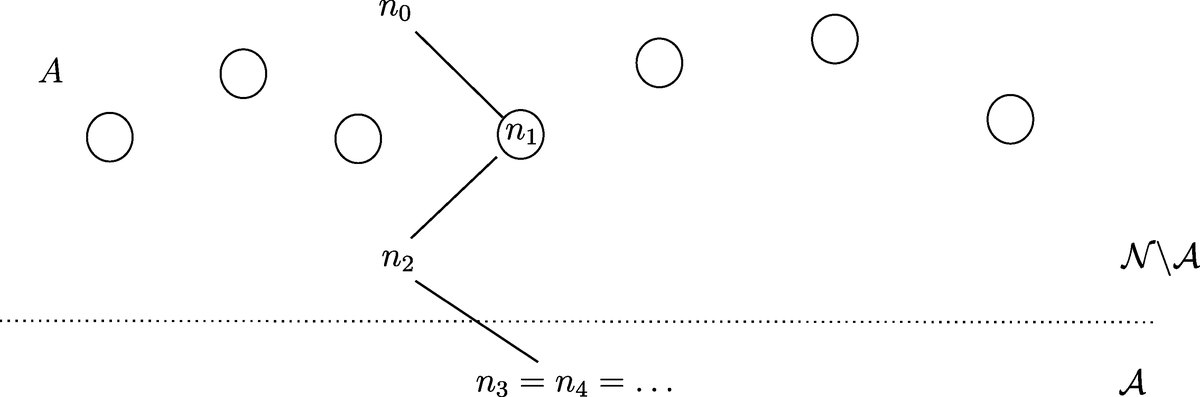
On his blog on May 3, UCLA mathematician Terence Tao wrote that the technique “in retrospect is very natural for controlling primitive sets.” Tao also noted that older papers on primitive sets had leaned on a related chain, which the team now calls the downwards Mertens chain, without spelling the idea out.
Eight authors, three more results
The preprint lists Boris Alexeev, Kevin Barreto, Yanyang Li, Lichtman, Price, Jibran Iqbal Shah, Quanyu Tang and Tao as authors. Alexeev gives OpenAI, the company behind GPT-5.4 Pro, as his address.
Using the same chains, the team proved a second 1966 conjecture, problem 1217, about divisibility chains. They also settled a revised Banks-Martin conjecture. And they wrote a shorter proof of problem 164, which Lichtman had cracked alone in 2022.
Their disclosure section spells out who did what. A similar autonomous run handled problem 1217, while other results mixed AI suggestions with ordinary pen-and-paper work. In the end, the authors write, “the final proofs in this paper have been generated and reviewed by the human authors.”
Part of the work also went through Lean, software that checks every logical step of a proof. A company called Math Inc. formalized a version of the 1196 proof there, according to the paper.
Still an unrefereed preprint
The arXiv version is labeled preliminary, and Tao calls the paper a work in progress. The arXiv record still shows only the May 1 version, with no journal reference, although a Lean version of the 1196 proof exists.
The case also says little about how often such a model gets things right. Price himself pointed out that problem 851 took over 20 continuations, totaling perhaps 15 to 20 hours of reasoning time. The paper does not report how many attempts on other problems failed.
Similar splits of work have shown up when AI is used in physics research and in sky surveys run by students. Here the model wrote the first draft of an argument. Lichtman, Tao and the others did the checking, cleaned up the prose and found where else it worked.
The full study, Primitive sets and von Mangoldt chains: Erdős Problem #1196 and beyond, was published as a preprint on arXiv.
Photo: Stanford University Department of Mathematics