The Humongous Fungus is a single honey fungus living under the Malheur National Forest in eastern Oregon. It covers an estimated 2,385 acres, or about 3.7 square miles, mostly hidden in soil and tree roots. There it kills conifers, then lives off their dead wood for years.
A 2008 Forest Service guide written by forest pathologist Craig Schmitt and silviculturist Michael Tatum calls it the “largest known fungus genet in the world.” Genet is the pathologists’ word for one genetically unique individual. The acreage comes from tree sampling in 1998 and 1999, and its age is still a rough guess.
Genet D near Prairie City
The guide places it in the Reynolds Creek and Clear Creek areas, in the mountains east of Prairie City. Researchers labeled it Genet D. Four other individuals of the same species, Armillaria ostoyae, share the area, and one of them covers 642 acres.
The guide explains that Malheur staff first spotted the large patches of dying trees there. Site checks confirmed Armillaria, and the forest then invited scientists to study it. Newer Forest Service research updates name the root-disease pathogen Armillaria solidipes, so you may see that name too.
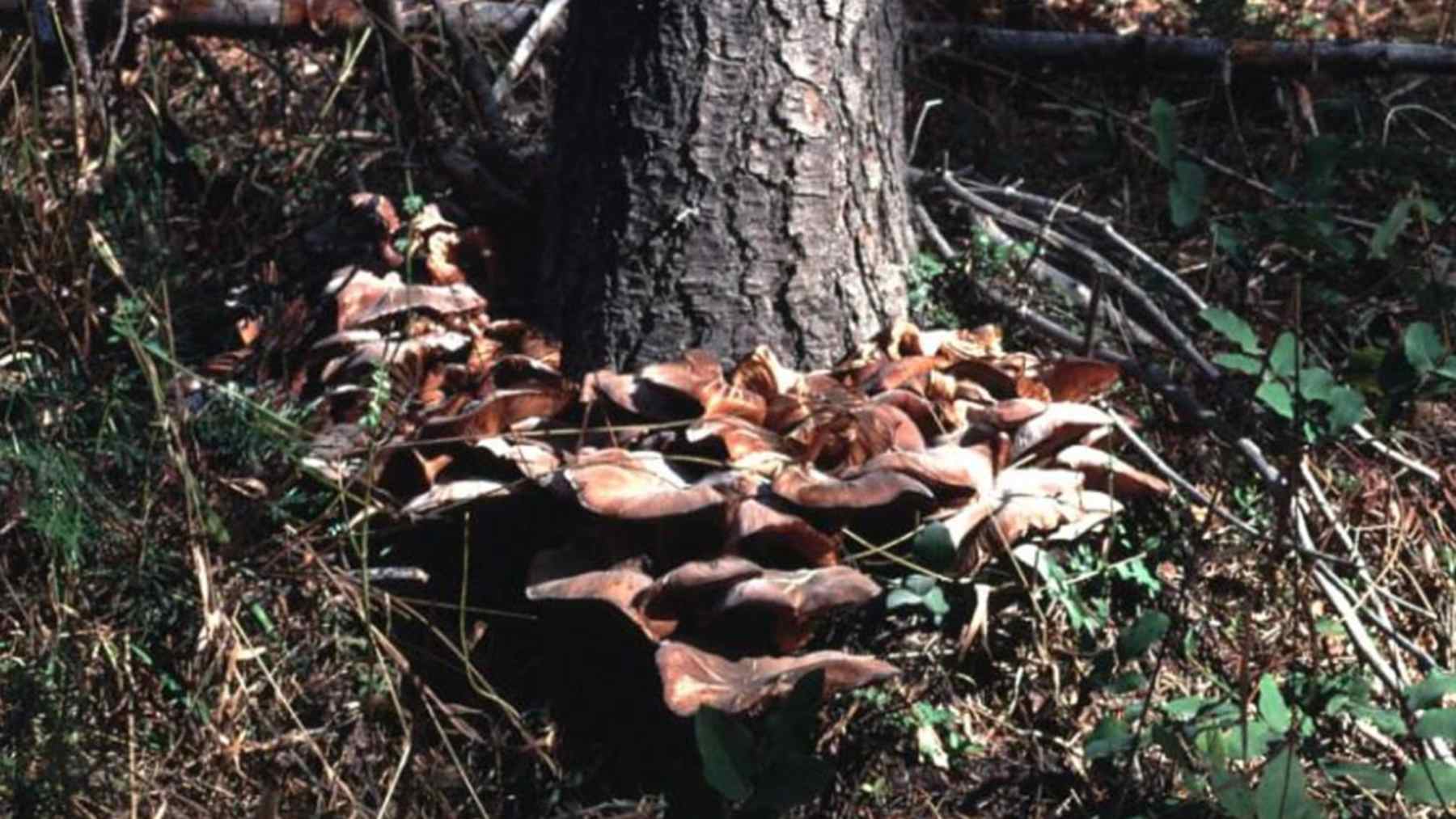
Most of its body is mycelium, a mass of branching fungal threads underground, so visitors usually see only the honey mushrooms. According to the guide, they come up briefly after the first fall rains at the base of infected or recently killed trees. “They do not persist for long,” it adds.
Petri dishes sorted five individuals
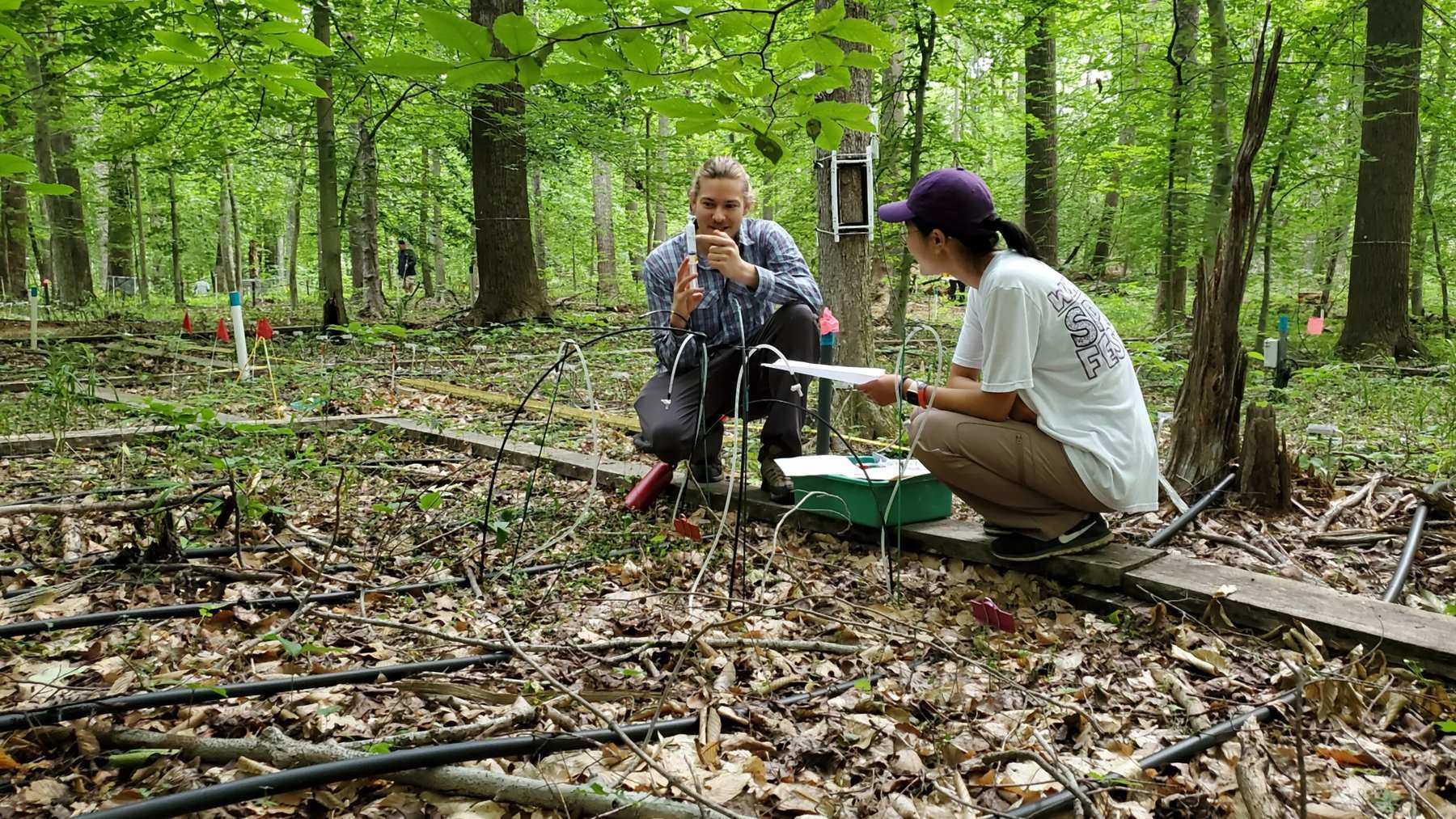
The 2003 study by Ferguson and four colleagues covered about 39,800 acres of dry mixed-conifer forest in the Blue Mountains. In 1998 and 1999 the team took wood samples from dead trees and from live trees showing symptoms. They obtained 112 Armillaria cultures from six conifer species, and 108 belonged to A. ostoyae.
Then came the dish test. Researchers paired cultures side by side on plates and read the reaction between them: a clear gap between two cultures of the same species meant two different individuals. That test, backed by DNA analysis, identified five separate A. ostoyae genets.
Of all the samples, 61 came from Genet D, and its two most distant collection points sat about 12,500 feet (3,810 meters) apart. Within its mapped boundary it covers about 965 hectares, the figure behind the 2,385 acres.
The authors note that perennial streams may have blocked the fungus along parts of its eastern edge. Hillsides across those streams showed no disease.
Ages from 1,900 to 8,650 years
Because nobody can date a fungus like this directly, the team halved the distance between its farthest samples to get a radius, then divided it by three published spread rates for the species. Those rates run from about 0.7 to 3.3 feet (0.22 to 1.0 meters) a year.
The result gave Genet D an age of 1,900, 2,200 or 8,650 years, depending on the rate. The paper calls the method conservative. If the fungus grew unevenly from its starting point, the true age would be greater.
Even the lowest figure means the fungus has outlived many generations of the trees it feeds on. The study describes the Blue Mountains genets as “possibly millennia-old.”
Shoestrings, felts and dying firs
The fungus spreads through root contacts and through rhizomorphs, black cords that look like shoestrings and grow through the soil. The Forest Service guide says rhizomorphs “find and infest new material, including live hosts.” You can tell them apart from fine roots by their white interior.
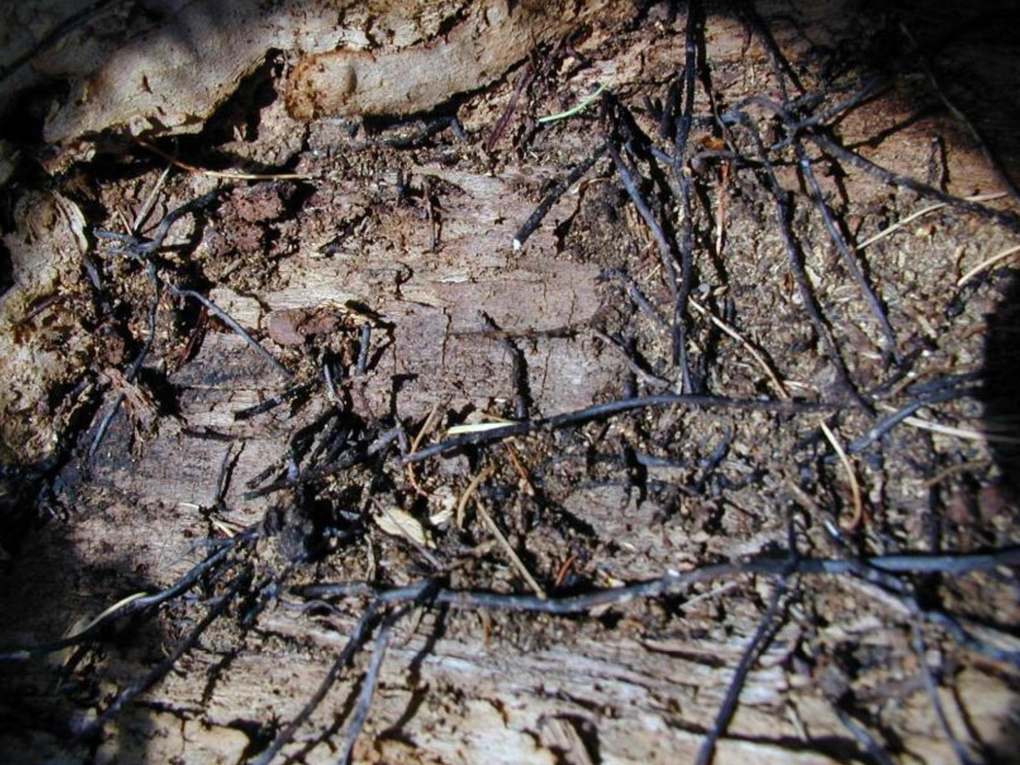
Under the bark of infected trees, the fungus forms white to cream mycelial felts with the texture of latex paint. These felts help kill the host, and resin often oozes out through the bark at the base of the trunk. Bark beetles usually move in on the weakened trees.
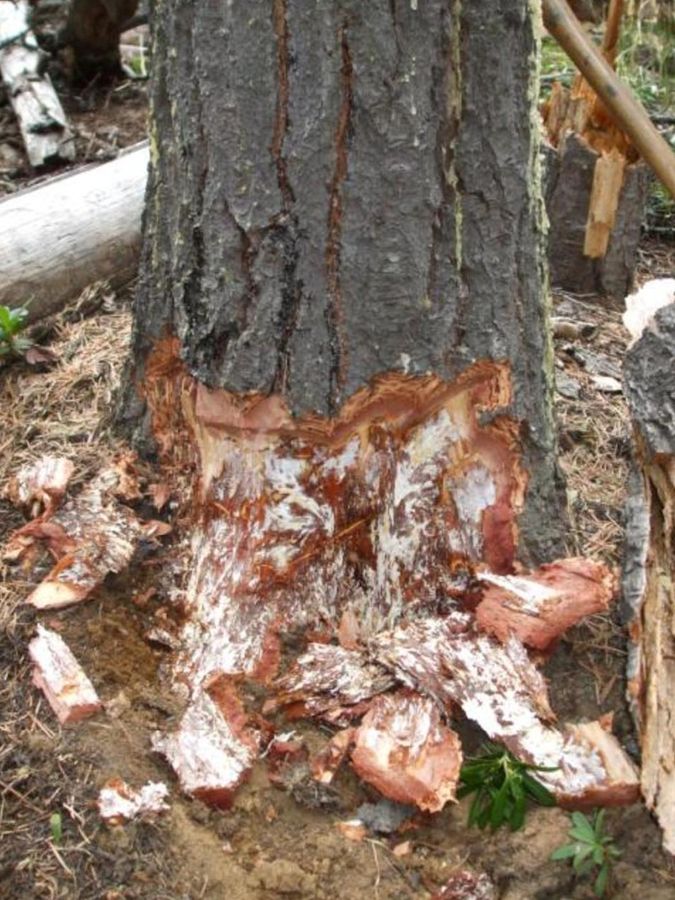
According to the guide, grand fir is highly susceptible and the most likely to die, while western larch usually survives inside disease centers. The 2003 paper adds that, where the fungus is abundant, it can kill mature and vigorous trees of susceptible species without prior stress. Resistant trees are colonized later, once harvest, bark beetles or fire have killed them.
Along a forest trail, each infection center follows a pattern. Old dead trees stand or lie in the middle, with freshly killed, sick and then healthy trees toward the edges. Young trees fill the openings as the fungus decays the dead wood, part of the breakdown of organic matter in soil.
Idaho microbes against root disease
A Rocky Mountain Research Station update by Ned Klopfenstein, dated November 19, 2025, explains why controlling Armillaria remains hard. The pathogen survives in roots, stumps and woody debris for centuries, so “managers have very few effective tools to control it,” the update says.
Researchers are now looking at soil microbes that help forests recover. At a western white pine planting in northern Idaho, a native relative called Armillaria altimontana and other microbes went along with healthier trees and less root disease.
A follow-up study in another Idaho forest compared burn severities. Low-severity or unburned ground kept those helpful communities, while severe fire could disrupt them. None of this work involved the Oregon fungus, and it does not offer a treatment for it.
Its weight rests on Michigan math
The 2008 guide puts Genet D at 7,567 to 35,000 tons of mycelium and rhizomorphs. That range borrows assumptions from smaller Armillaria individuals described in a 1992 Michigan study. Nobody has weighed the Oregon fungus itself.
The sampling also could not show that the fungus fills every acre inside its outline. The boundary links scattered samples from sick and dead trees. Some ground inside it may hold no fungus at all.
Area records depend on what is counted, too. In 2022 the University of Western Australia reported a single seagrass clone in Shark Bay whose meadows cover about 77 square miles (200 square kilometers). By visible size, a giant mushroom from Yunnan beats any honey mushroom in Oregon.
The full study was published in the Canadian Journal of Forest Research.
Photo: USDA Forest Service