Three micrometeorites swept from rooftops around Oslo, Norway, have helped scientists grow cell-like lipid bubbles in the lab. The grains came from Jon Larsen, a Norwegian jazz guitarist who has hunted space dust in city gutters for years. A team based in Gothenburg, Sweden, reported the experiment in Scientific Reports on July 11, 2026.
Micrometeorites are specks of rock from asteroids and comets that survive the plunge through the atmosphere. In the Swedish lab, fatty molecules called lipids crept over the grains overnight and folded into tiny pockets. It hints at an early step toward life, yet nothing living was made or arrived from space.
Three grains from Oslo roofs
Aldo Jesorka of Chalmers University of Technology wrote the paper with İrep Gözen, and Larsen sits on the author list. The paper describes the grains as collected from Oslo-area roofs in 2021, using the recovery method Larsen has published.
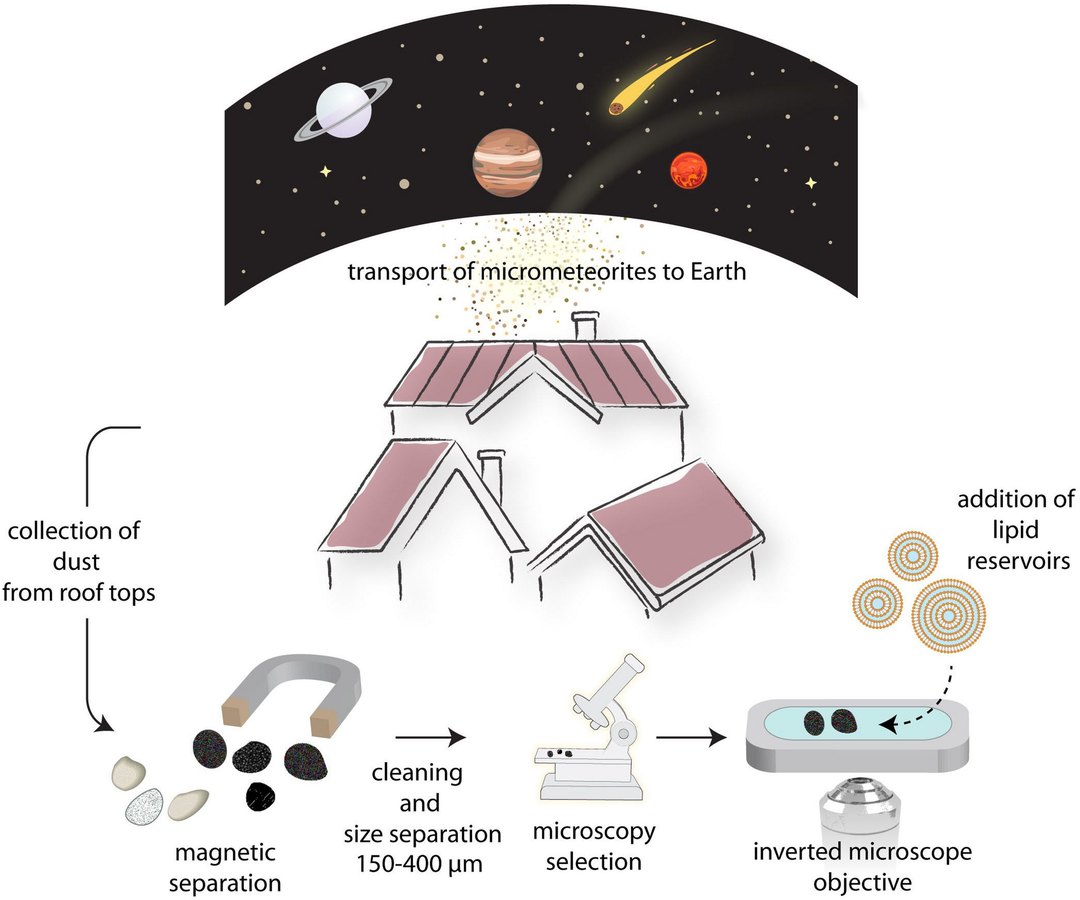
His method starts with rooftop debris and a magnet that pulls out every magnetic particle. Sieves remove the larger pieces, and the rest goes under a microscope. Most of what remains is ordinary or man-made dust, so the space grains are picked out by their shape and surface texture.
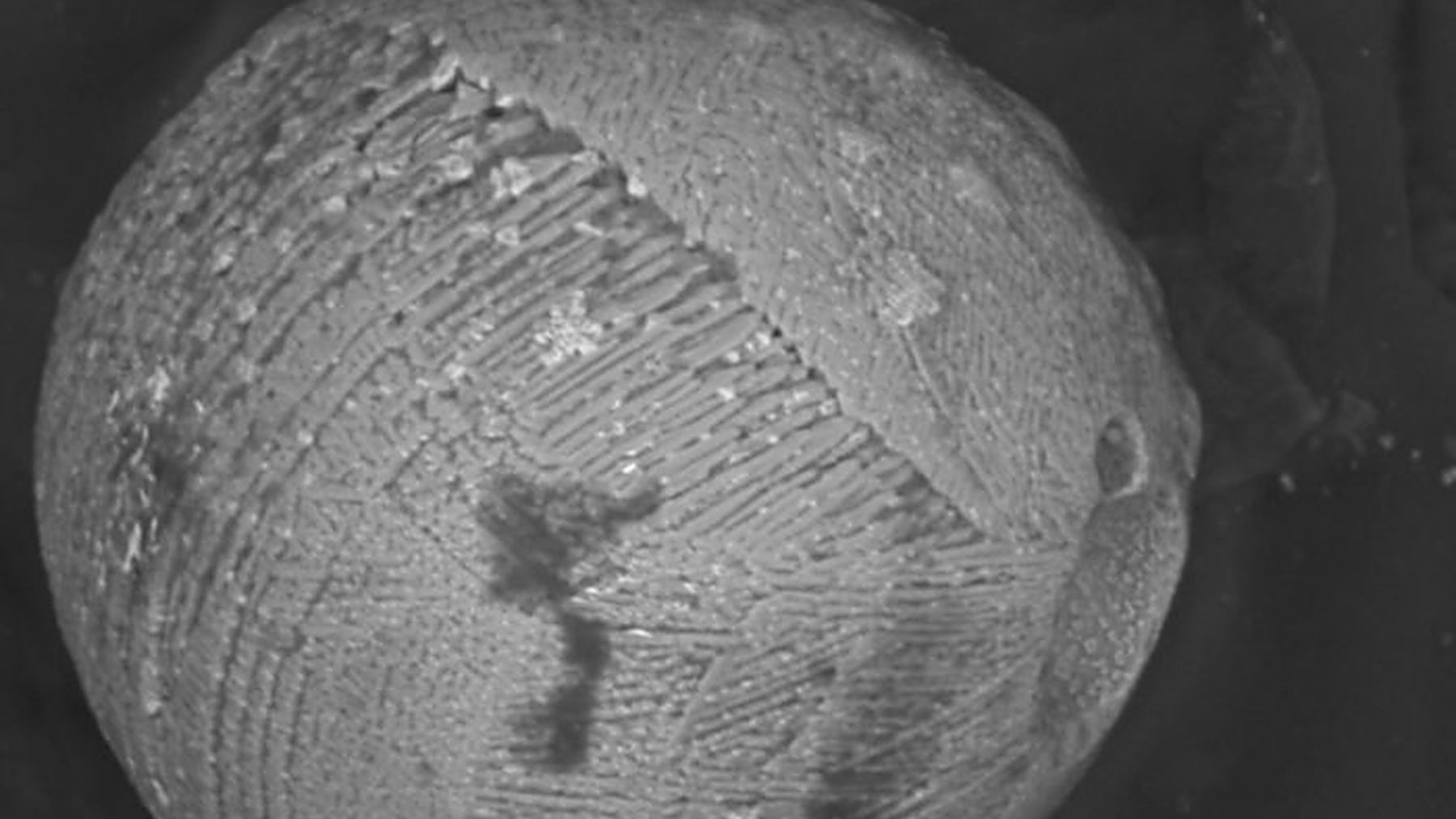
Each of the three grains belongs to a different family: porphyritic, scoriaceous and barred olivine. Those labels describe how the rock melted and crystallized during entry, at more than 6.8 miles (11 kilometers) per second. Magnesium, silicon and iron make up 89 to 90 percent of their elements, the team reports.
Before each test, the researchers cleaned the particles with solvents and oxygen plasma, an electrically charged gas. They set them in dishes of watery buffer, added lipids and left the samples overnight. Fluorescent dyes then let them watch the results under a microscope.
Archaeal lipids preferred space dust
For comparison, the team used magnetic sand from a beach on Vrångö Island, near Gothenburg. Those grains were picked to match the micrometeorites in size and shape. Half of them got the same plasma treatment, so the authors called them “model micrometeorites.”
Three lipid recipes went onto every surface. One mimicked archaea, single-celled microbes with unusually tough membranes, and another came from E. coli bacteria. The third blended soybean and bacterial lipids, a mix the group had already tested on rocks.
All the surfaces produced compartments, but not in equal numbers. Archaeal lipids formed them preferably on the real micrometeorites. Bacterial lipids did the opposite and crowded onto the sand, while the mixed recipe showed no strong preference.
On the grains, the lipids spread as a double film, ruptured and turned into networks of thin tubes. Some tubes swelled into bubbles. Others carried small lipid particles and reached out to objects floating nearby.
Clean surfaces falling from the sky
Why would dust from space matter here? The authors note that micrometeorites arrive as clean, never-weathered surfaces. Many also carry metals that can speed up chemical reactions, and on the early Earth they would have landed in warm ponds rich in organic molecules.
The sand tests pointed the same way. In the paper’s words, “pristine surfaces outperform weathered and contaminated surfaces as substrates for protocell development.” Protocells are simple, cell-like compartments that stand in for the first cells.
The paper cites an estimate of about 40,000 metric tons (44,000 short tons) of cosmic dust reaching Earth every year. Gözen is now a 2026-2027 fellow at Harvard Radcliffe Institute, studying protocells on space rocks. Work on cosmic dust made in the laboratory and on DNA and RNA letters in asteroid samples has raised similar questions.
A gutter hunt Genge once doubted
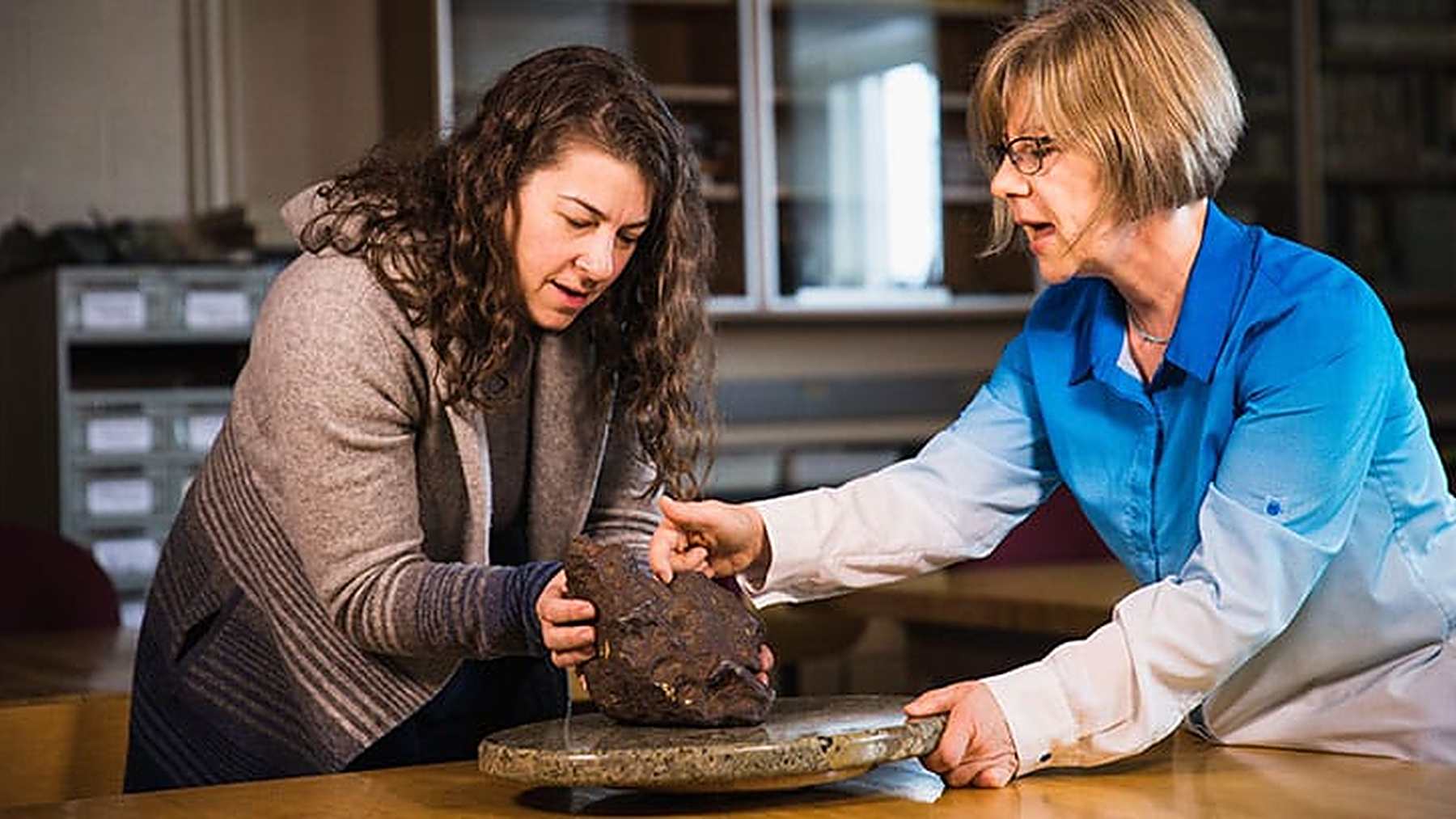
Larsen’s rooftop method took years to win over professionals. In 2011, he told Matthew Genge of Imperial College London that he believed city dust could hold micrometeorites.
“When Jon first came to me I was dubious,” Genge said in an Imperial College announcement from December 2016. Earlier urban finds, he explained, had all turned out to be industrial.
The pair then sifted 661 pounds (300 kilograms) of gutter sediment from roofs in Paris, Oslo and Berlin. They found 500 cosmic dust particles. Their study in the journal Geology suggested the grains had fallen within the previous six years.
Jonlarsenite, an alloy from Skedsmokorset
Larsen’s collection, known as Project Stardust, has passed 5,500 micrometeorites. One was picked up on August 15, 2022, from an industrial roof near Skedsmokorset, just north of Oslo. It held something new.
A 2025 study led by Luca Bindi of the University of Florence described jonlarsenite. It is a natural aluminum-copper alloy, named in Larsen’s honor and approved as a new mineral by the International Mineralogical Association.
The host grain is about 0.008 inch (200 micrometers) across, and the new crystals inside are roughly 2 micrometers wide. Oxygen isotopes confirmed its origin in space, one more of the microscopic surprises hidden in meteorites. Labs usually settle such cases through minerals, chemistry and texture together.
Only three grains, scrubbed with plasma
The authors are clear about what they did not make. “The lipid compartments observed here do not have the structural and functional features of protocells at the origin of life,” they write. The bubbles still share several traits with them.
The sample is small, with one grain of each type, and plasma cleaning only approximates conditions during entry. Grains on the early Earth may have met plasmas of other compositions. The team flags that as a topic for future studies.
Imaging was hard as well, because the grains are opaque and curved. The researchers call for tests on a larger selection of micrometeorites before firmer conclusions are drawn.
The full study was published in Scientific Reports.
Image: Imperial College London