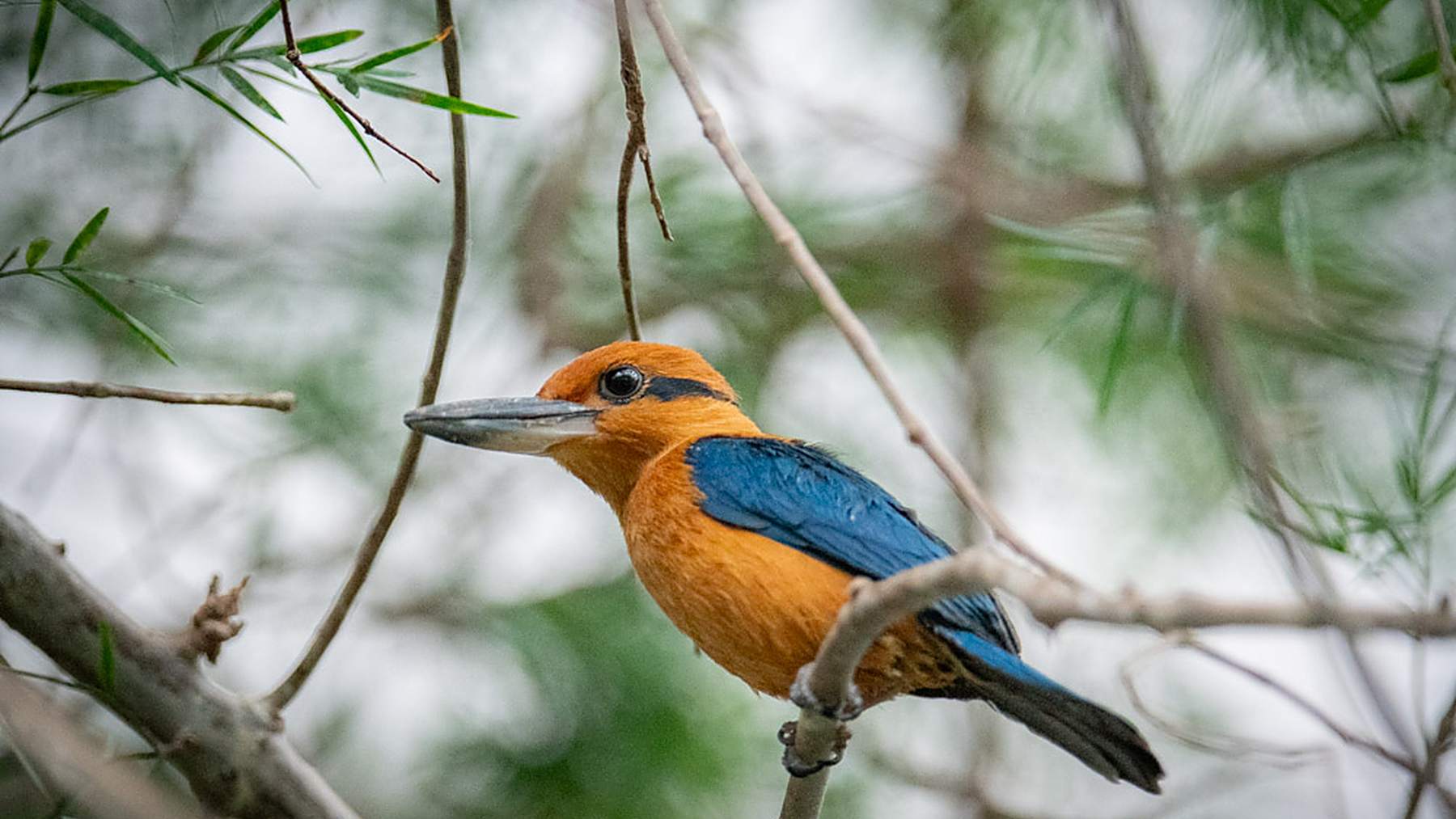
A 6-year-old Guam kingfisher named Guåhan should soon be flying free on Palmyra Atoll, in the middle of the Pacific. It is one of the rarest birds on Earth. The Oregon Zoo announced the plan on November 19.
The bird has spent the last few years in an aviary in Portland. Its species has been extinct in the wild for nearly 40 years.
Guåhan is one of five birds recently selected for the next release. In September it moved to Disney’s Animal Kingdom in Florida. There it is in quarantine in a bio-secure facility before the trip.
Behind the effort is a long list of partners from several countries. In 2024, the U.S. wildlife service named several of them. They included Guam’s Department of Agriculture, The Nature Conservancy and the Zoological Society of London.
Wiped out by a snake
The Guam kingfisher, also called sihek, is a small bird with cinnamon-colored feathers. Its downfall came from a non-native tree snake. The snakes all but wiped the species out on Guam.
The species was first listed under Guam’s own endangered species law in 1982, and on the U.S. Endangered Species List in 1984.
In the 1980s, Guam’s Department of Agriculture and the Association of Zoos and Aquariums rescued 29 sihek to start a captive-care program. The sihek has been extinct in the wild since 1988, mainly because of predation by the invasive brown tree snake, according to the U.S. Fish and Wildlife Service.
The snakes are still there, so returning the birds to Guam remains impossible for now. The fight against the snakes on Guam has even included dropping dead mice laced with paracetamol from the air.
A first home in the wild
Instead, the recovery program picked Palmyra, a U.S. National Wildlife Refuge with no invasive predators. The waters around it are protected out to 50 nautical miles as part of the Pacific Remote Islands Marine National Monument.
Nine young sihek, four females and five males, were hand-reared for months at Sedgwick County Zoo in Wichita, Kansas. On August 28, 2024, they flew to temporary aviaries on Cooper Island, a Nature Conservancy preserve on the atoll.
Six of them were living in the atoll’s forests by late September 2024, the wildlife service said at the time. The other three were to be released one by one once they were ready. All nine were released that year, according to the zoo.
So far, conservationists report that those birds are thriving, the zoo says. Some are even thought to have produced eggs this year. The upcoming release will be only the second time in 40 years that new sihek go to live in the wild.
In 2024, the partners set a target of 10 breeding pairs on Palmyra. The final goal is to bring the bird home to Guam once the snake threat is dealt with. Bringing animals back to safe ground has worked elsewhere, as when Australia saw 13 locally extinct mammals returned to fenced reserves free of feral cats and foxes.
Males living together
“We’re honored to have been trusted with Guåhan’s care these past few years and overjoyed to think he’ll be flying free on Palmyra soon,” said Nicole LaGreco, who oversees the Oregon Zoo’s bird population.
In Portland, the bird was also part of an experiment. Two other sihek, both male, still live in the zoo’s Vollum Aviary, and keeping males together was a new approach for the species.
“The conventional wisdom was that you couldn’t house males together because they’re so territorial and aggressive,” said Erica Royer, a sihek expert with the Smithsonian’s National Zoo and Conservation Biology Institute. “But the Oregon Zoo showed us that, actually, under the right circumstances, you can.”
Why every egg counts
That matters because the species is so scarce right now. Fewer than 130 sihek are left in the world, and the sexes are badly out of balance.
“Currently, the recovery program has 81 males and 44 females,” Royer said. Housing males together frees up space for breeding pairs at other zoos, Royer explained, which helps the whole recovery effort.
For Oregon, it is a new kind of farewell, since the zoo is known for sending California condors out to be released. The sihek, the release notes, is an even rarer bird. Other birds have made comebacks too, as when two young griffon vultures took flight over a Sicilian mountain range after about 70 years.
“Hopefully, he and the other sihek there can start a new chapter for this amazing species,” LaGreco said. No date for the release has been given.
Photo: Oregon Zoo / Michael Durham