For generations, the story of the ancient Iberians has often sounded like a tale of constant outside influence. Phoenician traders, Greek goods, Punic networks, and later Roman power all moved through the eastern Iberian Peninsula, leaving behind amphorae, ceramics, coins, jewelry, and ideas.
But what about the people themselves? A new ancient DNA study suggests that, for the most part, the Iberians of northeastern Spain kept a remarkably stable genetic identity for about six centuries, even while their world was being reshaped by intense Mediterranean contact. The research, led by a team at the Universitat Autònoma de Barcelona (UAB), analyzed the remains of 54 newborns from three archaeological sites and found no evidence of a massive migration behind the rise of Iberian culture.
A culture changed without replacing its people
The study focused on communities that lived roughly 2,700 to 2,100 years ago, from the Early Iron Age to the beginning of the Roman period. That span covers a crucial chapter in Iberian history, when settlements grew more complex and social organization became more hierarchical.
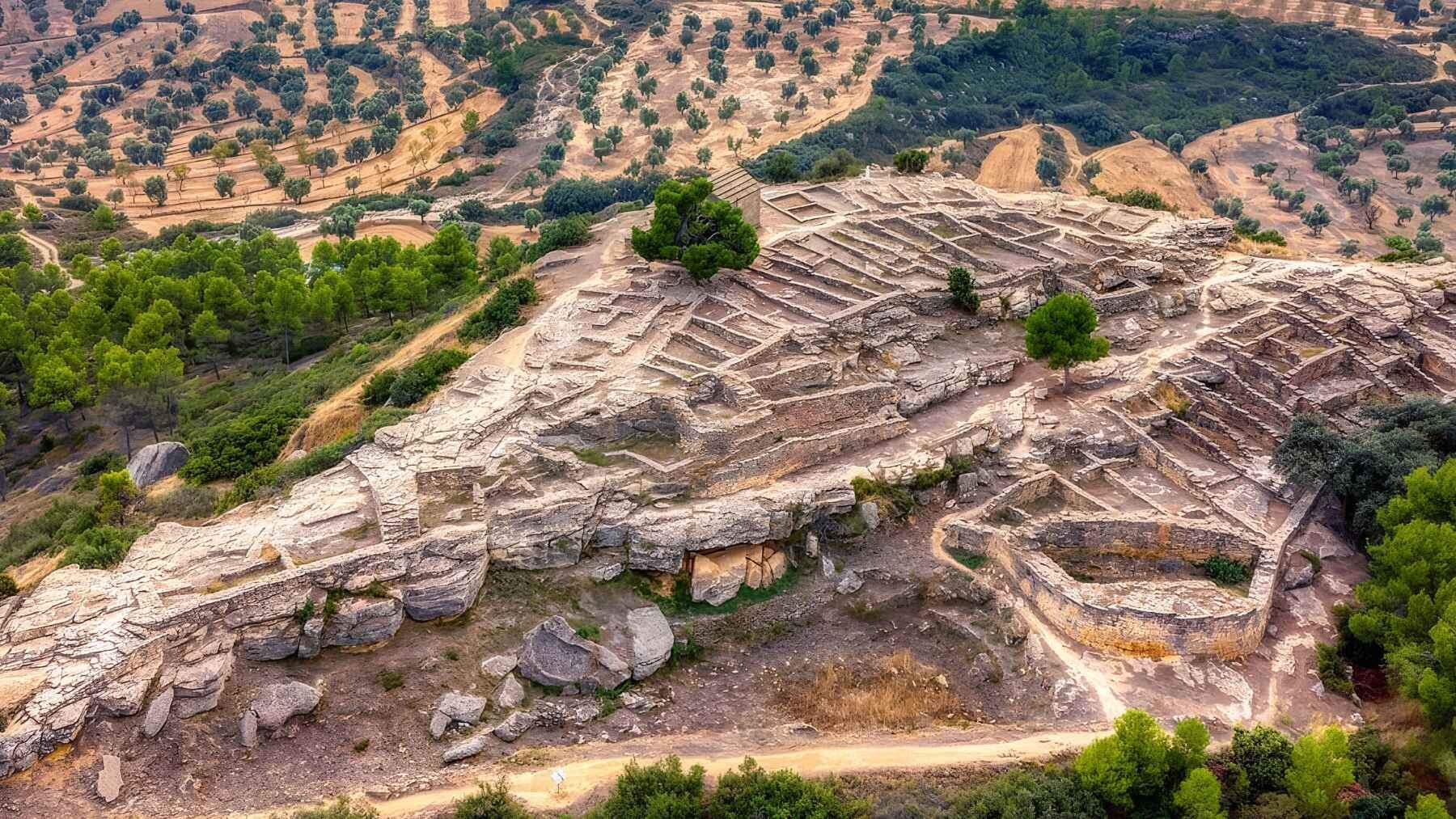
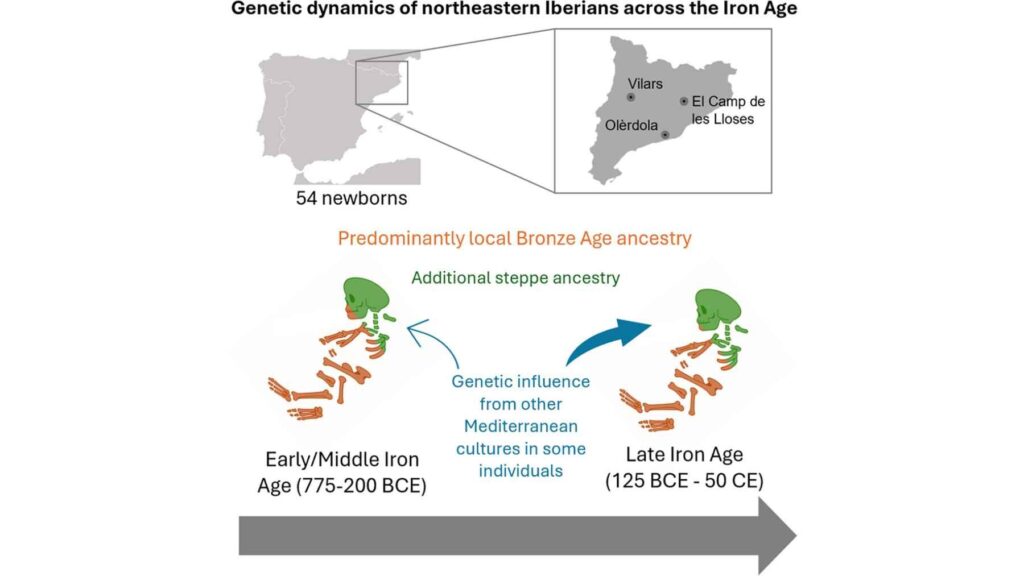
Researchers looked at newborns from Els Vilars in Arbeca, Sant Miquel d’Olèrdola in the Penedès, and El Camp de les Lloses in Tona. Together, these sites offered a rare genetic timeline across several Iberian groups in what is now Catalonia.
The results were striking. The genetic profile of most individuals was rooted in the same broad ancestry already present in prehistoric Iberia, including Western Hunter-Gatherer, Anatolian Neolithic, and Bronze Age Steppe or Yamnaya-related ancestry. In practical terms, the culture changed, but the population base largely stayed put.
Trade left marks, but not a population replacement
That does not mean the Iberians lived in isolation. Far from it. Archaeologists have long found material evidence of contact with Phoenician, Greek, Punic, and Italic worlds in these settlements.
The new study does detect outside connections, including some individuals with possible ancestry linked to the eastern Mediterranean or North Africa. But those signals appear occasional rather than overwhelming, more like drops of ink in a large bowl of water than a complete change in the mixture.
Cristina Santos, the UAB researcher who led the study, said the team expected stronger outside influence. Instead, she explained, “there is a great genetic continuity,” even though Mediterranean objects found in the archaeological record had suggested a more dramatic picture.
Why newborns held the key
One of the most unusual parts of this research is the source of the DNA. The Iberians commonly cremated adults, which makes ancient genetic work extremely difficult. Fire, time, and soil are not kind to DNA.
Newborns were different. In several Iberian settlements, infants were buried under homes, courtyards, and work areas, leaving behind fragile but vital biological evidence. It is a sobering detail, but also a powerful one.
Of the 54 newborns studied, researchers recovered enough genome-wide data from 22 of them to analyze more than 20,000 genetic variants. In nine more infants, they were able to recover mitochondrial DNA, which is inherited through the maternal line.
Family ties and old assumptions
The DNA also helped researchers test long-standing archaeological interpretations. At Els Vilars, they found no close kinship among the infants studied. At Sant Miquel d’Olèrdola, two babies buried together had once been considered possible twins because of the way their skeletons were arranged.
The genetics said otherwise. They were not twins, and they were not close relatives. That kind of result is a useful reminder that even careful archaeological interpretation can change when new tools enter the picture.
At El Camp de les Lloses, the team did find direct family links, including a pair of sisters and several second-degree relatives. Small details, yes, but they bring the human scale back into a story often told through pottery, walls, and trade routes.
Rome opened the genetic map
The biggest genetic shift appeared later, with Rome. El Camp de les Lloses, connected to logistical and productive activities during the Roman period, showed a more diverse population than earlier sites.
That makes sense. Roman expansion moved soldiers, traders, workers, administrators, and families across wide territories. Roads and power structures did not just carry goods. They carried people.
The study found that Roman-era influence brought more Mediterranean and North African ancestry into the region. Some of that may have arrived through Rome itself, while other traces could have come from Punic networks, southern Iberia, or the Balearic Islands.
A slower, more human story
The findings do not make Iberian history less interesting. Actually, they make it more believable. Instead of a simple story of outsiders arriving and replacing local communities, the evidence points to gradual cultural change built on a stable local population.
That matters because archaeology often shows what people used, traded, built, and buried. DNA adds another layer, showing who those people were biologically and how much their communities changed across generations.
At the end of the day, this study suggests that identity in the ancient Mediterranean was not always rewritten by mass migration. Sometimes, it changed through contact, exchange, marriage, imitation, trade, and politics. Slowly. Almost quietly.
Babies who rewrote Iberian history
There is something deeply moving about the fact that newborns, many of whom barely began life, are now helping scientists understand one of the main pre-Roman civilizations of the Iberian Peninsula. Their remains have preserved clues that adult burials usually could not.
The picture that emerges is not one of isolation, but of resilience. The Iberians traded across the sea, absorbed foreign goods and ideas, and later entered Rome’s expanding world. Still, for six centuries, their genetic roots remained surprisingly steady.
The study was published in the journal iScience.