Something unexpected happened nearly 1,800 miles beneath the Pacific Ocean. Around 2010, a broad flow of iron-rich liquid at the top of Earth’s outer core switched from drifting weakly west to moving strongly east.
Then things changed again.
A new reconstruction using observations from 1997 through 2025 suggests that the eastward motion later peaked and has been weakening since about 2020.
Nobody felt the shift at the surface. How could they? It happened incredibly deep underground. Still, it matters because this moving metal helps create the magnetic field that guides navigation and shields the planet from charged particles from the Sun.
The big question is why it happened. Scientists still don’t know. And that mystery could offer a rare clue about how Earth’s deepest layers interact.
A hidden ocean of metal
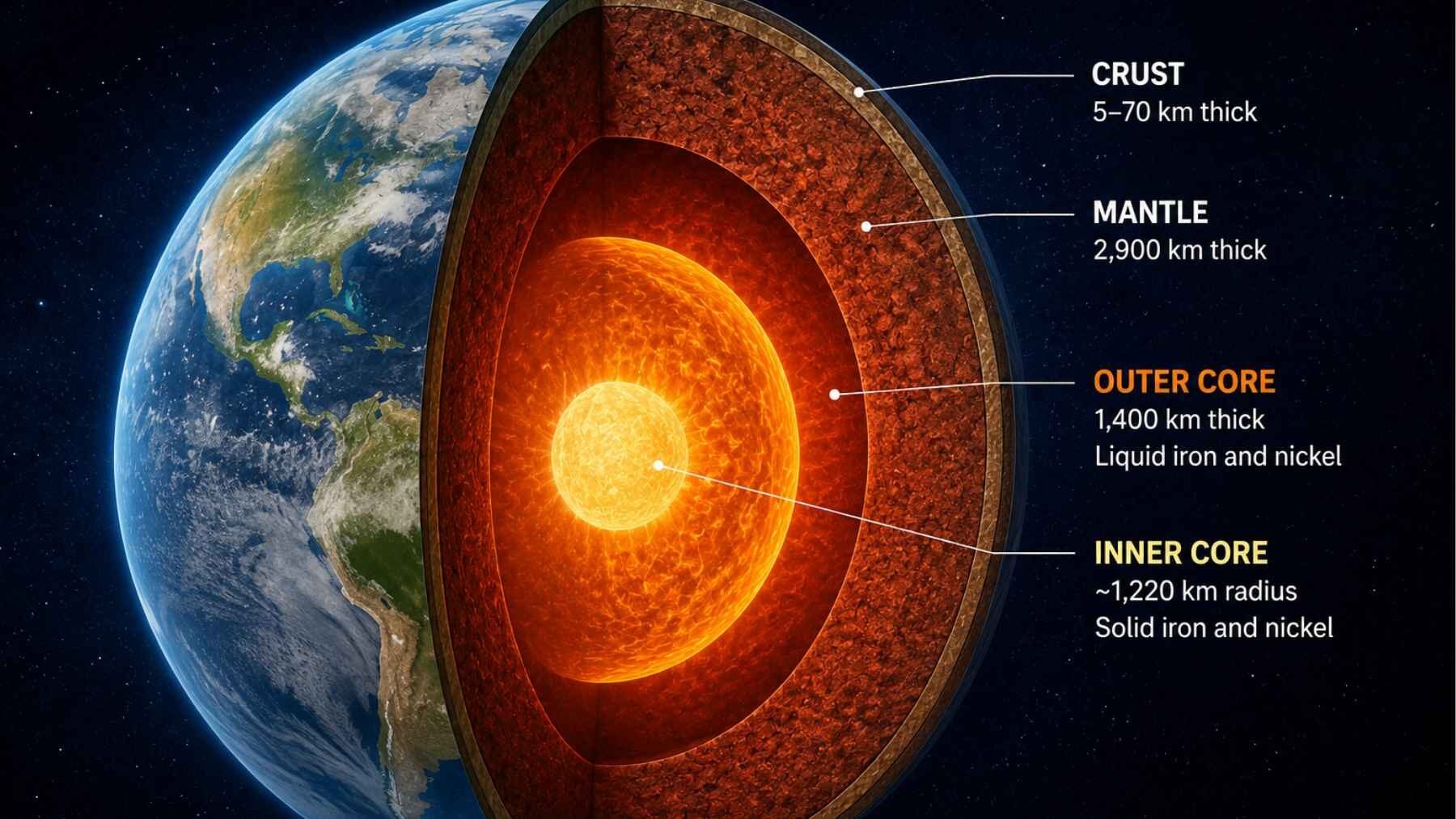
Earth’s outer core begins about 1,800 miles below the surface and extends roughly another 1,400 miles toward the center. It is mostly liquid iron and nickel, kept in motion by heat, buoyancy, and the planet’s rotation.
Picture a slow, planet-size ocean. Except this one is made of scorching metal instead of water.
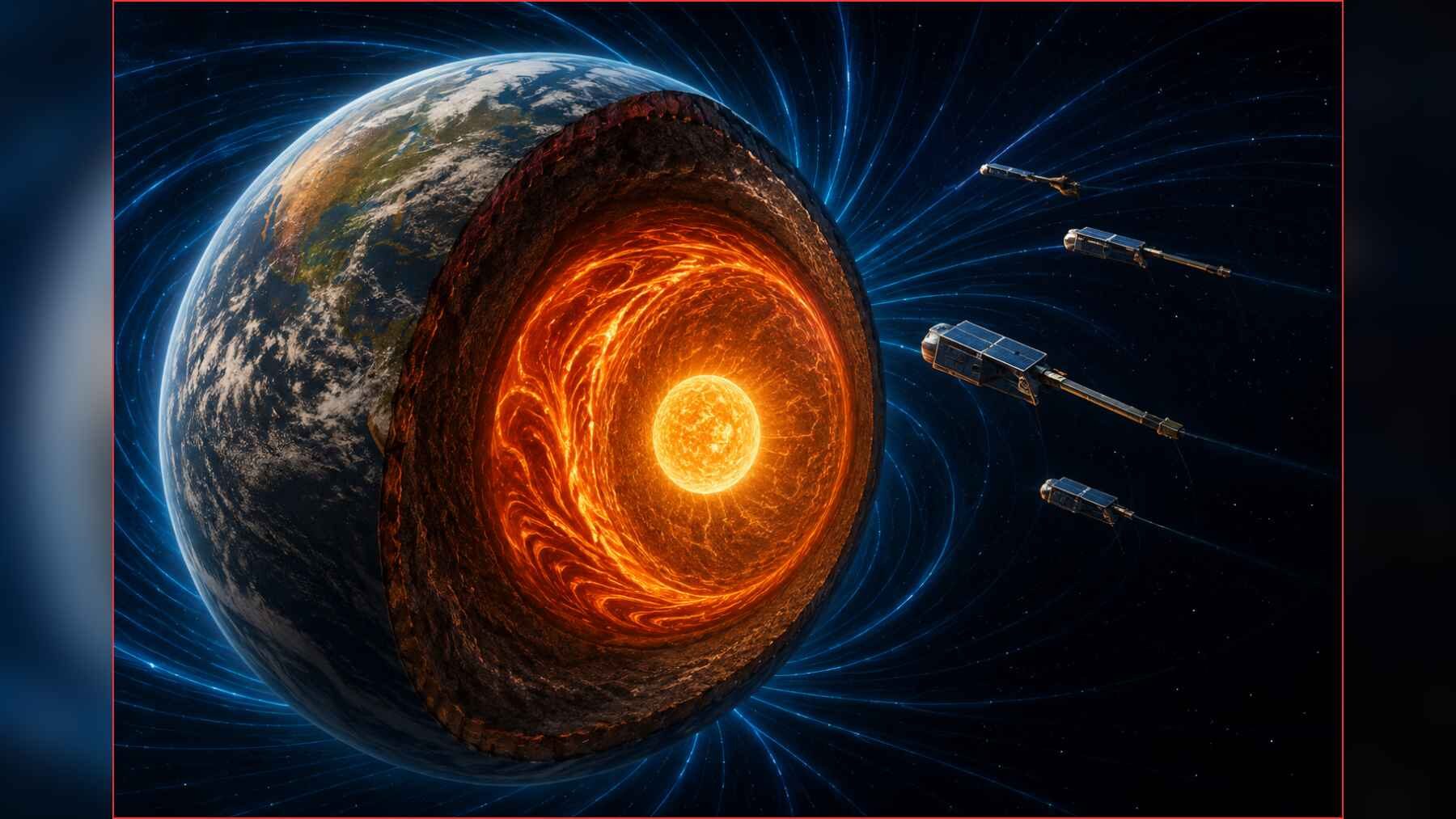
As that electrically conducting liquid moves, it generates currents and sustains the geodynamo, the natural engine behind Earth’s magnetic field. Scientists obviously cannot drill anywhere close to it. So they study tiny changes in magnetism measured at the surface and from orbit.
In simple terms, the magnetic field acts like a moving fingerprint of activity far below our feet.
How satellites looked inside
The European Space Agency’s Swarm mission uses three satellites equipped with sensitive magnetometers, instruments that measure magnetic-field strength and direction. The spacecraft fly in coordinated orbits, helping researchers separate signals from the core from magnetism produced by the crust, oceans, upper atmosphere, and near-Earth space.
Think of it like removing background noise from a recording until you can finally hear the bass line.
The new study combined ground observatories with data from Ørsted, CHAMP, CryoSat-2, and Swarm. CryoSat was actually built to monitor ice, but its onboard navigational magnetometer became useful after careful calibration.
That helped fill part of the gap between dedicated magnetic missions. Put all those records together, and researchers got a 27-year look at changing flow near the core-mantle boundary.
The Pacific flow flipped
Lead author Frederik Dahl Madsen worked with Isobel Howard, William J. Brown, and Kathryn A. Whaler, with affiliations spanning the University of Edinburgh and the British Geological Survey. They used principal component analysis, a method that sorts a complicated pattern into its strongest underlying parts.
Sounds complicated. The idea isn’t.
Imagine separating a song into drums, bass, and vocals so you can hear exactly which part changed.
The dominant pattern, a largely steady planetary swirl and a high-latitude jet, accounted for about 95% of the modeled variation. A second pattern, representing roughly 4%, exposed the Pacific reversal around 2010. The final sliver included standing and traveling waves.
Small numbers, yes. not necessarily small effects. Those weaker motions can still drive noticeable changes in the magnetic field over years or decades.
Clues from the inner core
So what caused the reversal?
The timing points toward a possible link with the solid inner core, but the researchers are careful not to call that connection proven. A 2024 Nature study found that the inner core began rotating more slowly relative to the mantle after 2008, close in time to the Pacific shift.
Interesting timing. But timing alone is not a smoking gun.
Another explanation comes from the boundary above the core, where heat escapes unevenly into the mantle. Earlier computer simulations found that differences in lower-mantle heat flow can organize circulation near the top of the outer core. The new study notes that stronger cooling can favor eastward motion.
For now, both ideas remain on the table. A trigger from the inner core is possible. So is control from the mantle.
Magnetic jerks leave a trail
The reversal also came before a 2017 geomagnetic jerk over the Pacific. Despite the strange name, a jerk is not some physical jolt deep inside Earth. It is an abrupt change in how quickly the magnetic field itself is changing.
Earlier research tied that 2017 event to sharp changes in core-flow acceleration. The new analysis also found smaller wave-like motions that can produce jerk signals.
Researchers spotted another bend in the magnetic record around 2020. That was when the strengthening eastward flow appears to have stopped accelerating.
What does that mean? Possibly that the reversal is temporary rather than the start of a permanent new arrangement. But the record is still too short to know for sure.
What it means at the surface
One important point. This is a reversal of liquid flow beneath one region, not a flip of Earth’s magnetic poles.
And there is no reason to panic.
According to the agency, the process poses no danger to people or climate. Its importance is scientific. The event shows that regional circulation inside the core can reorganize within about a decade.
Still, accurate magnetic-field models matter. We use them for navigation, spacecraft operations, and forecasts of near-Earth space weather. The field slowly evolves because the core is always moving, so long records help modelers keep up.
Something happening almost 2,000 miles below us can eventually matter far above our heads. Strange, but true.
The next years matter
Swarm launched after the 2010 shift, but its continuous coverage captured the aftermath with a consistency that ground stations alone cannot provide. That makes the next few years especially interesting.
Will the eastward current keep fading? Will it turn west again? Or will it settle into something new?
“Continued monitoring will be essential to determine how the flow evolves over the coming years,” Madsen said.
One thing is already becoming clearer. Earth’s core is not a simple motor turning at one steady speed. It is a turbulent system with stable background circulation, regional reversals, and smaller waves layered together.
Messy. Dynamic. And still full of surprises.
The full study was published in the Journal of Studies of Earth’s Deep Interior.