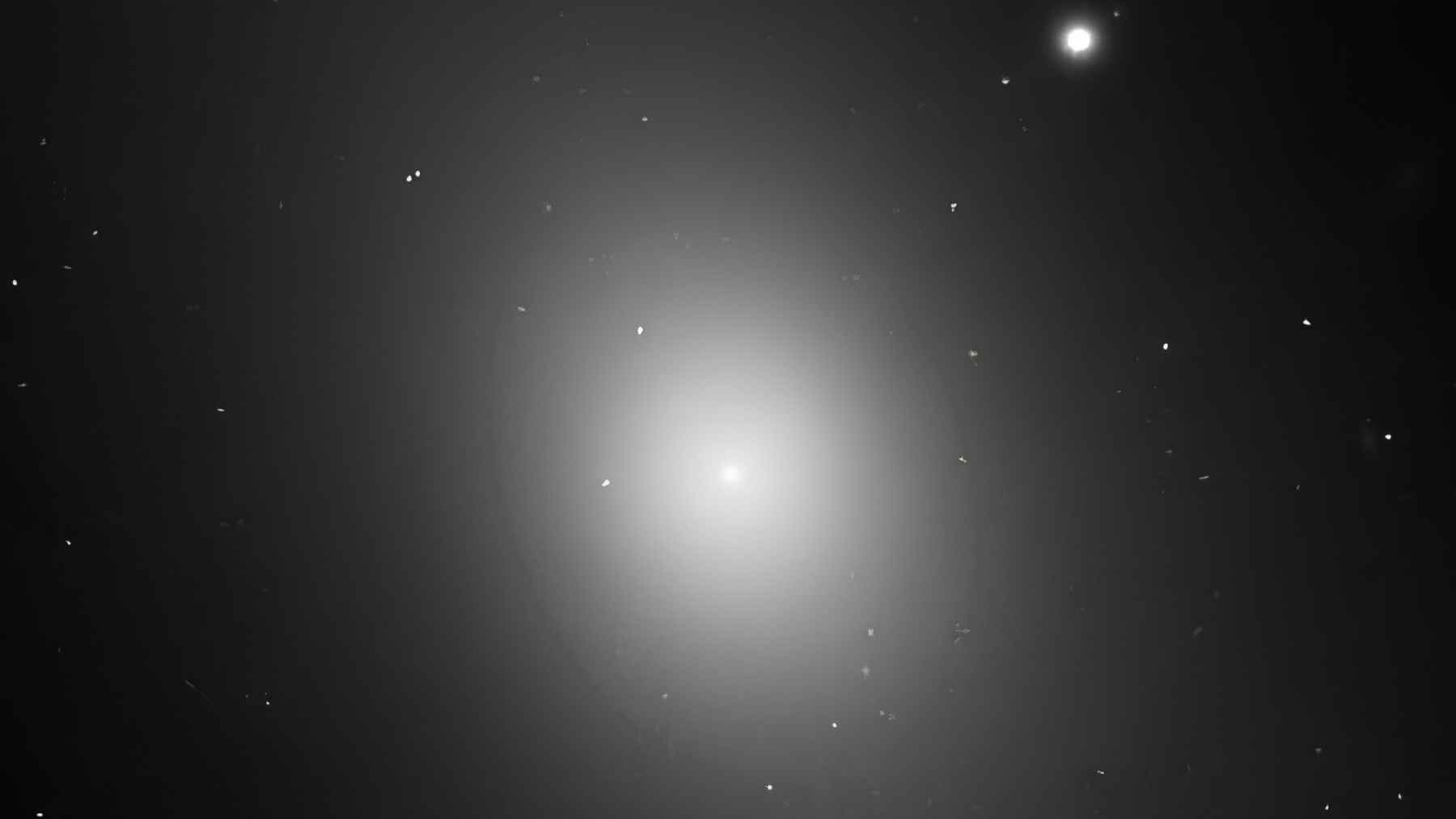
How can you measure something when its outer light blends into the light of an entire cluster of galaxies? Researchers were able to find the physical boundary of IC 1101, a giant galaxy located at the center of Abell 2029, using the most detailed images of the system ever taken.
They found that the main stellar body of the galaxy is about 260 kiloparsecs from its center, in the direction of its longest axis. This means that IC 1101 has an estimated diameter of approximately 520 kiloparsecs, or 1.7 million light-years, and that inside that limit there are stars with a total mass equivalent to 3.36 trillion solar masses.
A galaxy 17 Milky Ways wide
According to NASA, the Milky Way has a stellar disk that spans more than 100,000 light-years. Imagine 17 Milky Way disks, one next to the other, that would be the diameter of IC 1101.
The estimation of the mass does not mean that the galaxy contains exactly that amount of stars (3.36 trillion). It just represents the mass of stars measured in units of the Sun’s mass.
Why couldn’t we find its edge?
Galaxies do not have clear, defined borders. The starlight fades, and in such a dense cluster a faint halo is very difficult to distinguish from the light of other stars that are not clearly associated with a particular galaxy.
Previous observations had identified light around IC 1101 to approximately 607 kiloparsecs but could not see a defined boundary. This new study was able to separate the main stellar body of the galaxy from its diffuse outer layer and the light that surrounds it.
The deepest look so far
Researchers used the Wide Field Camera on the Isaac Newton Telescope (2.5 meters) at the Roque de los Muchachos Observatory.
They collected around four hours of exposure in the g band more than four hours in the r band. This allowed them to detect extremely faint light. They managed to prevent contamination from starlight, by modelling the point spread function, and as well as applying several corrections, they removed light from over 250 foreground stars.
A limit set by light
The edge was not only defined by the brightness cutoff. They also examined surface brightness, color, stellar mass density, ellipticity, and the position angle.
Several measurements changed simultaneously near 260 kiloparsecs, so they adopted an edge radius of 260 plus or minus 38 kiloparsecs. Therefore, the boundary really represents a broader structural transition.
The galaxy goes beyond this boundary
The estimated diameter of 520 kiloparsecs refers only to the main stellar body, not every star associated with the system. Beyond that boundary, that outer layer extends to about 475 kiloparsecs in radius.
Stellar mass reaches about 4.2 trillion solar masses within 620 kiloparsecs, although the authors caution that measurements at those distances increasingly mix the galaxy with diffuse intracluster light.
Eight signs that the galaxy is still growing
After removing scattered light, researchers found eight faint structures which were named A through H. These included streams of stars and other areas where the light was more concentrated.
According to the study, these features suggest that IC 1101 is still gaining mass. Earlier X-ray work observations showed that this activity may be the result of a collision with a smaller galaxy cluster or group around 2 to 3 billion years ago.
A giant still taking shape
Based on the boundary used in this study, IC 1101 is the largest known galaxy. Its huge size may also help astronomers understand how galaxies can grow over billions of years through several mergers.
The study was published on arXiv and has been accepted for publication in Astronomy & Astrophysics.