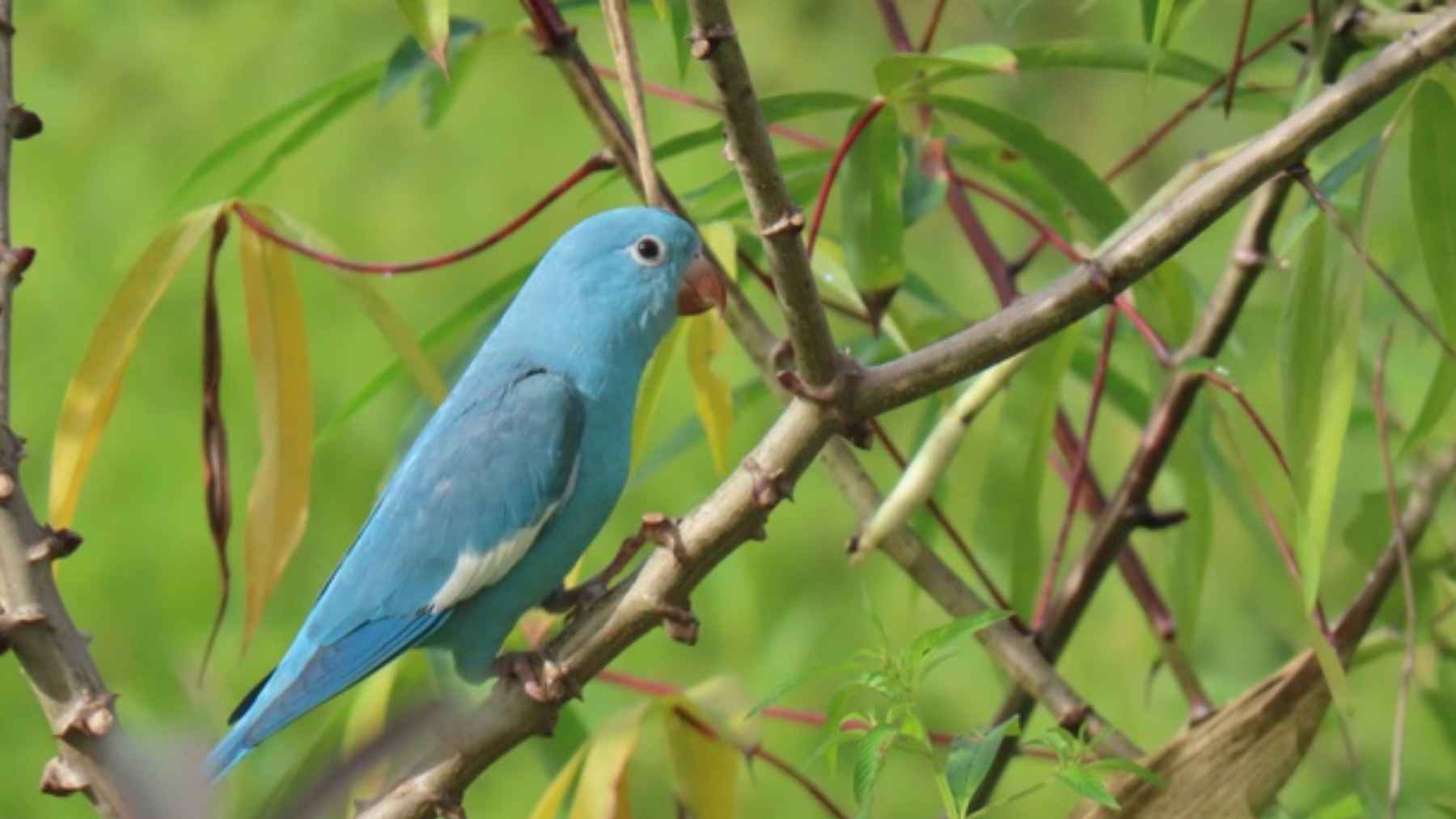
A routine birdwatching moment in Tocantins, Brazil, ended with a surprise that even seasoned observers rarely see. A wild parakeet showed up looking more sky-blue than leaf-green.
The bird appears to show “cyanism,” a genetic change that removes pigments that normally create yellow, orange, and red tones in parrot feathers. So how does a bird that is supposed to blend into green foliage wind up looking blue instead?
A blue parakeet spotted by chance
The unusual bird was photographed on April 2, 2026, in São Félix do Tocantins, where a flock was feeding in a cornfield. The photo was taken by environmental analyst Bianca Montanaro, who noted that these kinds of sightings in the wild are “rare and valuable” because they help document natural variation and underline the need to protect biodiversity.
In most cases, the species involved has a stable green coloration that blends into trees and brush. This time, the bird stood out in the flock with a plumage that looked predominantly blue, the kind of thing that makes people do a double take.
The species is Brotogeris chiriri, widely known in English as the yellow-chevroned parakeet. It is the sort of small parrot that can thrive around open areas and human activity, which makes an odd color morph even easier to notice.
What cyanism actually does
Cyanism is not an infection or a stain, and it is not something the bird “caught” from the environment. It is a genetic condition that changes which pigments the body can produce in feathers.
In parrots, the missing pigments are often described as “psittacine” pigments, and scientists also use the term psittacofulvins for these molecules. When those pigments are missing, the yellows and oranges fade out, and the remaining colors can take over.
This is where the blue comes in. The bird is not “painting itself” blue, but revealing the blue effects that were already built into the feather’s physical structure.
Why green feathers can flip to blue
Many birds do not rely on a simple green pigment in feathers. Instead, green can be a mix of yellow pigment layered over a blue color created when tiny structures in feathers scatter light.
A 2013 study in the Journal of Experimental Biology described this mixing effect in Amazon parrots, showing that yellow pigment can filter light so a feather looks green. When that pigment layer is absent, the remaining color shifts toward blue-green.
In other words, the color change is a kind of unmasking. Take away the yellow component, and the blue structural color is what is left for your eyes to notice.
What newer research says about parrot pigments
Scientists have been digging into how parrots make their signature colors because they do not follow the same rules as many other birds. Unlike carotenoids, which many animals must get from food, parrots can produce key pigments inside their own bodies.
A 2024 Science paper led by Roberto Arbore mapped part of the chemistry behind yellow-to-red color variation in parrots and tied it to how feathers handle psittacofulvin pigments during growth. It also explains why greens are often a blend of yellow pigment and structural blue, which helps clarify why losing yellow pigment can push a bird toward blue.
For a teen-friendly comparison, think of mixing paints. If green paint is made from yellow and blue, then removing the yellow leaves you with something that looks much closer to blue.
Does this color change hurt the bird?
On its own, cyanism is mostly about appearance, and it is not known as a direct health problem. The bigger question is how the outside world reacts to a bird that does not match the usual pattern.
Camouflage is one concern. In a landscape full of green leaves and shadows, being bright blue can be like trying to stay unnoticed while wearing a loud shirt on a field trip.
There is also the social side, which people often forget. Color can affect how birds recognize each other and how successful they are at mating in the wild.
Why rare sightings matter for conservation
A single bird in a cornfield might sound like a small story, but it adds a real data point about genetic diversity in wild populations. It also shows that even “common” species can carry hidden variation that only shows up now and then.
These records can help scientists ask better questions about inheritance and survival. If a trait makes life even slightly harder, it tends to remain rare, which is one reason odd color morphs do not show up every day.
For conservation, the practical value is simple. Better records lead to better monitoring, and better monitoring can shape how habitats are managed in places where agriculture, towns, and wildlife sit side by side.
What happens after the photo
For now, this case is mainly a reminder that field observations still matter, even in the age of lab genetics. It is also a nudge to look closely, because unusual individuals can slip by in a moving flock.
Scientists would need genetic testing to confirm exactly which changes caused this color pattern, and that is beyond what a single photo can prove. Still, careful documentation, clear images, and location details are often the first step toward deeper research.
The press release was published by the Brazilian Institute of Environment and Renewable Natural Resources.