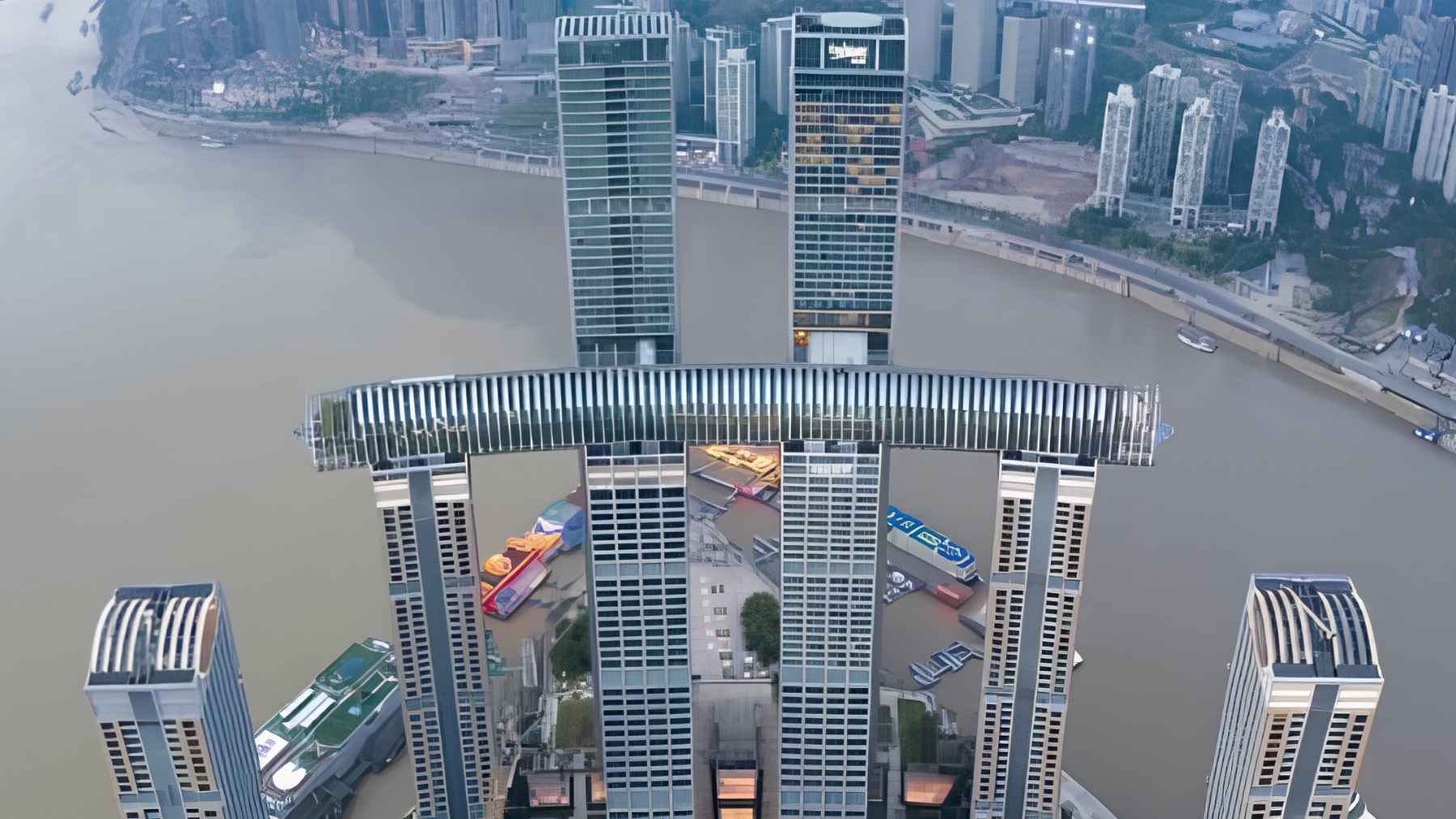
Most skyscrapers are designed to climb higher and higher. In Chongqing, China, one of the most striking high-rise projects in the world asks a different question. What if part of the city could stretch sideways across the sky instead?
That is the idea behind The Crystal, the suspended structure at Raffles City Chongqing. It runs about 984 feet long, sits roughly 820 feet above the ground, and links several towers in a dense riverfront district where space is not exactly easy to find.
A skyscraper that runs sideways
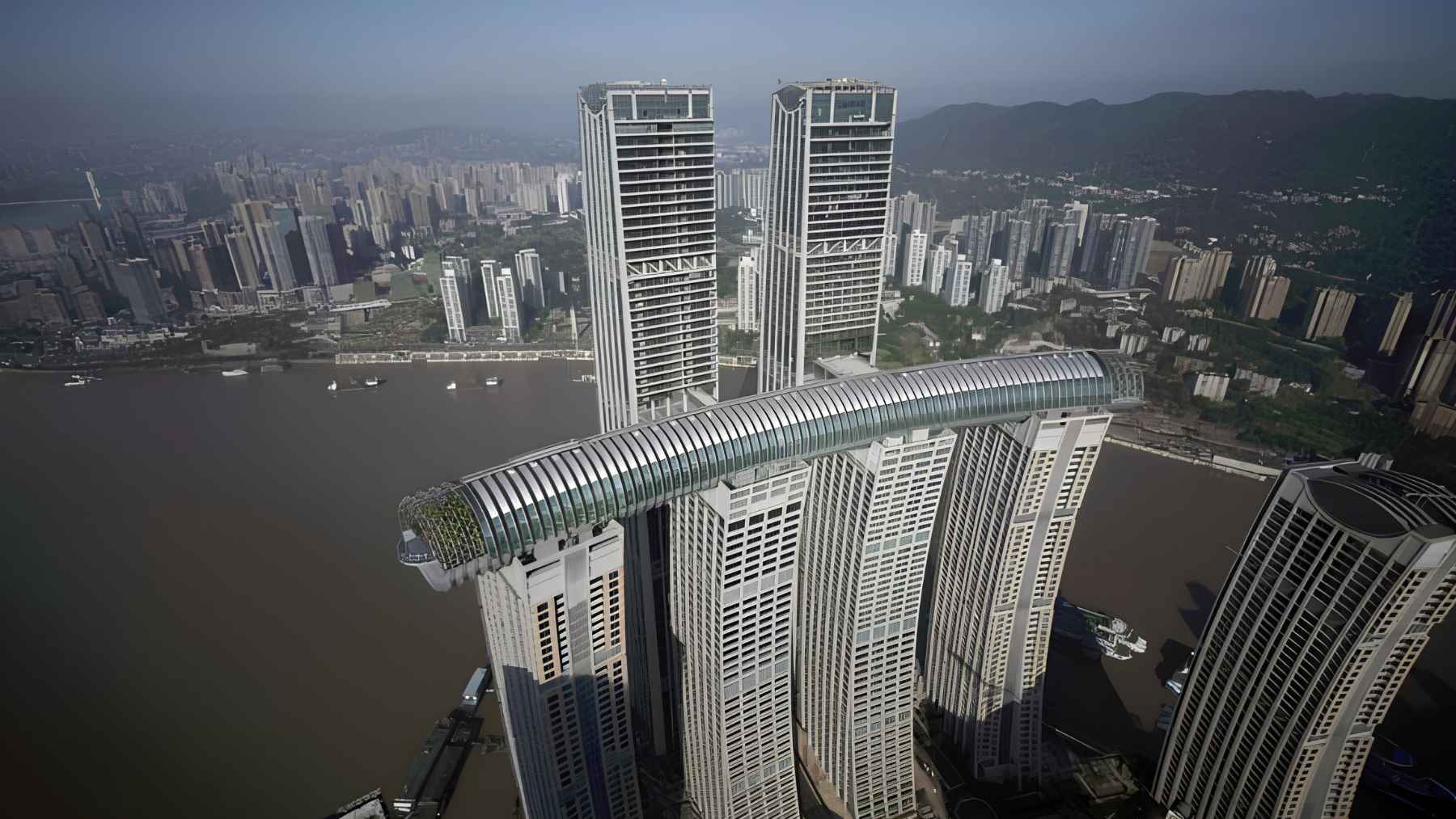
The Crystal is often called a “horizontal skyscraper,” and for once, the nickname is not just marketing. CapitaLand says the structure measures about 984 feet in length, 107 feet in width, and 87 feet in height, with more than 107,000 square feet of total space inside.
It rests above four towers that rise about 820 feet and connects to two neighboring towers by cantilevered bridges. In plain English, a cantilever is a section that sticks out and is supported from one side, a bit like a balcony taken to an extreme.
Why Chongqing needed something different
Chongqing is not a quiet backdrop for this kind of experiment. The municipality had a reported population of 31.91 million in 2023, and the project sits where the Yangtze and Jialing rivers meet.
That location matters. In a crowded, hilly city, building up is normal, but connecting buildings in the air changes how people move, shop, eat, and look out over the city without always going back down to street level.
Designed like a city in the sky
Raffles City Chongqing was designed by Safdie Architects, the firm led by Moshe Safdie and known for major projects such as Marina Bay Sands in Singapore. For this project, the firm described the complex as a “3D city,” a phrase that makes sense once you see how offices, homes, retail, hotel space, and recreation are stacked together.
CapitaLand developed the complex, while Arup worked as structural engineer. The official project page lists a total size of about 12.1 million square feet, which makes the suspended bridge feel less like a one-off attraction and more like the crown of a giant urban machine.
Lifting millions of pounds
The steel structure of The Crystal weighs about 26.5 million pounds, roughly the same total weight CapitaLand compares with the Eiffel Tower. That is the part that makes the project feel almost unreal. The Eiffel Tower stands on the ground, but this steel frame had to be carried by towers hundreds of feet in the air.
To make the job safer and more controlled, crews did not assemble every piece high above Chongqing. CapitaLand says three middle sections were built on the ground and hoisted into place using hydraulic strand jacks, which work like powerful synchronized lifting systems.
Each of those middle sections weighed up to about 2.4 million pounds. Imagine lifting a massive building piece into the air and then making it line up with tower connections hundreds of feet above traffic, wind, and river fog. That was the challenge.
Glass, aluminum, and vertigo
The outside of The Crystal is wrapped in about 3,000 glass panels and close to 5,000 aluminum panels. Safdie Architects says the curtain wall is integrated into a concertina-style structural frame, which gives the building its long, faceted look.
Inside, the main public draw is the Exploration Deck. CapitaLand describes a visitor route that starts with an exhibition developed with National Geographic, then continues by express elevator to the upper levels before ending at an open-air sky deck with a see-through glass floor.
The supplied project brief lists the glass-floor viewing area at about 16,000 square feet. For visitors, the math is less important than the feeling. One step forward, and the streets of Chongqing appear far below your shoes.
More than a lookout point
The Crystal is not only a glass-floor thrill ride. Safdie Architects says it includes dining areas, bars, event spaces, a hotel lobby, gardens, and a members-only club with a 164-foot infinity pool.
CapitaLand has also described the wider development as a major mixed-use project with a shopping mall, office space, residential apartments, serviced residence space, and a hotel. In practical terms, that means the complex is trying to function like a small vertical neighborhood, not just a collection of tall towers.
The cost of ambition
The official developer figure is much larger than some online summaries suggest. CapitaLand listed the project development expenditure at RMB ¥24 billion, which was widely reported at about $3.4 billion based on exchange rates used around the project period.
That price tag helps explain the scale. The development includes more than 400 shops, thousands of parking spaces, public access areas, transit connections, and riverfront views that turn the building itself into a tourism product.
What The Crystal really proves
The Crystal does not mean every city will soon have sideways skyscrapers. Projects like this need deep budgets, unusual sites, strong towers, and engineers willing to solve problems most buildings never face.
Still, it shows how high-rise design is changing. A skyscraper does not always have to be a single needle pointing upward. Sometimes, it can become a bridge, a park, a viewing deck, and a piece of city life suspended in the air.
The main press release was published on CapitaLand’s website.