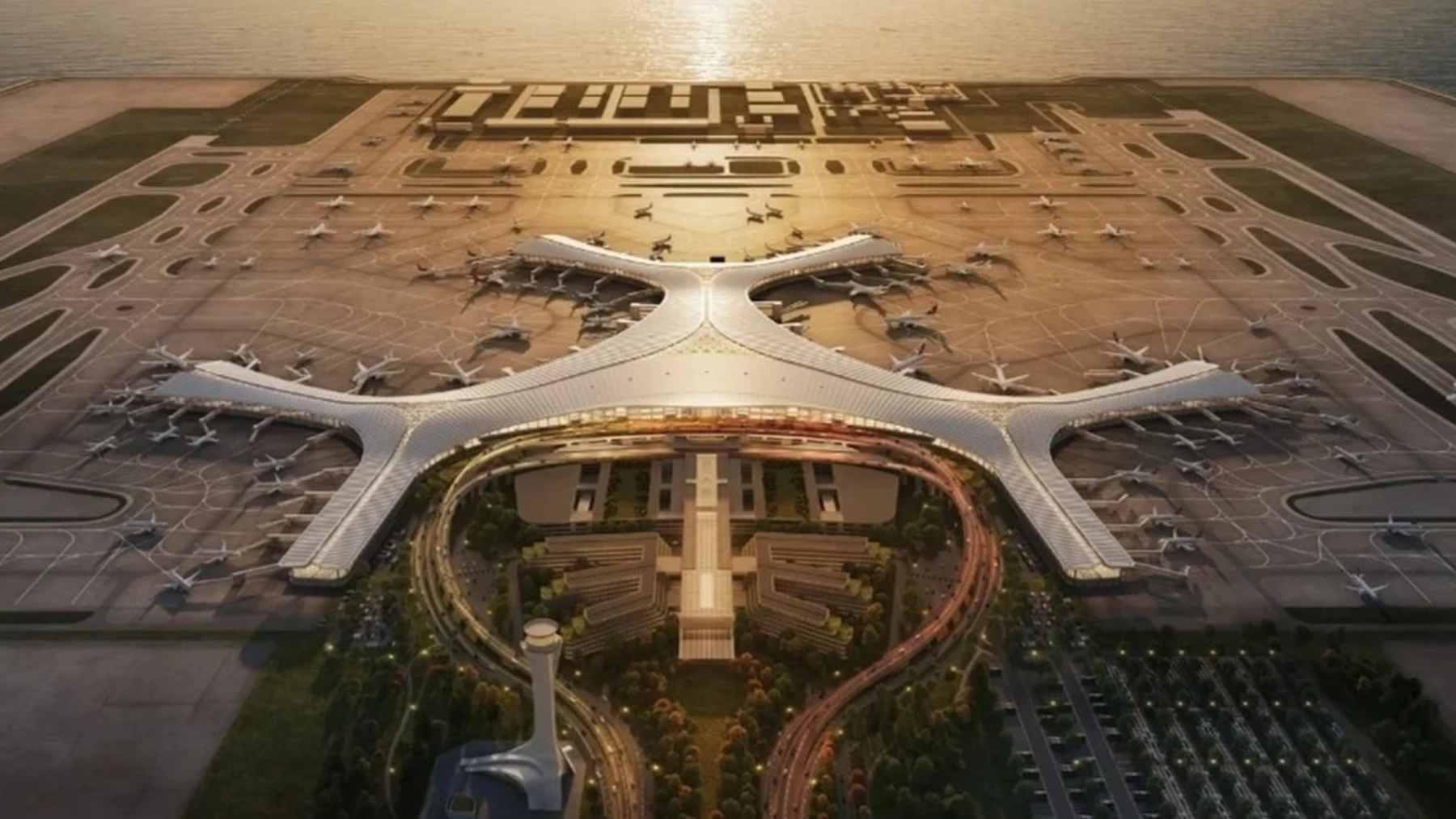
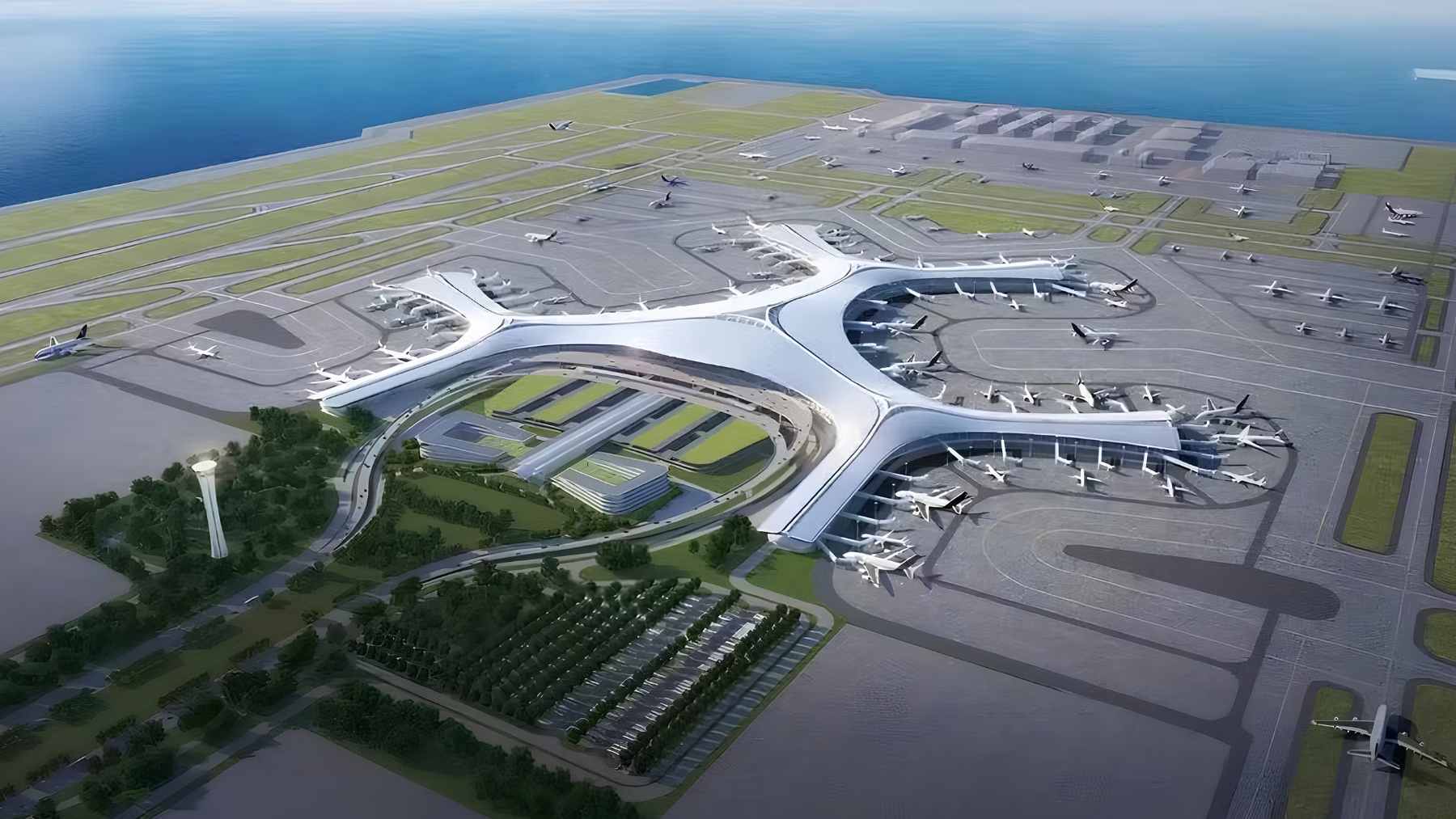
China is pushing forward with one of the most unusual airport projects on Earth, a giant new air hub being built in the sea off Dalian, a port city in northeastern China. The Dalian Jinzhouwan International Airport is not a floating platform, despite how the project is often described, but a full artificial island made from reclaimed land.
The idea is simple, even if the construction is not. Dalian needs more airport space, and the land around its current airport is tight, so China is moving the next chapter of the city’s aviation future into Jinzhou Bay.
Built from the sea
The planned airport will sit on about 7.7 square miles of reclaimed land, nearly 4,940 acres, in the eastern waters of Jinzhou Bay. The Liaoning provincial government describes it as China’s first offshore artificial-island airport and says the project is part of the country’s current national development plan.
That size is what makes the project stand out. The South China Morning Post reported that the island would be larger than the artificial-island sites used by Hong Kong International Airport and Kansai International Airport near Osaka, Japan.
So, is it really “floating”? Not in the way most people would picture it. Engineers are creating land where there used to be water, then strengthening the seabed so terminals, taxiways, and runways can handle the constant weight of aircraft and passengers.
Why Dalian needs it
Dalian’s current airport, Dalian Zhoushuizi International Airport, has served the city for nearly a century. But it has little room left to expand, and its location in a valley surrounded by mountains makes operations harder, especially when weather turns rough.
That matters because Dalian is not just another coastal city. It is a major gateway for trade with Japan and South Korea, with oil refining, shipping, logistics, and tourism all tied to how easily people and goods can move in and out of the region.
In practical terms, more airport capacity could mean shorter bottlenecks for travelers, faster cargo movement, and less pressure on a crowded old facility. Anyone who has sat in airport traffic or waited through repeated delays knows why that matters.
The numbers are huge
The long-term plan calls for four runways and a terminal of about 9.7 million square feet. China State Construction Engineering Corporation says the airport is designed to handle up to 80 million passengers a year, along with about 1.65 million U.S. tons of cargo and mail in its future phase.
The first phase is already large on its own. Official project information describes two parallel runways, a T1 terminal of about 5.4 million square feet, capacity for 43 million passengers a year, and about 606,000 U.S. tons of cargo and mail.
The price tag is heavy, too. A €4.3 billion estimate in the project brief equals roughly $5 billion using the European Central Bank’s May 20, 2026 euro-to-dollar reference rate.
The hard work is underground
Building on reclaimed land is not just a matter of dumping soil into the sea and paving it. The ground can settle unevenly, and that is a serious problem when heavy jets need perfectly stable runways.
In June 2025, the Liaoning provincial government said deep foundation treatment had entered a key stage. Crews were working across about 3.9 square miles of ground treatment, and about 0.5 square miles had already been reinforced, roughly 13% of that major foundation task.
Earlier work also showed how carefully the project is being staged. In August 2024, local government reports indicated a reclaimed terminal core area of about 829,000 square feet had completed deep foundation treatment, improving the land’s bearing capacity for later construction.
Risks in the water
Moving an airport into the sea solves one problem, but it creates others. Artificial islands depend on bridges, tunnels, utilities, and power lines, and those links have to keep working during storms, accidents, and other disruptions.
Aviation consultant Li Hanming told the South China Morning Post that Dalian’s claim to the largest artificial-island airport is credible. The same report also noted concerns that access bridges could be vulnerable to earthquakes, typhoons, or ship collisions.
That is not a small issue. For a traveler, one damaged road link can mean missed flights. For a city, it can mean cargo delays, lost revenue, and a very expensive reminder that the ocean is not an easy construction site.
What comes next
The project is no longer just a drawing on a planning board. Dalian’s 2026 government work report said Jinzhouwan International Airport was among the major projects being accelerated, alongside other large infrastructure investments.
In September 2025, China State Construction Engineering Corporation announced that a consortium had won the terminal, elevated approach bridge, and supporting facilities contract. The company said that step marked a new stage for construction of the airport.
If the project reaches its long-term goal, Dalian will gain a new regional air hub built where the city could not grow on land. That is the real story here, not just China building something big, but China trying to turn a stretch of sea into the next front door for a major northeastern city.
The main official project information has been published by the Liaoning provincial government and China State Construction Engineering Corporation.