Erin Brockovich, the environmental advocate whose work on the Pacific Gas and Electric groundwater case helped secure a $333 million settlement for residents of Hinkley, California, is now focusing on a very different kind of infrastructure. This time, the issue is not a leaking utility site, but the fast spread of AI data centers across the United States.
Her message is not that every data center should be stopped. The sharper question is simpler: why are so many communities learning about these projects only after major decisions have already been made? In a May 2026 post on The Brockovich Report, she said 3,862 residents had submitted reports in one month, and the most common concern was “transparency.”
What data centers do
A data center is basically a large building filled with servers, cooling systems, cables, backup generators, and security equipment. Those servers store data, run websites, support cloud services, and now power many artificial intelligence tools that can write, search, translate, and generate images.
That sounds invisible when you use a phone or laptop, but on the ground, it can look like a massive industrial campus, with traffic, construction noise, exhaust fumes, power lines, substations, and cooling equipment that may run all day and night.
AI has made the buildout feel urgent. Companies need more computing power to train and operate large language models, which are the systems behind many chatbots and AI tools. Put simply, more AI often means more servers, and more servers mean more electricity and heat.
Why towns are worried
The energy numbers help explain the pushback. A Lawrence Berkeley National Laboratory report led by Arman Shehabi found that U.S. data centers used about 176 billion kilowatt-hours of electricity in 2023, or 4.4% of total U.S. electricity use. The same report estimated that the figure could rise to between 325 billion and 580 billion kilowatt-hours by 2028.
That is not just an abstract grid problem. A Carnegie Mellon University and North Carolina State University modeling team, including Michael Blackhurst and Jeremiah Johnson, estimated that data center and cryptocurrency mining growth could raise average U.S. electricity generation costs by 8% by 2030. In some regional markets, the increase could be much higher.
Then there is water. Many large facilities need water to keep equipment from overheating, especially in hot weather when everyone else is also thinking about air conditioning and the electric bill. The Environmental and Energy Study Institute says larger data centers can use up to 5 million gallons of water per day, about what a town of 10,000 to 50,000 people might need.
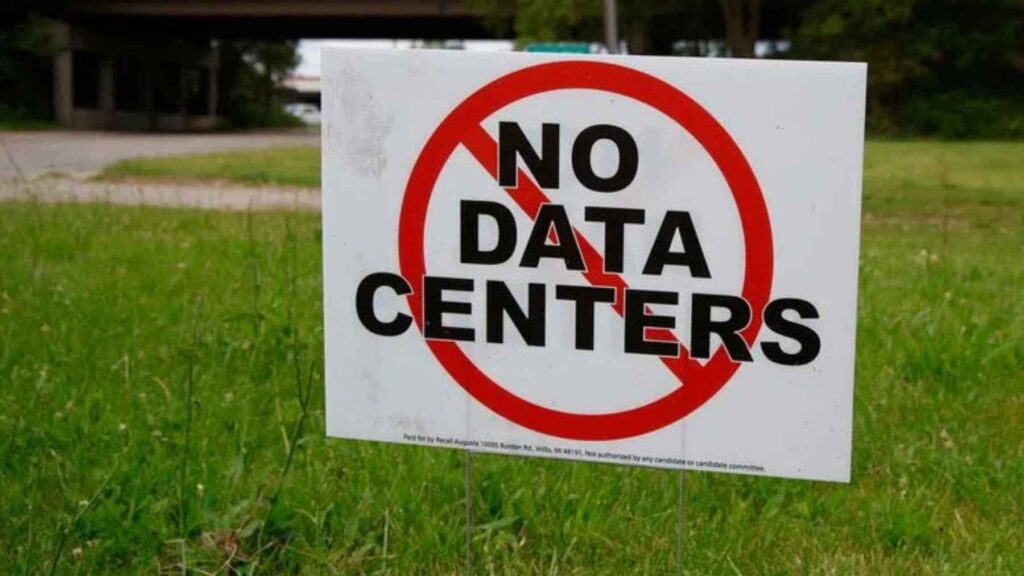
A protest sign reading “No Data Centers” highlights community opposition to large AI infrastructure projects over concerns about transparency, energy use, water consumption, and neighborhood impacts.
Benefits are real, too
Data centers can bring money, which is part of what makes the debate so tense. In Loudoun County, Virginia, local officials say data centers generated $875 million in actual tax revenue in fiscal year 2024, which was $35 million more than the county government’s general operations budget.
Meta has made a similar economic argument in Louisiana. The company says its Richland Parish Data Center will be its largest so far, with more than $10 billion in investment, 4 million ft.² of space, more than 5,000 skilled trade workers on site at peak construction, and more than 500 operational jobs once completed.
So, the issue is not as simple as good or bad. For the most part, the conflict is about who gets the benefits, who carries the costs, and whether local people are invited into the conversation before the bulldozers arrive.
The trust problem
In Holly Ridge, Louisiana resident Diane Cobb told New Orleans Public Radio that people near Meta’s Hyperion project were not properly notified before construction began. “Nobody told us anything,” she said. For neighbors dealing with dump trucks, dust, road safety fears, and water questions, that kind of silence can feel personal very fast.
A similar frustration has surfaced in Box Elder County, Utah, where a data center project backed by Kevin O’Leary drew major public concern. County commissioners unanimously approved plans for a large data center in Hansel Valley, while residents worried about water, power demand, and the future of the rural landscape.
What happens when a town feels decisions are already locked in? People stop seeing a project as development and start seeing it as something being done to them. That is where Brockovich’s campaign has found its opening.
What transparency means
Brockovich’s new reporting website collects community concerns and places them on an interactive map of AI data centers that are operating, under construction, proposed, or reported by residents. The site says it is not meant to show every facility in the country, but to help people see the bigger picture as development spreads town by town.
Transparency, in this fight, is not a slogan. It means advance notice, public hearings, clear estimates of electricity use, water demand, noise, traffic, tax breaks, and effects on local infrastructure. It also means elected officials should explain what they knew, when they knew it, and whether any nondisclosure agreements limited what residents could hear.
At the end of the day, what many communities are asking for is not complicated. They want a seat at the table before the deal is signed, not after.
The AI boom comes home
For years, the internet felt weightless. Search engines, social media, cloud storage, and now AI tools seemed to live somewhere far away. The data center boom is a reminder that the digital world has a physical address.
That address may be next to farmland, near a school bus route, beside a water source, or close enough for residents to hear the hum at night. Is that a fair trade? Some towns may say yes, especially where tax revenue supports schools, roads, and public services.
Others may say no, or at least not without stronger rules. The trouble is, the clock is moving faster than local politics. Brockovich is betting that public attention can slow the process enough for communities to ask better questions before the next giant server farm breaks ground.
The original report has been published in Fortune.