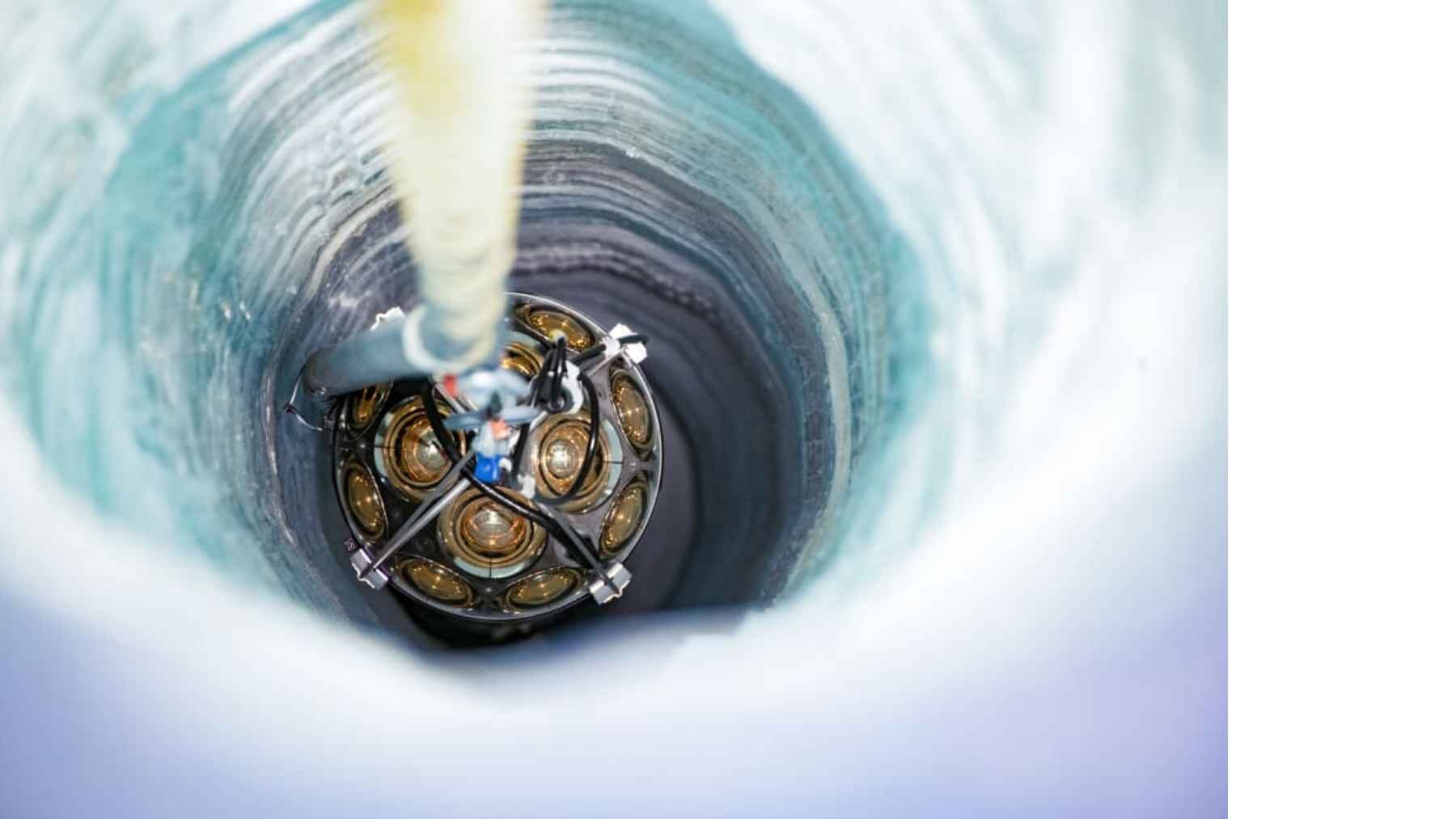
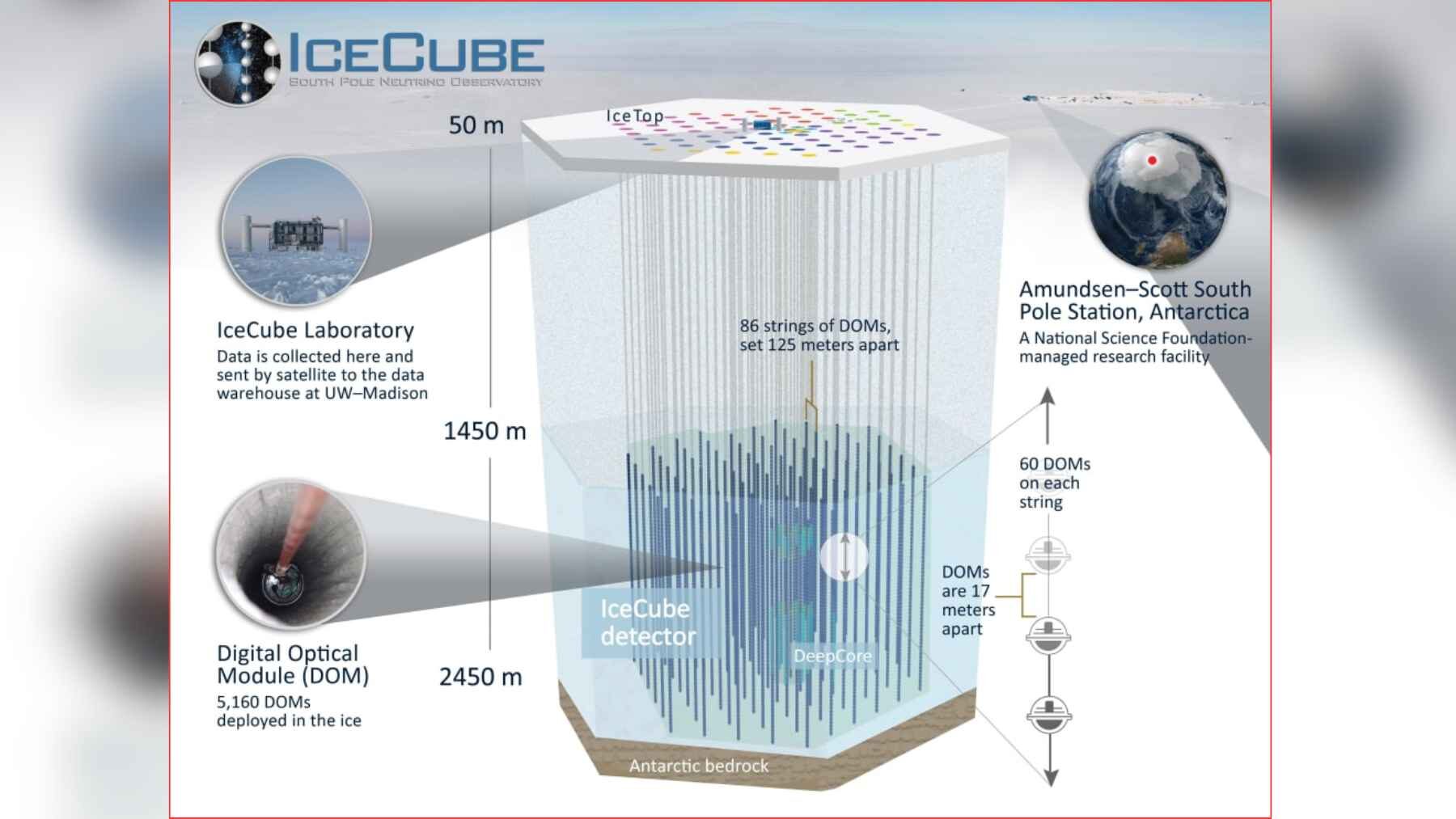
At the geographic South Pole, astronomers are looking straight down to map the stars. By suspending 5,160 light sensors across 86 strings frozen between 4,757 and 8,038 ft. beneath the surface, researchers have transformed a cubic kilometer (0.24 cubic miles) of clear Antarctic ice into an unprecedented telescope — one that uses the entire Earth as its filter.
Its cleverest feature is the planet beneath our feet. For many searches, IceCube watches for particles arriving upward after crossing Earth, which blocks ordinary atmospheric muons while allowing many neutrinos to reach the detector from the northern sky.
A telescope made from ice
Neutrinos are nearly massless, electrically neutral particles that rarely interact with matter. Around 100 trillion pass through your body each second, which sounds dramatic until you realize almost none leave a trace.
That is why IceCube had to be enormous. The ice acts as the target for rare collisions, the transparent medium that carries the resulting light, and the rigid structure that keeps thousands of sensors fixed in three dimensions.
How an invisible particle flashes blue
So how do you catch a particle that is famous for passing through almost everything? IceCube waits for the rare moment when a neutrino strikes a proton or neutron and creates a charged secondary particle that can move faster than light travels through ice, though never faster than light in a vacuum.
The particle produces a cone of blue Cherenkov radiation, much like the pressure wave behind a supersonic jet. By comparing which sensors light up first, how bright they become, and how the glow spreads, software estimates the particle’s direction and energy.
Tracks and showers
Muon neutrinos can create muons that travel long distances, leaving extended tracks that point back toward the sky with relatively good precision. Other interactions produce compact cascades, which often capture deposited energy well but are harder to aim at a single source.
This is not a camera image in the everyday sense. Each event is closer to reconstructing a lightning strike from the timing of distant microphones, except the signal lasts only a tiny fraction of a second and unfolds inside ancient ice.
Why IceCube looks through Earth
Cosmic rays striking the atmosphere above Antarctica generate huge numbers of downward-moving muons. Even with the detector buried deeply, that background can swamp the much rarer neutrino signals scientists want to study.
Earth solves much of the problem because a muon cannot cross the entire planet. An upward-moving track can therefore be traced to a neutrino that traveled through rock and ice before interacting near the detector, although atmospheric neutrinos remain a background that researchers must separate statistically.
Earth is a shield with limits
“Looking through Earth” is useful, but the planet is not perfectly transparent. As neutrino energy rises, the chance of an interaction also rises, and the highest-energy particles are increasingly absorbed before they can reach the South Pole.
IceCube confirmed this effect in 2017 by measuring fewer energetic neutrinos along the thickest paths through Earth. For the southern sky, researchers instead select events that begin inside the array, use outer sensors as a veto, and rely on event shape and energy to reject incoming atmospheric particles.
What IceCube has found
In 2013, IceCube reported strong evidence for high-energy neutrinos from beyond the solar system. A 2017 alert later helped connect a neutrino with the flaring blazar TXS 0506+056, while years of data produced evidence for emission from the obscured active galaxy NGC 1068 in 2022.
Then came a view no optical telescope could make. In 2023, the collaboration produced the first image of the Milky Way in high-energy neutrinos, using cascade events and statistical patterns to reveal the galactic plane through particles rather than light.
The southern sky opens
The technique keeps improving. A study published in March 2026 found a 3.0 sigma excess from a selected group of X-ray-bright Seyfert galaxies in the southern sky, using starting-track events to suppress the heavy atmospheric background.
That result is evidence, not final proof, and the distinction matters. Neutrino astronomy still works with sparse signals, uncertain directions, and careful probabilities rather than the sharp certainty of a familiar space photograph.
Frozen in place
Crews built the original detector from 2004 to 2010 by melting 23.6-inch-wide holes down to 8,038 ft. Each hole took about 48 hours to drill, and lowering one cable of sensors took another 11 hours before the water refroze around equipment that can no longer be retrieved.
In early 2026, IceCube completed its first major expansion, adding five denser strings with more than 600 enhanced sensors and calibration instruments. Principal investigator Albrecht Karle said the new equipment would help scientists “measure neutrino properties and observe transient astronomy,” while improved calibration should sharpen old reconstructions and test technology for IceCube-Gen2.
A new way to see
Neutrinos can escape dense regions that block light, and magnetic fields do not bend their paths because they carry no electric charge. That makes them valuable messengers from black holes and other extreme cosmic accelerators, even when traditional telescopes see only part of the story.
Ultimately, the real achievement is not merely that scientists buried thousands of sensors in Antarctica, but that they turned the ice, the darkness, and even Earth itself into working parts of a telescope.
The official statement was published on IceCube Neutrino Observatory website.