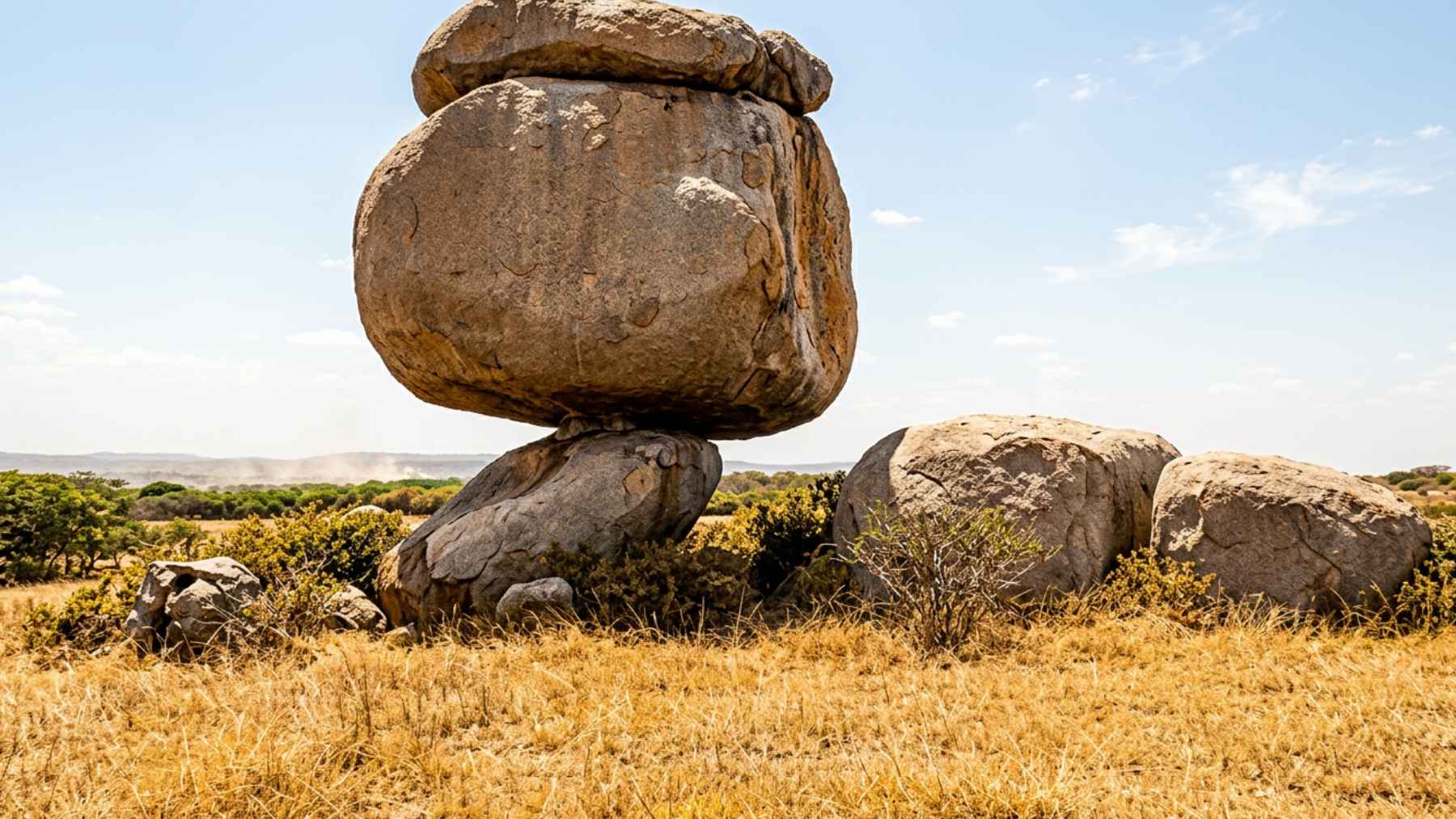
A strange-looking rock formation in Brazil’s northeast is getting fresh attention after a May 9, 2026, visit brought new eyes to one of Belém do Brejo do Cruz’s most curious local landmarks. Known as Pedra da Maravilha, the formation appears to balance on a small rocky base, creating the kind of image that makes people stop, zoom in, and ask the same question: Is that real?
The answer, based on local records and recent visitor footage, is yes. The stone has long been known by residents in this part of Paraíba’s sertão, the dry inland region of Brazil’s northeast. What changed is the internet.
A place that older generations treated as part of the local landscape is now reaching people far beyond the town, especially those who see the rock online and wonder whether they are looking at nature or a clever edit.
A rock that looks too balanced
Pedra da Maravilha stands out because its lower section appears much smaller than the block resting above it. From some angles, the base looks almost too narrow to hold the larger stone, giving the whole scene a suspended, frozen-in-place feeling.
That visual trick is what makes the formation so memorable. Walk around it, and the shape changes. One side can look thin and fragile, while another looks wider and more solid, like a large boulder locked into the dry landscape.
There is no public geological report in the supplied material explaining its age or exact formation process. That matters. The safest way to describe Pedra da Maravilha is as a natural rock formation with an unusual appearance, not as a scientifically explained mystery.
Why people doubt the images
Have you ever seen a photo online that looked just a little too perfect? That is part of the appeal here. Pedra da Maravilha seems to challenge what the eye expects from a heavy rock sitting on a small base.
In the video account cited in the source material, visitors move around the formation to show the base, the upper block, and the surrounding area. The point is simple. They are trying to answer viewers who suspect the scene may be edited or staged.
This kind of doubt can actually help a local attraction grow. People comment, share, argue, and then some decide they want to see it for themselves. The mystery becomes part of the trip.
Belém do Brejo do Cruz gets noticed
Belém do Brejo do Cruz is a small municipality in Paraíba, far from the country’s best-known tourist routes. Brazil’s official statistics agency, the Brazilian Institute of Geography and Statistics (IBGE), lists its 2022 census population at 6,268 people and its area at about 232 square miles.
That local scale is part of the story. Pedra da Maravilha is not a polished attraction with big-city crowds, ticket lines, and souvenir stalls. It is a striking piece of landscape that residents already knew and visitors are now discovering through phones and social media.
For a town like Belém do Brejo do Cruz, one strong image can matter. A single rock, when it looks this unusual, can become a postcard, a conversation starter, and a reason for travelers to take a detour.
Residents help prove the scene
The recent record mentioned in the source material shows visitors at the site on May 9, 2026. Among them was Bartolomeu, a local resident who went close to the stone and helped show the formation from the ground level.
That detail gives the story a more human layer. For people who live nearby, Pedra da Maravilha is part of local memory. For viewers online, it can look almost unreal until someone stands beside it and shows the rock from different angles.
This is where local knowledge and digital curiosity meet. Residents do not need convincing that the stone exists, but outsiders often do. That is why simple videos filmed on site can feel more persuasive than polished promotional images.
The sertão has hidden landmarks
Pedra da Maravilha also points to a broader truth about Brazil’s northeast. The sertão is often discussed through drought, heat, and distance, but it also holds unusual landscapes, rock formations, trails, reservoirs, and communities with strong local identities.
Not every attraction needs to be massive to be meaningful. Sometimes the draw is smaller and more personal, like a roadside stop, a family memory, or a place where someone says, “You have to see this from the other side.”
That is especially true in the age of social media. A curious natural feature can move from local landmark to regional talking point quickly, especially when the image is easy to understand and hard to ignore.
Curiosity should come with care
There is another side to this attention. Natural sites can be damaged when visitors treat them as props instead of places. Climbing on fragile formations, leaving trash, or trying risky poses for photos can turn curiosity into a problem.
Pedra da Maravilha’s appeal depends on the same thing that makes it worth visiting: the rock, the setting, and the feeling that the landscape has been there long before the cameras arrived. Protecting that matters.
The best visit is simple. Look, photograph, ask locals about the place, and leave it as it was found. That way, the next person gets the same surprise.
What makes Pedra da Maravilha so striking
The power of Pedra da Maravilha comes from three things working together. It has an unusual shape, it sits in the dry inland setting of Paraíba, and it creates instant doubt for people seeing it on a screen.
For residents, it is a familiar landmark with local value. For visitors, it is a photo opportunity and a reason to explore a lesser-known corner of the northeast. For everyone else online, it becomes a question that is hard to resist.
At the end of the day, that may be the real story. Pedra da Maravilha is not famous because scientists have solved it, at least not in the material available here. It is famous because it looks improbable, and sometimes that is enough to put a small town on the map.
The main report used for this article was published by Click Petróleo e Gás,