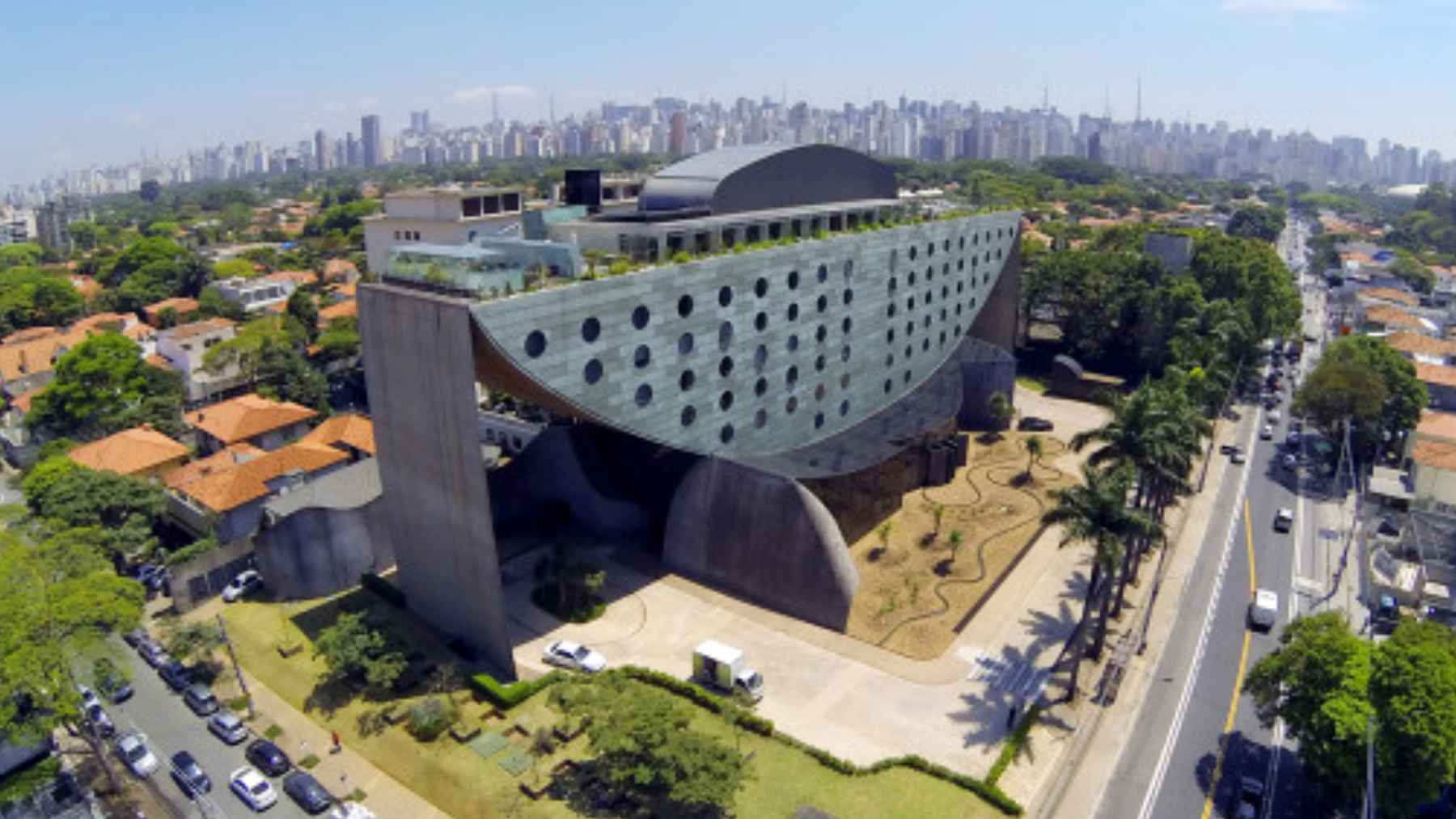
In São Paulo’s Jardins district, one hotel has become almost impossible to confuse with any other building. Hotel Unique looks like an upside-down ship, with exposed concrete, round windows, copper panels, mirrored glass, and a red rooftop pool glowing above one of Brazil’s busiest cities.
The point is not just visual drama. Designed by Brazilian architect Ruy Ohtake and completed in 2002, the hotel turned a difficult concrete curve into a landmark that still feels startling more than two decades later. Ohtake’s office describes the project as a long inverted arch with side concrete walls, six floors, 96 guest rooms, circular windows about 5.9 feet wide, and a rooftop restaurant overlooking São Paulo.
A ship in the city
From the street, Hotel Unique does not behave like a normal hotel tower. Its curved belly, narrow base, and round openings make it look like the hull of a vessel lifted into the air. Who would expect to see that on Avenida Brigadeiro Luís Antônio?
The source material describes the arched facade as about 276 feet long, while Ohtake’s office describes the broader inverted-arch form as nearly 328 feet long. Either way, the message is the same. This is not a plain glass box, but a sculptural object placed inside the everyday rhythm of traffic, sidewalks, and office towers.
Concrete that appears to float
The boldest part of Hotel Unique is not the red pool. It is the engineering behind the shape. The building is wider toward the top and narrower near the base, which means its weight had to be controlled through concrete walls, deep supports, and careful structural planning.
In simple terms, the hotel uses reinforced concrete. That means steel bars are placed inside concrete so the material can handle pressure and pulling forces. It sounds technical, but the result is easy to see. Heavy concrete appears to float.
The Council of Architecture and Urbanism of Brazil has described Ohtake as one of the major figures of his generation, noting his use of color, waves, and daring shapes across more than 300 built works. Here, that design language becomes almost literal. The structure looks improbable, but it is doing serious work.
Why the windows are round
Most hotels choose rectangular windows because they are simple, familiar, and easy to repeat. Hotel Unique went the other way. The circular openings keep the curved facade from being chopped into a grid, so the ship-like outline stays intact.
The round windows are not just decoration. They frame the city like a picture, giving guests a focused view of São Paulo and the green edge of Ibirapuera Park. For a hotel room, that small change matters. It turns looking outside into part of the stay.
Architectural coverage of the project has pointed out that Ohtake faced a local height limit in the area and responded with an unusual inverted arch instead of a taller block. That constraint helped shape the hotel’s identity. Sometimes a rule does not kill creativity; it forces it to get sharper.
The red pool on top
Then comes the roof. Skye Restaurant & Bar sits above the hotel with a reddish pool, a lounge, and panoramic views toward Ibirapuera Park, the São Paulo skyline, and Paulista Avenue. The hotel presents it as one of the city’s most celebrated rooftops, and that is easy to understand when the lights come on.
In practical terms, the roof completes the illusion. A wood deck, glass details, and the edge of the pool make the bar seem to hover above Jardins. Anyone who has crossed São Paulo in rush-hour traffic knows how heavy the city can feel, so the sensation of floating above it has obvious appeal.
The red pool also gives the building a second life at night. During the day, the eye catches the concrete curve and the circular windows. After sunset, the roof becomes the visual hook.
A different kind of luxury
Classic luxury hotels often lean on marble, symmetry, glossy lobbies, and quiet facades. Hotel Unique chooses a more restless path. The building itself becomes the first experience, even before a guest reaches the reception desk.
The official hotel page says the property was designed as a cutting-edge hotel by Ruy Ohtake, with interiors by João Armentano and landscaping by Gilberto Elkis. That matters because architecture is not only the outside shell. The rooms, lobby, gardens, and rooftop all have to keep the same visual story alive.
That is why the circular windows, curved corridors, copper panels, and exposed concrete do not feel like isolated tricks. They form a complete identity. Some people see a ship, others see a melon, but almost nobody sees a forgettable hotel.
Keeping the icon intact
Buildings like this require care. Exposed concrete is concrete deliberately left visible instead of being hidden by paint, stone, or another finish. In a polluted megacity, that surface can stain, age, and absorb moisture, so cleaning and waterproofing become part of preserving the design.
The copper panels need attention too. Over time, copper can develop a greenish patina, a thin surface layer that helps protect the metal while changing its color. In this case, aging is not just damage. Managed well, it becomes part of the look.
That may be the most interesting thing about Hotel Unique. It is not only a strange building for photographs. It is a working hotel that turns structure, materials, maintenance, and skyline views into one continuous experience.