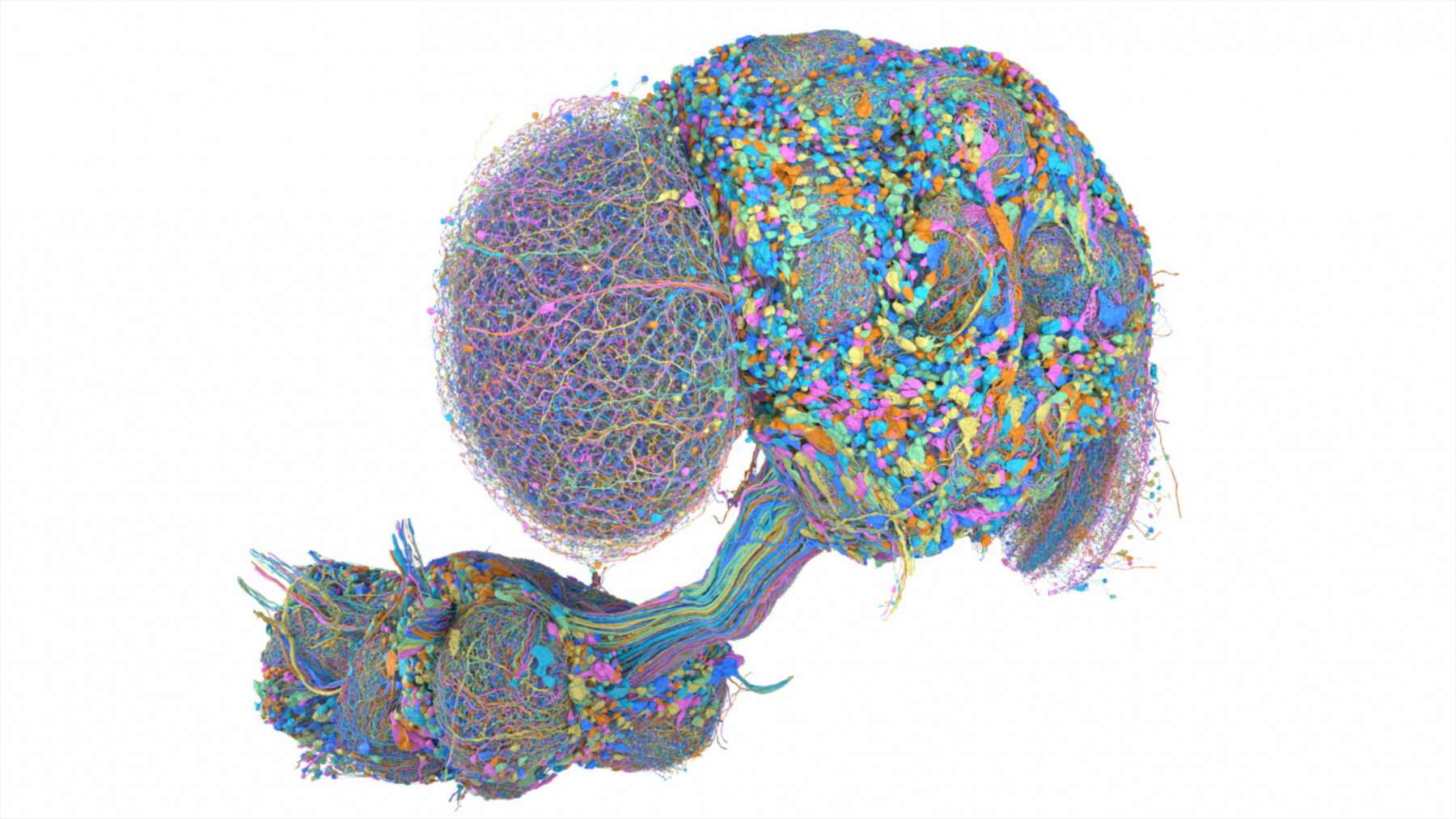
In 2008, Gerry Rubin’s lab in Ashburn, Virginia, decided to map every neuron in a fruit fly’s brain. A lot of other scientists thought the idea was crazy. The lab’s own math wasn’t encouraging either. With the tools of the day, the job would take 500 people 10 years.
Rubin, the founding executive director of the Janelia Research Campus, went ahead anyway.
“We felt, which wasn’t a universally accepted idea, that we wouldn’t be able to understand the brain at a satisfying level without having a wiring diagram,” he said in an account published Sept. 3 by the Howard Hughes Medical Institute, which runs the campus. “We knew it was possible; it was a well-defined problem. We just had to figure out how to do it.”
It took 18 years. On Sept. 3 the journal Cell published the full wiring diagram of one male fruit fly’s central nervous system. It has 166,700 neurons, in the brain and in the nerve cord that works like a spinal cord, and the authors sorted them into 11,710 types. Anyone can read the paper and download the data for free.
Every fly brain mapped before this one was female, Janelia said when it first posted the data in October 2025.
“It is the first time we can compare both sexes of an animal with complex social behavior,” Rubin said then. “Male and female flies have a lot of differences in their behavior, and neuroscientists want to understand how the brain controls those behaviors. This now allows us to easily home in on the neurons that are causing those differences.”
Twenty-nine proofreaders, three years
The fly was cut into slices and each slice was photographed with an electron microscope. Harald Hess, a senior group leader at Janelia, spent years making that kind of microscope sharp enough for the job, the institute said.
“Janelia was just ideally set up to have the patience for developing these technologies,” Hess said.
Software from Google Research then traced each neuron through the pictures. People checked the work. The Cell paper says 29 expert proofreaders went over it for three years, an effort the authors put at 44 person-years. Google Research counts 125 million connections between the neurons and calls the result “the largest brain map by number of neurons to date.”
The model was a worm. Twenty years before the fly project started, scientists had mapped the 302 neurons of C. elegans, and that took more than a decade.
“It was us having the leap of faith that we could assemble an interdisciplinary team who would develop ways to increase the efficiency of generating connectomes by more than 1,000-fold,” Rubin said. “That was our key contribution, and without that, we could still be waiting.”
“From eyes to legs in one go”
Earlier maps covered the fly’s brain or its nerve cord. This one has both, from the same fly.
“It basically lets us get from eyes to legs in one go,” said Greg Jefferis, a neuroscientist at the MRC Laboratory of Molecular Biology and the University of Cambridge who helped lead the project. “Connectomes are really one of the most powerful ways we have to understand how brains give rise to different behaviors.”
Males and females turned out to be wired mostly alike. The paper counts 8,069 types of neuron that are the same in both sexes, 138 that both have but that connect differently, 289 found only in males and 71 only in females.
Jefferis said the comparison could matter for people one day. “Understanding how genetic differences translate into differences in brain wiring and behaviour should eventually help us to understand how brains malfunction,” he said in a University of Cambridge statement, naming autism and schizophrenia as conditions with a strong genetic basis.
Then somebody made it play Doom
Days after the paper came out, programmers hooked the map up to video games.
Tom’s Hardware reported Sept. 8 that a software engineer, Alex Wormuth, was training it to play Doom, and that another developer, Jessica Paquette, had it playing Super Mario 64. In Paquette’s clip, the site said, Mario kept “taking off and bumping into a wall.”
“Will the fly learn to survive?” Wormuth asked in a post the site quoted.
At least one of these projects is upfront about its limits. The documentation for nfly, an open-source program that uses the map, says it copies the fly’s wiring and that everything else “is a deliberate simplification.”
The paper’s authors are careful too. Their section on limitations says a wiring diagram shows structure, and that experiments are still needed to confirm what it predicts about behavior. They call the map “a snapshot in the lifetime of an animal.” It came from one fly.
Janelia has moved on to fish, starting with the larval zebrafish, the institute said. Rubin is now its head of biology.
“For me, I’ve been doing this for a long time, longer than I’ve ever worked on any other scientific goal in my life, and I’m ready to stop and think about something else,” he said. “But with an immense sense of pride and accomplishment for the group of people that we brought together here and that pulled it off.”