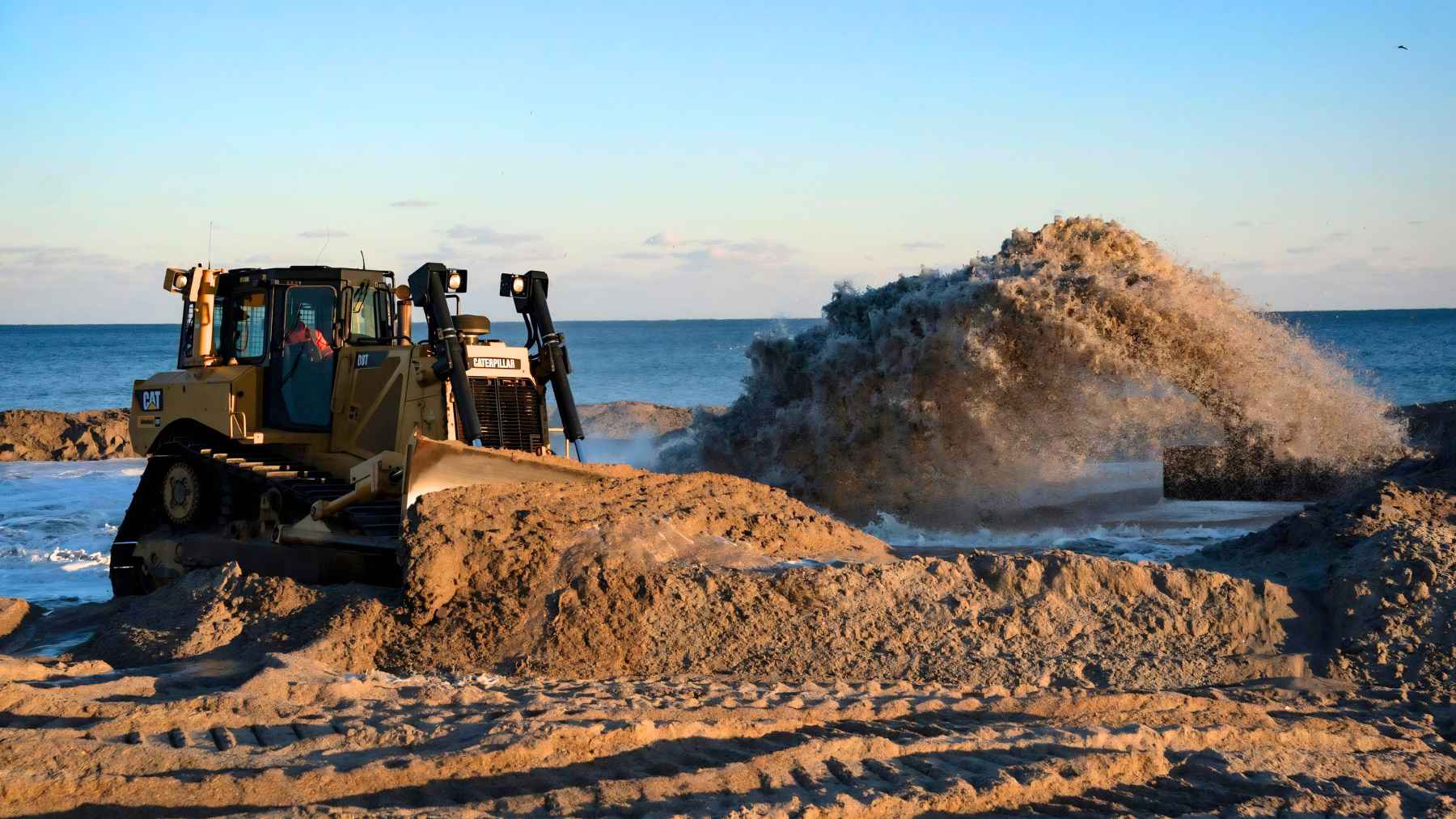
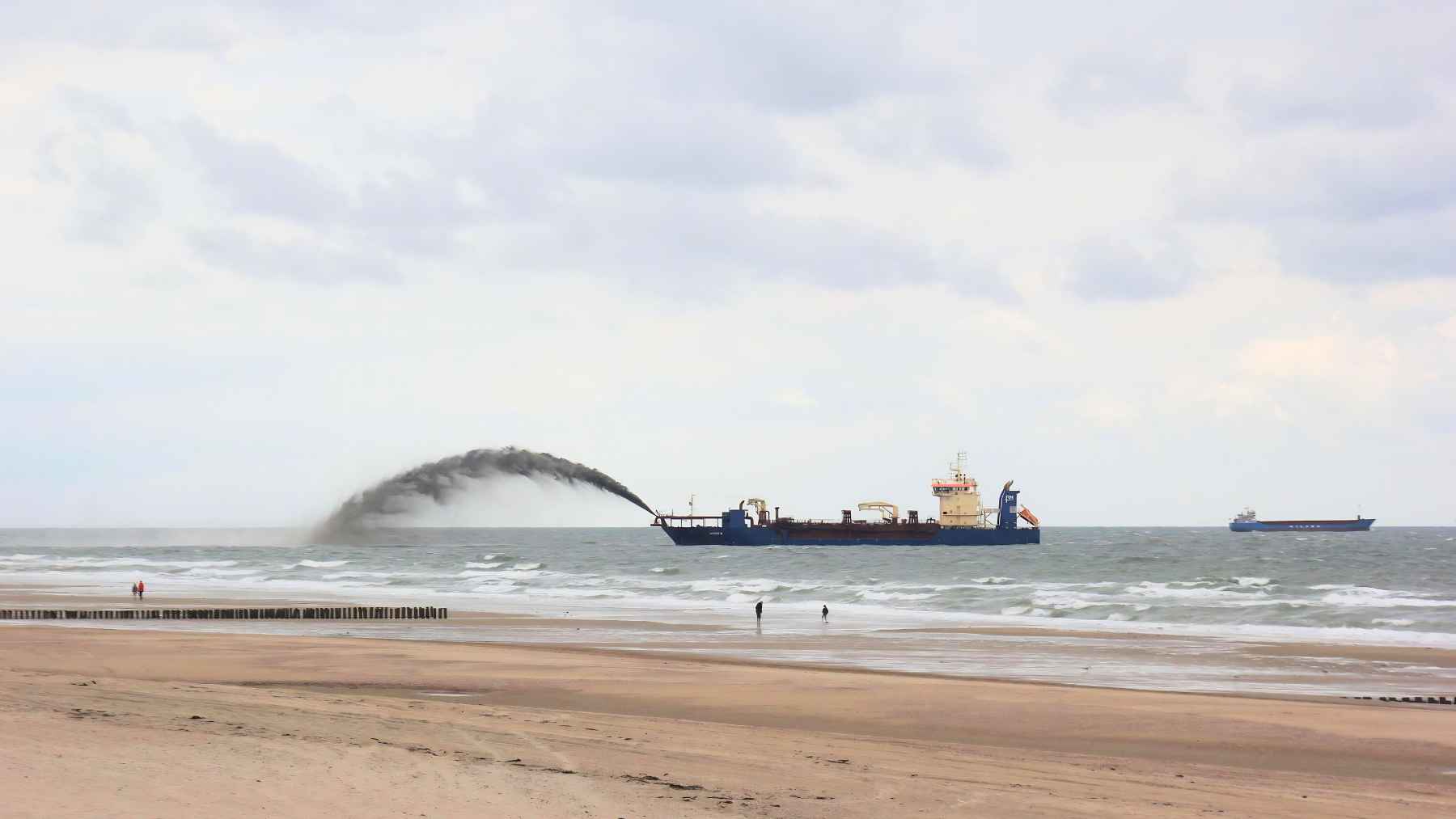
Portugal has launched one of the Algarve’s most eye-catching coastal rescue efforts, moving roughly 2.2 million U.S. tons of sand to rebuild a vulnerable stretch of shoreline between Quarteira and Garrão. The plan is simple to describe but huge to carry out: dredge sand from an offshore area, move it by sea, and spread it across the beach to widen the dry sand by about 123 feet on average.
The project covers about 4.2 miles of coastline in Loulé, one of Portugal’s best-known tourism zones, where summer days often mean packed towels, rental umbrellas, and families trying to find a place near the water. Officials say the artificial beach nourishment is meant to slow erosion, stabilize the coast, and strengthen protection before the bathing season begins.
A beach built back up
The operation involves placing about 1.8 million cubic yards of sediment along the coast, according to Portugal’s government announcement. That sand is being used to rebuild the beach profile where waves, wind, gravity, and sediment shortages have gradually eaten away at the shoreline.
The investment is about $17.2 million, based on the European Central Bank’s May 22, 2026 reference rate of $1.1595 per euro. For a beach project, that is a serious bill, but the logic is also clear enough. Without sand in the right place, the sea reaches farther inland.
Why move so much sand? Because this stretch is considered especially exposed to coastal erosion, sea-level rise, and stronger weather events. The new layer of sediment is supposed to act like a buffer, taking the first hit when waves push toward the cliffs and developed areas behind the beaches.
How the sand moves
Artificial beach nourishment is not the same as dumping random material on the shore. Before the work begins, the extraction area is studied so the new sand closely matches the beach it is meant to support.
This means dredging sand from a submarine deposit, transporting it by ship, and then spreading and shaping it across the beach. The idea is to reinforce the natural coastal profile rather than create a hard concrete barrier.
The work has been phased through areas including Trafal, Vale do Lobo, Garrão, Forte Novo, and Quarteira. Local reports citing the Portuguese Environment Agency (APA) said the beach-feeding stage began after offshore piping was installed in early April, with completion expected by May 6, before the peak beach season.
Why the Algarve needs it
The Algarve is famous for beaches, cliffs, warm water, and that bright Atlantic light tourists remember long after they leave, but the same coast that fills postcards is also under pressure from natural erosion and heavy human use.
Portugal’s government said the intervention is designed to mitigate cliff erosion, stabilize the coastal stretch, and avoid negative effects on the Ria Formosa barrier island system downstream. Before the project reached the ground, officials also required an environmental impact study and an environmental impact declaration.
Maria da Graça Carvalho, Portugal’s minister for environment and energy, said the government is committed to ensuring “the safety of people and the protection of the coastline.” That sentence sums up the political reality of coastal work. It is about nature, yes, but also homes, tourism, jobs, and public safety.
A reset, not a cure
This is the part that matters most for readers. Beach nourishment can buy time, but it does not freeze the coastline in place forever.
The Algarve has seen similar interventions before, including in 1998, 1999, 2006, and 2010, according to APA project documents. After the 2010 operation, a significant amount of the deposited material was later lost, a reminder that sand added today can still be pulled away tomorrow.
That does not make the project useless. It means expectations should be realistic. At the end of the day, the sea keeps working, and coastal defense often becomes a cycle of monitoring, replenishing, and adapting.
The bigger coastal question
For the most part, artificial nourishment is considered a softer option than seawalls or heavy rock structures, because it works with sand and beach shape instead of replacing the shore with hard infrastructure. Beachgoers still see a beach, not a wall.
Softer, however, does not mean simple. Moving more than 2 million U.S. tons of sand takes vessels, fuel, engineering, environmental monitoring, and careful timing so work does not collide with summer tourism more than necessary.
The Algarve project is really a snapshot of a wider problem facing coastal communities across the world. What should towns do when the beach that protects them starts getting thinner? For now, Portugal’s answer is to rebuild the sand, widen the shore, and hope the new buffer holds long enough to keep people safer.
The official statement was published on the Portuguese Environment Agency’s website.