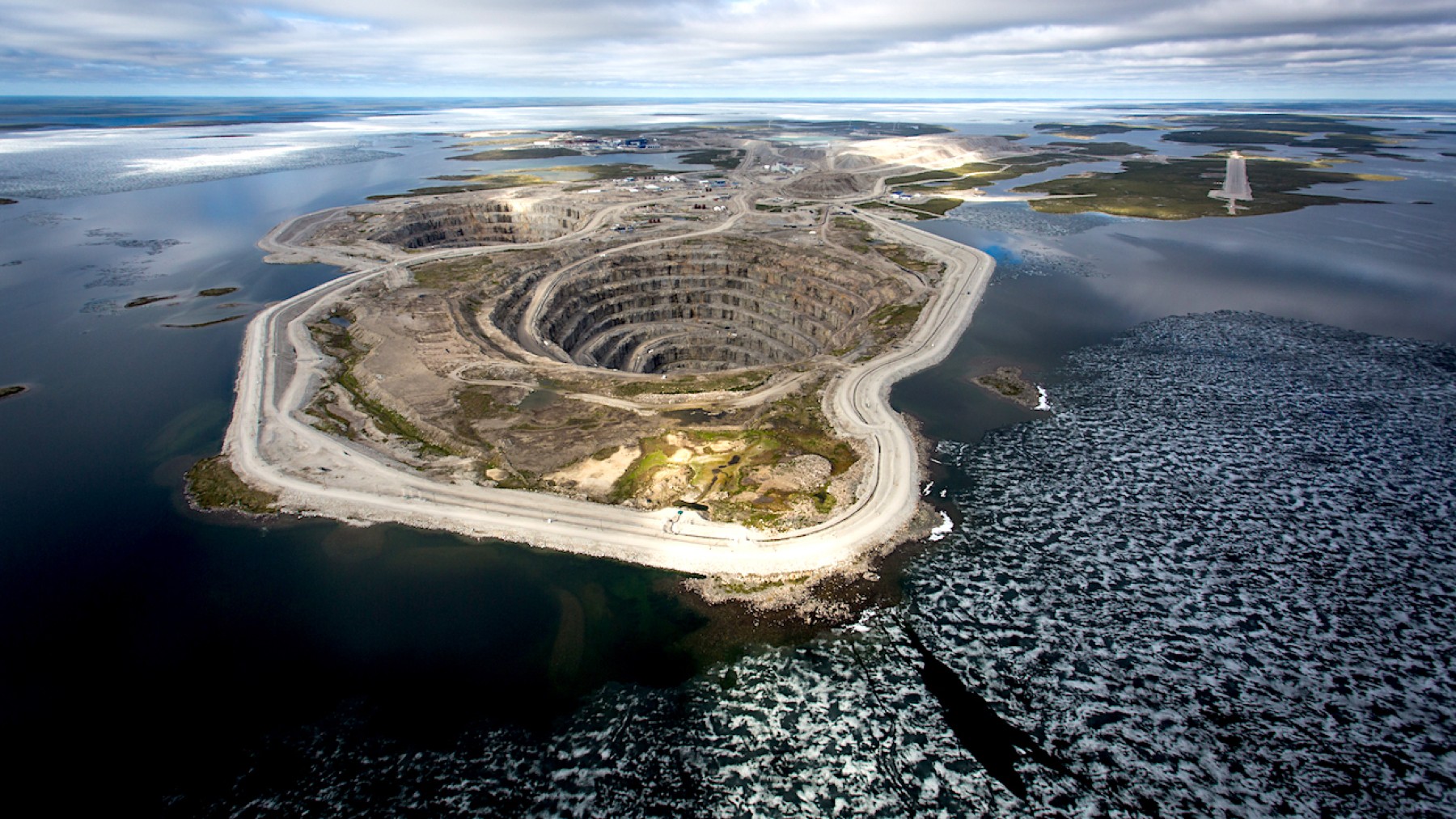
Buried in the permafrost of Siberia lies Aikhal, one of the largest diamond mines in the world-run by Russia’s Alrosa. It produces close to 12 million carats of diamonds each year, and the mine site is now gearing for a big expansion. By increasing activities into the depths, the company targets strengthening its position as a global diamond leader, all within the world’s most challenging environment.
Alrosa doubles down with its RUB 10 billion investment to secure Aikhal mine’s future
Alrosa has unveiled a project for the sum of RUB 10 billion, equivalent to $154 million, for the extended operational life of the Aikhal mine until 2044. This ambitious project has, among other things, a 300 m underground extension added, which, in turn, carries almost 20 million carats in the mine’s raw material base.
Hence, the mining and processing division of Aikhal will maintain an annual output of 500,000 tonnes of ore. “The project is attractive in that, in fact, it does not require any major re-equipment or mosque new infrastructure,” Evgeny Denisov, director of the Aikhal Mining and Processing Division, said.
This should thus reflect Alrosa’s strategic approach to maximizing its resources at the least cost: while the extension will add a real and operational benefit to production, it will enhance the contribution of this division to Alrosa’s global domination in diamond mining.
Aikhal is part of a much larger division which constitutes two open-pit mines, namely Yubileyny and Komsomolsky. Combined, all these operations create a large facet of Alrosa’s reputation as the leading diamond producer by output in the whole world. For instance, about $1.2 billion worth of diamonds were mined by the division the previous year alone.
Permafrost challenges: How Aikhal adapts to harsh Siberian conditions
Permafrost-shock Aikhal with operational challenges. The single short summer period melts the permafrost, produces a lot of rockfalls, and renders open-pit operations virtually impossible. This is one reason why Alrosa has a lot of emphasis on assets in underground mining.
Now, learn how to install the innovative approaches that the company has deployed to ensure safety and stability in harsh environments. For example, 1,400 square meters of berms have been stabilized using Geobrugg. This is a TECCO G65/3 mesh, secured with TITAN 40/16 nails and P33/50 spike plates. These berms are often deep into erosion from thawing permafrost.
Installation has a narrow constriction since thawing occurs from mid-May to mid-September. Logistics contribute to the complexity of Aikhal operations. During winter, goods generally move on the ice road on frozen Lena River.
In summer, the transport is by ship to the European part of Russia at a distance which takes 1.5 months. The logistical challenges in the two speak of the ingenuity and resilience expected to be displayed to keep an operation in such a remote and unforgiving environment.
Fractured dolomite & exceptional diamond yields: Aikhal’s geology
This mine within Aikhal really is as impressive in geological makeup as it is in its output. Predominantly fractured dolomite constitutes the ‘unstable layer’, which measures between 1.1 and 1.5 meters in thickness and needs careful stabilization efforts.
Yet despite all this, the Aikhal mining and processing division continues to deliver exceptionally good results, producing beautiful diamonds that are the foundation for cost-effective global operations for Alrosa. The underground operations are supplemented by the two open-pit mines, Yubileyny and Komsomolsky, and the total diamond yield recorded in these two sites is evidence of economic efficiency in the mining strategy of Alrosa.
The new extension ensures that Aikhal will remain a cornerstone of the company’s production for decades to come. The extension project is also very resourceful and sustainable because it will minimize the environmental footprint while maximizing economic returns for Alrosa through existing infrastructure and equipment.
It wedged indeed between innovation and efficiency a characteristically progressive approach to mining by the company. This is basically reflected by investing in the extension of the Aikhal mine, which lays further claim for Alrosa as a leader in the diamond industry.
Using sophisticated technologies and efficient logistics to tackle the problems of the permafrost region of Siberia will secure a diamond production line for many years to come. Apart from precious stones, the mine also digs deeper into the earth by strengthening Alrosa’s reputation as a global leader in innovation and resilience in the mining sector.