For years, squid have looked like one of the big winners of our changing oceans. Their numbers climbed steadily for decades, and many people assumed warmer water was giving these fast-living animals a helping hand.
A new modeling study from Denmark suggests that idea may be backwards. Researchers at the Technical University of Denmark found that warming actually lowered squid biomass in their simulations, and that the long squid boom is better explained by something humans did directly (fishing out the big predators that used to keep squid in check).
A boom that puzzled scientists
The squid story really took off in 2016. A study led by Zoë Doubleday at the University of Adelaide, published in Current Biology, looked at catch rates for 35 cephalopod species or genera from 1953 to 2013 and found populations rising around the world.
“The consistency was the biggest surprise,” Doubleday said at the time. “Cephalopods are notoriously variable, and population abundance can fluctuate wildly, both within and among species.”
Two main suspects emerged in the years that followed. One was warming seas, the other was overfishing of the fish that eat squid. The trouble is, nobody had tested both ideas against each other inside a full ecosystem.
Putting two theories head to head
That’s what the new work set out to do. The team was led by marine biologist Rémy Denéchère at the Center for Ocean Life, part of DTU Aqua (Denmark’s National Institute of Aquatic Resources).
They built a computer model called FEISTY-squid that tracks five groups of sea life. Those are small pelagic fish, large pelagic fish, bottom-dwelling fish, mesopelagic fish from the ocean’s twilight zone, and squid.
The model ran two kinds of seas. One was a shallow shelf system about 164 feet deep, and the other a deep open ocean system roughly 6,560 feet deep.
Warmer water, fewer squid
Here’s the surprise. When the researchers raised water temperature by about 3.6°F, squid biomass went down in both settings, not up.
The reason comes down to metabolism. Warmer water speeds up a squid’s body and helps it hunt, but it also raises the basic energy cost of simply staying alive. If there isn’t more food around to cover that extra bill, the animals come out behind.
It’s a bit like cranking up the air conditioning in a heat wave. The house stays usable, but the electric bill climbs, and something else in the budget has to give.
What happens when the predators disappear
Fishing turned out to matter more. When the model removed large predatory fish, squid biomass rose in both the shelf and open ocean systems, which is in line with the study’s title pointing to the “loss of top predators” as the better explanation.
But the gains were not a free-for-all. According to coverage of the study, the predators lost far more biomass than the squid gained, so the ecosystem as a whole came out poorer.
And there was a twist. As the big fish vanished, the pressure on squid did not really ease, because squid increasingly turned on each other. Cannibalism, in other words, acted as a built-in brake.
Food, not fear, sets the limits
In practical terms, the model suggests squid are mainly held back by how much food is available rather than by how many predators hunt them. Ecologists call this “bottom-up” control, as opposed to “top-down” control from above the food chain.
The authors also point to the squid’s lifestyle. They grow fast and die young, a strategy ecologists describe as “r-selected,” which lets them move quickly into disturbed, unstable seas before slower fish can bounce back.
Think of them as weeds in a freshly cleared lot. They are first to arrive, not necessarily because the soil is better, but because the competition is gone.
Why this matters for fisheries
If the Danish team is right, the squid boom is to a large extent a side effect of industrial fishing, not a sign that warming oceans suit squid. That has real consequences for the whales and fish that depend on them for food, and even for how carbon moves through the ocean.
It also hints at where things could go next. If fisheries management helps predator stocks recover while the ocean keeps heating up, the model points to squid biomass eventually falling rather than rising.
So the era of ever-growing squid numbers may not last. At the end of the day, the model describes a boom built on an ocean that humans reshaped, and one that could fade as that ocean shifts again.
A word of caution
The research is a preprint, which means it has not yet gone through peer review. It was posted on September 1, 2026, and its conclusions could still change before formal publication.
It’s also a model, not a direct count of squid in the sea. Models simplify reality, and experts will want to see how well these results hold up against real catch and survey data from different regions.
Even so, the study reframes a familiar story. The squid may not be taking over the oceans on their own merits, but rather filling a gap we left behind.
The study was published on bioRxiv.
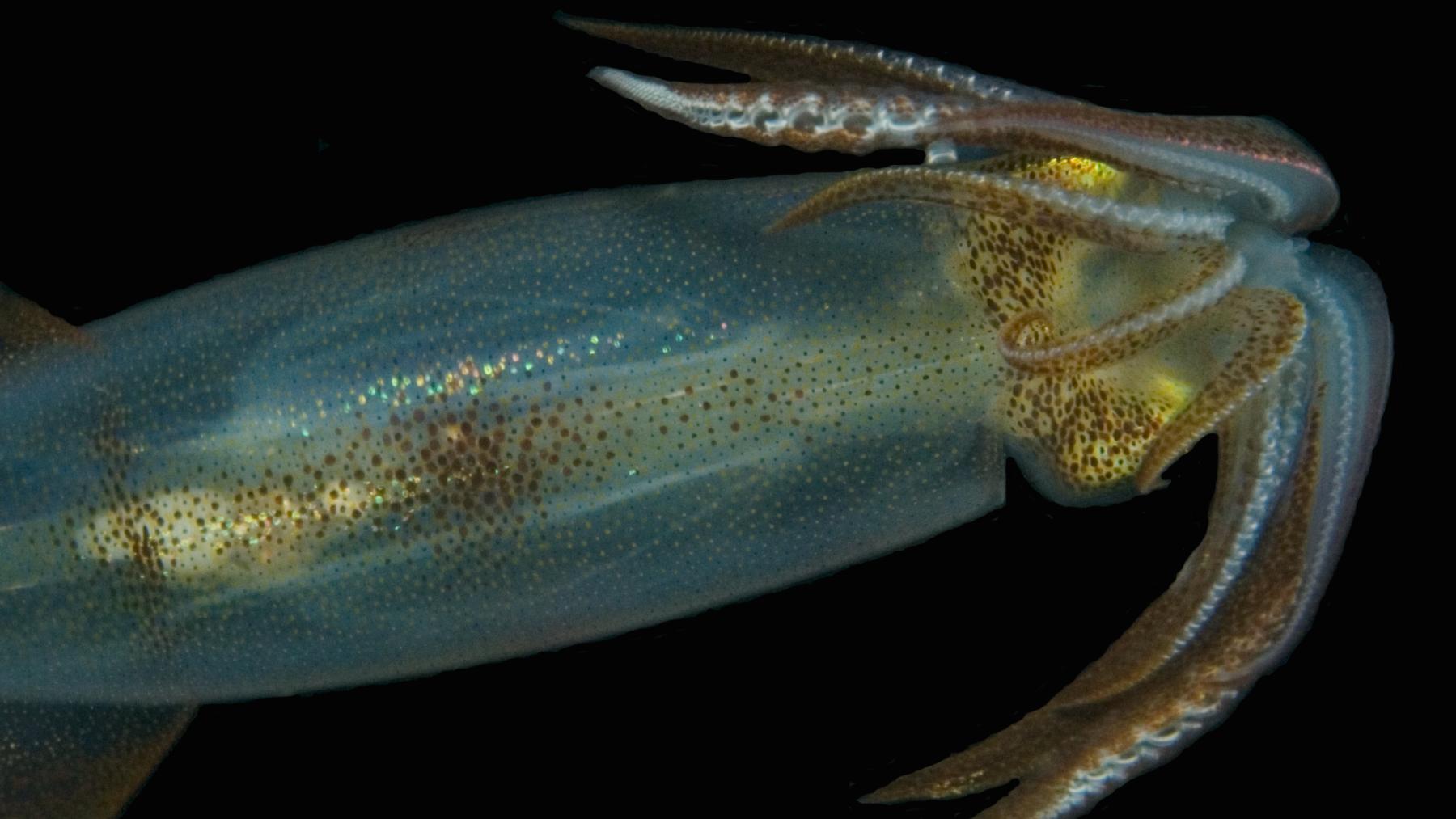
Photo: NOAA National Marine Sanctuaries.