Artificial intelligence has helped scientists identify two superconductors in a rare end-to-end success that began with computer screening and ended with laboratory proof. The compounds, YRu3B2 and LuRu3B2, are real bulk superconductors, but they do not work at room temperature. Their value lies in showing that researchers may be able to replace years of educated guesswork with a faster, more systematic search, and that is the real breakthrough.
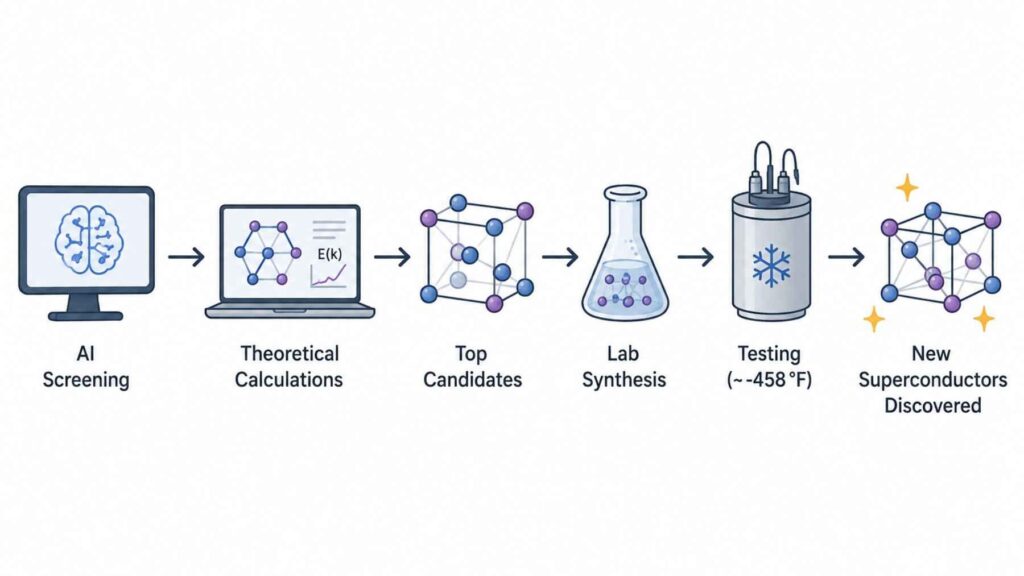
An international team connected to Aalto University’s SuperC consortium used machine learning to filter possible materials, detailed quantum calculations to study promising candidates, and experiments at Rice University to confirm the results. More than 7,000 superconductors have been recognized over the decades, yet Aalto says only about 20 had been successfully identified through theoretical prediction. That is the enormous gap this new approach is trying to close.
Not room temperature yet
First, the important reality check. YRu3B2 becomes superconducting at about -458.2°F, while LuRu3B2 makes the transition near -458.0°F, only around 1.5°F and 1.7°F above absolute zero. Those temperatures are nowhere close to an ordinary room, so this is not the long-awaited room-temperature breakthrough.
So what did scientists gain instead? Both materials showed bulk superconductivity through magnetization, specific heat, and electrical transport measurements, with superconducting fractions of roughly 100% for YRu3B2 and 90% for LuRu3B2. In other words, the effect was not limited to a tiny impurity hiding inside the samples.
How AI narrowed the field
The search for superconductors is brutally difficult because the possible combinations of elements and structures are effectively vast, while full quantum calculations demand serious computing power. Running the most detailed tests on every imaginable compound would be like checking every grain of sand on a beach one by one. Machine learning works as the first sieve.
The initial screening highlighted YRu3B2, while LuRu3B2 was later pursued as a closely related compound after an early calculation suggested possible instability. Researchers then applied more accurate calculations before deciding which materials should be made and tested. “With machine learning, we may be able to push the number of materials we can process into the billions,” Aalto University Professor Päivi Törmä said.
A basket-weave clue
The two compounds share a kagome lattice, a repeating atomic arrangement named after a traditional Japanese basket-weaving pattern. In these materials, ruthenium atoms form the geometric network, which shapes how electrons move and creates nearly flat electronic bands. Flat bands can place many electronic states close together in energy, a feature that may help superconductivity emerge under the right conditions.
Still, the pattern is not a magic switch. The study found that the relevant bands were more dispersive than those in a related compound, reducing the density of electronic states and weakening the interaction between electrons and atomic vibrations. That helps explain why the measured transition temperatures were lower than the team’s original predictions.
Lab tests closed the loop
A computer prediction is only the opening move. At Rice University, a team led by Professor Emilia Morosan combined high-purity elements to synthesize the proposed compounds, checked their crystal structures, and cooled the samples for testing. The researchers then looked for several independent signatures of superconductivity rather than relying on a single electrical reading.
That full chain matters because machine learning can produce false leads, and a theoretically promising compound may be difficult or impossible to manufacture. Here, the candidates survived screening, first-principles calculations, synthesis, and physical measurement. The method did not merely suggest where treasure might be buried – it helped researchers dig it up.
Why the energy promise matters
Superconductors can carry direct electrical current without resistance below their critical temperature, sharply reducing resistive losses inside the material. They already support technologies including quantum computers, MRI scanners, powerful magnets, fusion research, and magnetic-levitation trains. The catch is the cooling equipment, which is expensive and consumes energy of its own.
A practical room-temperature material could change that balance. Data centers might generate less waste heat from electrical resistance, power equipment could become more efficient, and some cooling loads could fall, trimming the electric bill and potentially emissions, but zero resistance in one component would not make an entire computer, grid, or train consume zero energy.
The hard part begins
The SuperC consortium, formed in 2023 and coordinated by Aalto University, has set a goal of finding a room-temperature superconductor by 2033. This discovery moves the search forward, but the new materials themselves are not candidates for everyday deployment because they still require extreme cooling. The result is a better compass, not the final destination.
Researchers must now improve critical temperatures while also confronting stability, cost, manufacturability, scalability, current-carrying performance, and the environmental footprint of any new material. Machine-learning models also depend heavily on the quality and diversity of their data, so human judgment and laboratory verification remain essential.
The study was published on June 17, 2026, in Physical Review Research.