Stanford researchers estimate that tropical cyclones alone accounted for nearly $450 billion in national debt worldwide in 2019, and small island states face the tightest squeeze
A Stanford-led study in PNAS links tropical cyclones and warming to higher national debt since 1980, with small island states under the most pressure.

· 4 min read
Tropical cyclones leave small islands with more than damaged homes. They leave debt. A Stanford-led study estimates that in 2019, tropical cyclones alone accounted for nearly 450 billion dollars in debt worldwide. Researchers analyzed 181 countries over roughly four decades, and found that cyclones account for about 20 percent of the debt-to-GDP ratios of exposed countries. Small island states such as Jamaica, Barbados and Grenada face the biggest squeeze. Less than 5 percent of the United States has historically been exposed to Category 3 or stronger winds, but a single hurricane can hit virtually all of Barbados. Lead author June Choi said the hottest and poorest countries also have the weakest credit ratings, or none at all. The authors warn of a vicious cycle of debt, and point to options like pausing debt collection after disasters, grants, and debt-for-nature swaps.
Key points
- Less than 5% of the US has been exposed to Category 3 winds.
- Storm effects on debt peak five to 10 years later.
- Debt-for-nature swaps are among the policy options.
Tropical cyclones can leave small islands with far more than broken roofs. When a strong hurricane hits, the damage does not end once the wind dies down. Rebuilding roads, farms and homes costs money, and many countries have to borrow it.
A Stanford-led study now puts a number on that burden. In 2019, debt attributable to tropical cyclones alone reached nearly $450 billion globally, according to the study. The findings were announced by the Stanford Doerr School of Sustainability.
The study was published on November 17 in the Proceedings of the National Academy of Sciences, and the school's release is dated November 23, 2026.
Four decades, 181 countries
The researchers analyzed economic output, national debt, temperatures and exposure to tropical cyclones across 181 countries. Their data covered roughly the past four decades.
This is a statistical analysis, not a tally of storm damage. The team estimated how GDP and debt would have looked without the cyclones and the warming, and compared that with what actually happened.
According to the authors, tropical cyclones and human-caused warming together dragged down GDP across the 181 countries by an average of 12% in total from 1980 to 2019. Among exposed countries, tropical cyclones account for about 20% of their debt-to-GDP ratios.

Tropical cyclones and rising temperatures have shaped economic output and borrowing costs in more than 64 countries over the past four decades. Small island states face the biggest squeeze.
The pressure is especially intense for islands such as Jamaica, Barbados and Grenada, where tropical cyclones tend to be the main cause of big financial shocks.
The US versus Barbados
How much a storm hurts an economy depends on how much of the country it hits and how strong the winds are. The Stanford release gives a clear comparison.
Less than 5% of the United States has historically been exposed to winds of Category 3 or higher. A single hurricane, by contrast, can hit virtually all of Barbados.
"Small island states are rarely in the direct path of tropical cyclones due to their small size, but when tropical cyclones do make landfall, their entire economy is exposed to the strongest winds," said lead author June Choi.
Choi did the research as a Ph.D. student in Earth system science at Stanford. She is now a fellow at the London School of Economics Global School of Sustainability.
What a storm does to debt
In the study's estimates, the effect is larger for stronger winds. If a tenth of a country's land is exposed to tropical-storm-level winds, its debt-to-GDP ratio rises by 2.5% after a decade, and its GDP falls by 0.2%.
If the same share of land gets Category 3 hurricane-strength winds, the debt ratio rises by 5%. The effect on GDP peaks at 1%.
These effects peak five to 10 years after a storm and fade after 15, according to the authors.
Heat works more slowly
Warming has had an even bigger impact on GDP than tropical cyclones, the researchers found. In line with earlier work by senior author Marshall Burke and others, a year 1 degree Celsius hotter than a country's average cuts GDP by 1% after four years.
Yet warming alone showed no clear effect on debt ratios. Storms destroy roads, farms and homes and prompt investment to rebuild, the authors explain. Heat erodes economies more slowly, for example by cutting crop yields and labor productivity, without a rush of emergency spending.
As temperatures rise, hotter and more storm-exposed countries are more likely to see credit downgrades and higher borrowing costs. Some colder countries with high ratings could see upgrades instead, as warming boosts their growth. Countries with no rating may find it harder to get one.
"The hottest and poorest countries in the world also have the weakest credit ratings, or have never received a rating," Choi said. That, she added, is a major barrier for investment in both climate change mitigation and adaptation.
"This study shines a new light on the role of tropical cyclones in shaping the historical debt burden of small island states, irrespective of climate change," said senior author Noah Diffenbaugh, a professor of Earth system science at Stanford.
Ways out of the debt trap
The authors warn that further warming and future storms could trap many countries in a "vicious cycle" of debt. Losses from climate disasters climb, while their ability to borrow to prepare for the next impact declines.
Burke, a professor of environmental social sciences at Stanford, said the results support what developing countries have argued for years: "Climate shocks do worsen indebtedness in affected countries."
The release points to several policy options. One is agreements to pause debt collection after disasters. Others are more climate finance in the form of grants and debt-for-nature swaps, where some foreign debt is forgiven in exchange for conservation commitments.
Climate finance was again a major theme of this year's climate talks in Antalya, Turkey. The talks ended on November 22 without advancing on key climate finance targets, the university noted.
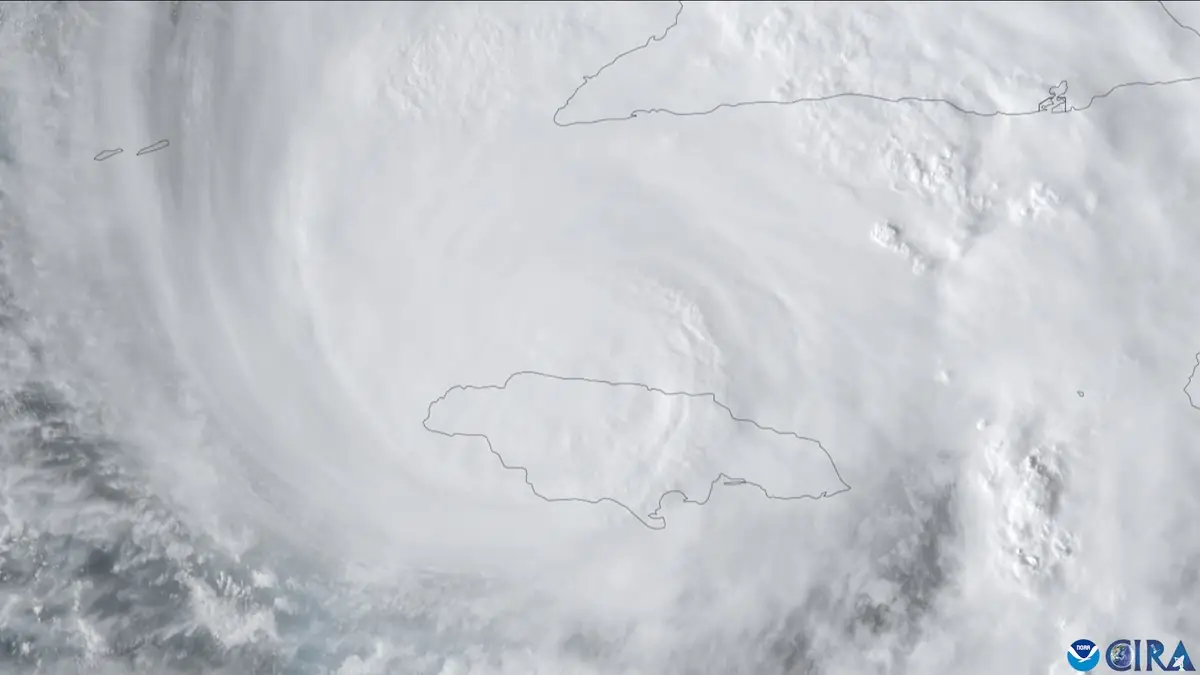
GOES imagery: CSU/CIRA & NOAA
Glossary for this story
- Climate change
- A long-lasting shift in the planet’s climate: temperatures, rainfall and extreme events. Today’s change is caused mainly by burning fossil fuels.
- NOAA
- The National Oceanic and Atmospheric Administration: the U.S. agency that tracks weather, climate, oceans and fisheries.
Javier Niño
Writer at ECOnewsJavier Niño has been a Spanish National Police officer since 2017 and a journalist specialising in employment, labour law and Social Security, with more than seven years of writing experience. At ECOnews he covers environment, energy and sustainability news, focusing on how new regulations and court rulings affect people in their everyday lives.
More from Javier NiñoComments · 0
Rules ›No comments yet. Be the first to share your view.