UC Santa Cruz scientists call prickly pear cacti "living solar panels": eight linked stems reached 4.5 volts, which could one day charge farm sensors
UC Santa Cruz researchers harvested small voltages from prickly pear cacti using their water-saving photosynthesis, to power farm sensors.

· 3 min read
Key points
- The voltage comes from an acidity difference between the sunny and shady sides of the stem.
- Cacti left without water for 15 months still produced electricity.
- Adding nitrogen kept voltage production going later into the day.
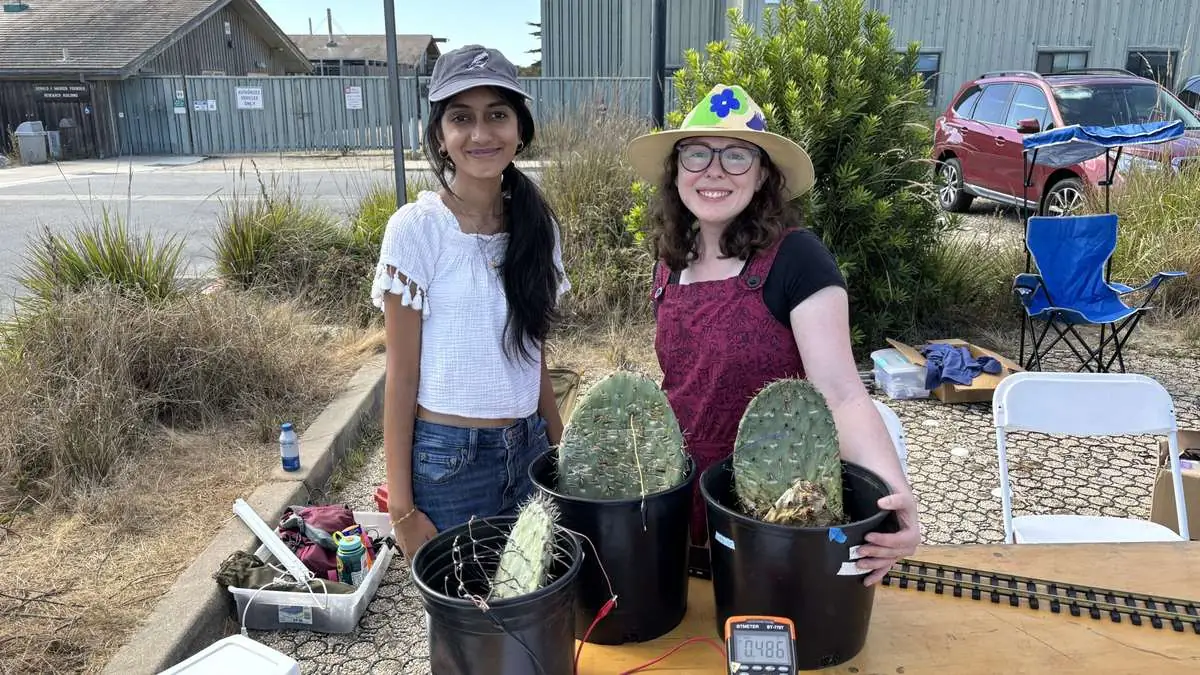
In a greenhouse at the University of California, Santa Cruz, voltage is being produced from an unexpected source. Researchers there have turned the stems of prickly pear cacti into what the university describes as "living solar panels."
The cactus panels produced up to half a volt. By linking eight stems together, the team reached 4.5 volts. By comparison, a standard AA battery generates 1.5 volts, the university noted on November 19, 2026.
The results appear in a study in the journal Plants, People, Planet.
These are small amounts of power, measured here in volts rather than the watts a home needs. The researchers see the cacti as a possible source for low-power sensors that monitor crops on farms, not for homes.
A plant that saves water
The trick lies in the way these cacti photosynthesize. Prickly pears use a process called crassulacean acid metabolism, or CAM, which helps them save water in hot, dry conditions.
Most plants open small pores in their leaves during the day to take in carbon dioxide, but that lets water escape. CAM plants take in carbon dioxide only at night and store it as malic acid. Aloe, pineapple and dragon fruit work the same way, according to UC Santa Cruz.

In effect, CAM plants spread the work of turning carbon dioxide into sugar over 24 hours. That lets them take advantage of cooler temperatures at night.
When the sun hits the cactus, photosynthesis begins breaking down that acid, but only on the side facing the light. The thick stems photosynthesize only in the outer 2 millimeters of each side.
The difference in acidity between the sunny side and the shady side creates a voltage. The team collects it with a wired electrode attached to the plant.
Undergraduates in the lab
The project was led by Charlie Chesney, who earned a Ph.D. in environmental studies at UC Santa Cruz, and Michael Loik, a professor of environmental studies. Loik has studied cactus physiology and ecology for around 40 years.
Loik says he has been obsessed with the plant for as long as he can remember. His knowledge of the plants led him to predict that they could produce electricity, and the team set out to measure it in field plots at the UCSC Farm, in greenhouses and in laboratories.
Chesney brought in undergraduates from engineering, the sciences and the social sciences. Seven of those former students are now authors of the published study.
"The undergraduate students told me they liked this project so much because it felt whimsical, and like a light-hearted approach to something that is so serious," Chesney said.
Summer, sunburn and drought
The team also tested how the environment changes the output. The voltage was much higher in summer, with plenty of sunlight, than in winter, and it followed the amount of sunlight through the day.
Too much light works against it, though. "If it's too high, then the cactus will start trying to protect itself from a sunburn, which will also decrease the voltage," Chesney said.
The researchers also left cacti without water for 15 months. The plants were still alive and photosynthesizing, and the voltage in the drought-stressed stems was sometimes higher than in well-watered ones.
"This was a really surprising result, but also showed how resilient a cactus is," Chesney said.
A part of the study led by undergraduate Erin Langness looked at nitrogen, a common fertilizer ingredient. Adding it raised the plants' supply of malic acid, so photosynthesis and voltage production lasted later into the day.
From farm sensors to plant health
The team envisions planting prickly pears alongside other crops. Farmers would then have a renewable power source for sensors that monitor field conditions, which are in growing demand as climate change puts pressure on crops.
The voltage could also show how healthy the cactus itself is. Prickly pears are grown for their edible stems, known as nopales, and their fruit, called tunas.
"It could be connected to a plant that acts as sentinel, measuring conditions and sending it back to the base station at the farmer's office," Loik said. The researchers think the technique could also work with other CAM plants, such as agave or pineapple.
Some plants may be more sensitive to the wires needed to harvest the electricity, they note. Assistant Professor Colleen Josephson and her Ph.D. student John Madden are now carrying the project forward to strengthen the signals.
Photo: UC Santa Cruz
Glossary for this story
- Solar power
- Electricity made from sunlight, usually with panels whose cells turn light directly into current.
- Drought
- A long period of much-lower-than-normal rainfall that reduces the water in rivers, reservoirs and soil.
- Climate change
- A long-lasting shift in the planet’s climate: temperatures, rainfall and extreme events. Today’s change is caused mainly by burning fossil fuels.
ECOnews Newsroom
Writer at ECOnewsA team of journalists specializing in socio-environmental news, sustainability, climate change, the environment, responsible consumption, and innovation. At EcoNews, we provide clear, reliable, and relevant coverage of the environmental and social challenges shaping our era.
More from ECOnews NewsroomComments · 0
Rules ›No comments yet. Be the first to share your view.