Drought now covers 33.6% of the US, down from 35.1% a week earlier, as storms soak Nevada and Utah while Vermont and Indiana dry out
The weekly U.S. Drought Monitor map shows drought easing in the West and Texas but spreading in the Midwest, Northeast and South.

· 4 min read
Key points
- Nevada's share in drought fell from 52.7% to 19.9% in one week.
- Arkansas remains entirely in drought, with 63.4% of the state in exceptional drought.
- Extreme drought or worse rose nationally, from 7.3% to 7.7%.
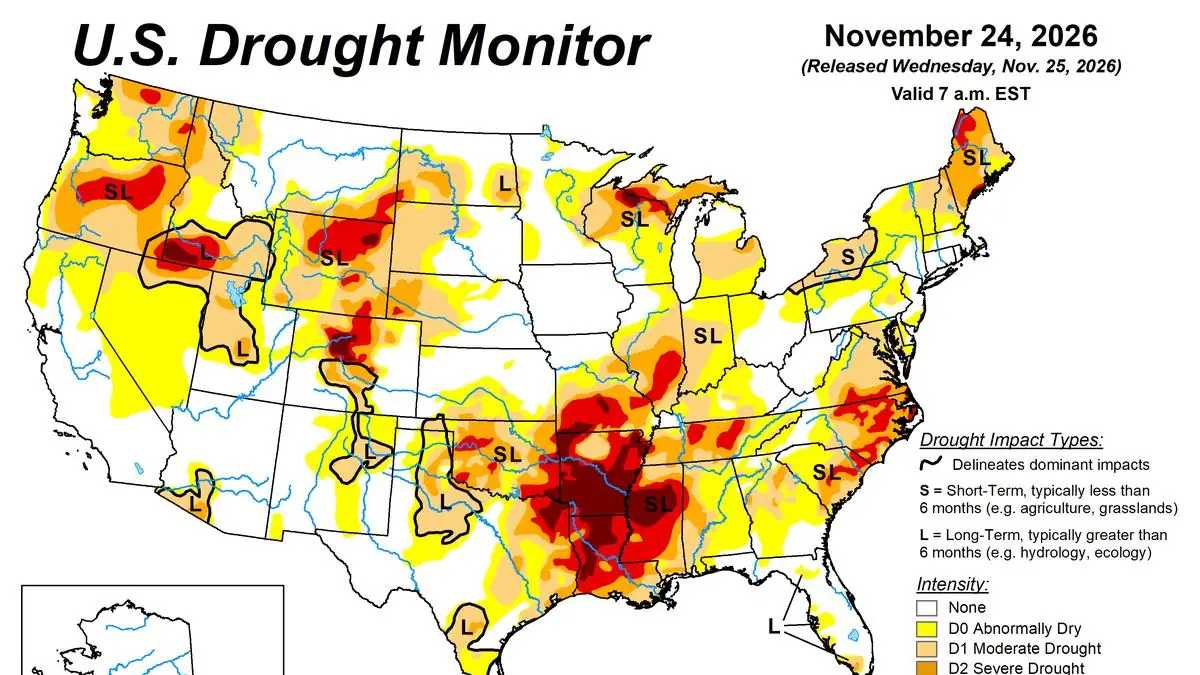
Drought shrank across the United States this week, although some states moved the other way. The latest weekly map from the Drought Monitor is dated November 24, 2026. It shows 33.6% of the country in moderate drought or worse, down from 35.1% on November 17.
That is a drop of 1.5 percentage points in seven days. You can follow the weekly figure on our U.S. drought tracker, which updates itself from the official map.
The map reflects conditions as of 7 a.m. EST on Tuesday. It was released on Wednesday, November 25, a day ahead of Thanksgiving.
How this week compares
A year ago, on November 25, 2025, the share was 36.1%, so this week's figure is 2.5 points lower. In the past two years, the peak was 52.5% on April 21, 2026. The low was 24.9% on June 3, 2025.
In the lower 48 states alone, drought covers 40.2% of the land, down from 42.0% a week earlier. These figures come from the Drought Monitor's data tables, which also break the map down by severity.
By severity, the picture is more mixed. Severe drought or worse fell from 17.4% to 16.7% of the country, the data show.

Extreme drought or worse rose from 7.3% to 7.7%, and exceptional drought, the top category, went from 2.02% to 2.15%.
Pacific storms bring relief out West
Widespread improvements came in the West, where a series of Pacific storms brought heavy rain to parts of California and heavy snow to the mountains. Snowfall topped 3 feet in some areas of the Sierra Nevada, according to the weekly summary.
Nevada saw the largest change of any state. Its share in drought fell from 52.7% to 19.9% in one week.
Utah went from 53.3% to 34.7%. Its area in severe drought or worse dropped from 24.2% to 5.0%.
New Mexico fell from 18.8% to 10.2%, and California from 8.7% to 3.7%. Over the past 90 days, parts of California, Nevada, Utah, Arizona, Colorado and New Mexico got more than 150% of normal precipitation.
As of November 23, snow water equivalent stood at 350% of the 1991-2020 median in California and 173% in the Great Basin. It was only 54% in the Pacific Northwest and 44% in the Missouri basin.
Texas and Florida also improve
Drought in Texas went from 43.1% to 37.4% after beneficial rains fell in isolated areas of the South Texas Plain and the Gulf Coast. Those areas received 1 to 3 inches or more.
In Florida, a multi-day rain event left storm totals above 10 inches at numerous locations in the east-central and southeast. Isolated totals approached 18 inches, with severe flooding in some areas. Drought in Florida fell from 7.0% to 4.2%.
Where drought got worse
The picture was the opposite in parts of the Northeast and Midwest. Vermont saw the sharpest increase, from 32.3% to 57.2% of the state in drought. Indiana rose from 33.2% to 47.0%, Illinois from 57.9% to 67.5% and Michigan from 45.9% to 55.4%.
In Illinois, the area in extreme drought or worse jumped from 0.7% to 14.7% in a week. In parts of the Midwest, precipitation ran 2 to 8 inches below normal over the past 30 to 60 days, the summary says.
In Minnesota, Wisconsin and Michigan, the week ran 12 to 16 degrees Fahrenheit or more above normal.
In the Northeast, drought expanded in New York's Adirondack Mountains. It also grew in Pennsylvania, Vermont, New Hampshire and West Virginia. The authors cite short-term dryness, declining streamflows and below-normal soil moisture.
Drought stays severe across the South
Arkansas remains entirely in drought, and 63.4% of the state is in exceptional drought. Louisiana went from 94.8% to 99.6% in drought. In Mississippi, the area in extreme drought or worse rose from 53.6% to 66.9%.
Over the past 90 days, much of Arkansas, Louisiana, Mississippi and eastern Texas ran 4 to 12 inches or more short. Soil moisture was below the 10th percentile in parts of Arkansas, Louisiana, Mississippi, Tennessee, southeastern Oklahoma and eastern Texas.
Alabama, Georgia and Virginia also got worse, with Alabama's share in drought rising from 36.6% to 42.8%. In North Carolina, the area in extreme drought or worse eased slightly, from 26.2% to 24.4%.
What comes next
From November 24 to December 1, the National Weather Service expects 1 to 3 inches in parts of the South, Southeast, Mid-Atlantic and Northeast. Western Washington, western Oregon and northern California could get 2 to 5 inches or more.
The Climate Prediction Center's outlook for November 29 to December 3 favors above-normal temperatures across the entire contiguous United States. It also favors above-normal precipitation across most of the lower 48.
This week's national drought summary was written by David Simeral of the Western Regional Climate Center and Brad Rippey of the USDA. The weekly map is produced by the National Drought Mitigation Center at the University of Nebraska-Lincoln, the USDA and NOAA.
Map courtesy of NDMC
Glossary for this story
- Drought
- A long period of much-lower-than-normal rainfall that reduces the water in rivers, reservoirs and soil.
- NOAA
- The National Oceanic and Atmospheric Administration: the U.S. agency that tracks weather, climate, oceans and fisheries.
Jordi Company
Writer at ECOnewsJordi Company is a well-known figure in Catalan publishing and a pioneer of the free press model, with 40 years of experience in television, radio and print. He has founded and led several media groups and today heads ECOticias.com, an environmental news outlet read in Spanish and English around the world and an audience leader since 2004. He is a member of the International Network of Writers for the Earth (RIET), among other organisations.
More from Jordi CompanyComments · 0
Rules ›No comments yet. Be the first to share your view.