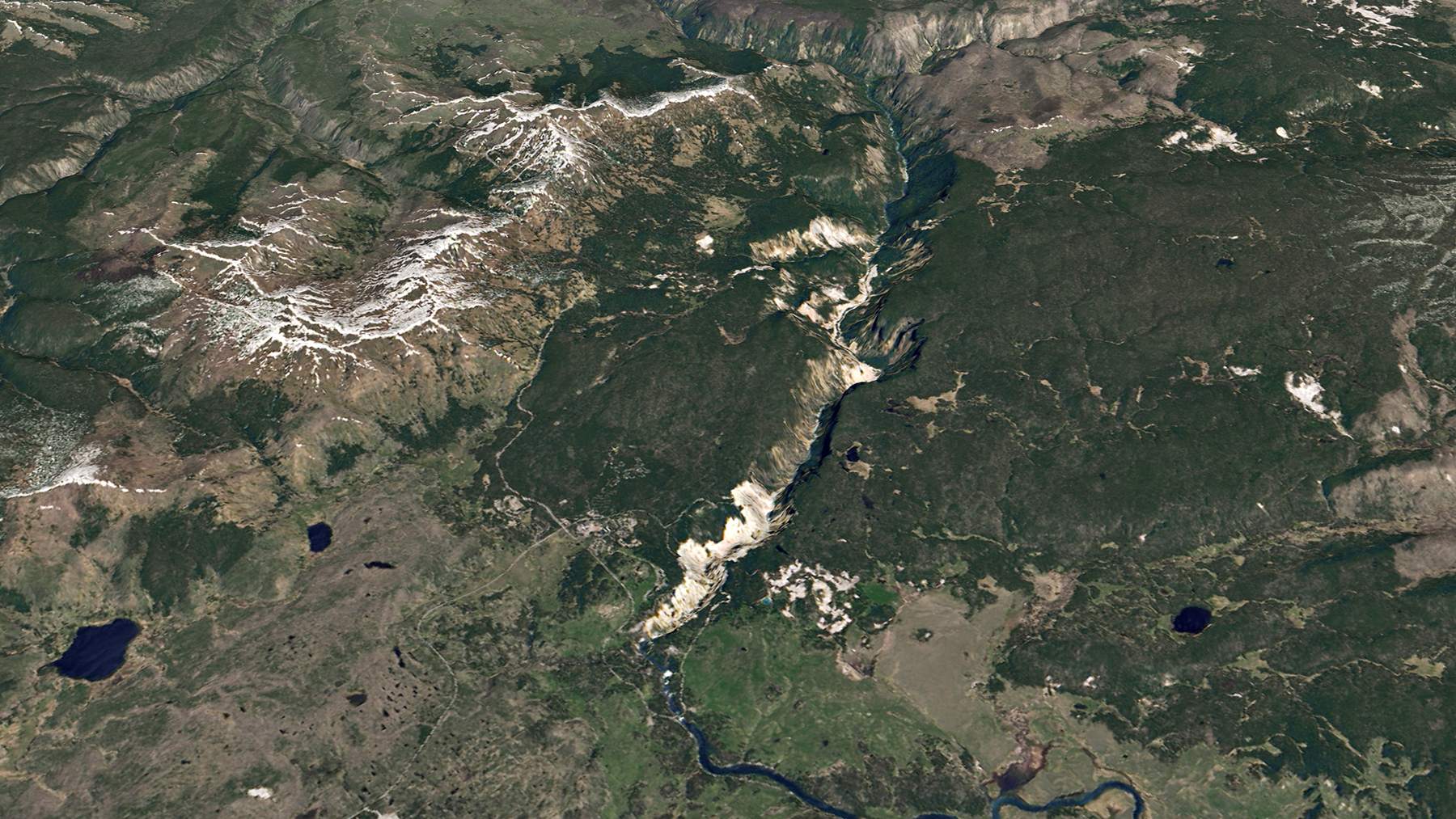
Yellowstone has always held a dual fascination. But, as new research reveals, the reality may be quite different, and even more intriguing. A recent discovery has brought this volcano back into the headlines: more than 86,000 hidden earthquakes have been identified beneath the caldera, thanks to artificial intelligence. The revelation doesn’t indicate an immediate risk, but it changes the way we understand what’s happening beneath our feet.
Hidden earthquake swarms uncovered
Scientific investigations discovered a hidden magma base underneath Yellowstone National Park, which has brought forth momentous geological observations. A layer of molten rock called magma lies beneath the park surface, and its movement concerns experts about volcanic potential. According to the authors, Yellowstone is one of the most seismically active volcanoes on the planet, and much of this activity appears in the form of “earthquake swarms,” or seismic swarms, as they are called.
“By understanding patterns of seismicity, like earthquake swarms, we can improve safety measures, better inform the public about potential risks, and even guide geothermal energy development away from danger in areas with promising heat flow,” said Li
These swarms aren’t signs of an imminent eruption, but they serve as small windows into how fluids, magma, gases, and hot water move deep within the crust. It’s as if the supervolcano is constantly sending subtle messages, which we’ve only just begun to decipher in detail.
Yellowstone’s slow fury: the hidden power of riolitic lava
Now, while the tremors are already attracting attention, the big question remains: how would Yellowstone actually erupt in the future? The answer might frustrate Hollywood screenwriters, but it fascinates geologists. After all, the public tends to associate volcanic eruptions with what they see in Hawaii: spectacular basaltic lava fountains and incandescent rivers flowing at high speed. But Yellowstone is in a different category. Its signature is not a fast, fluid spectacle, but rather something much slower and more ponderous.
After the caldera formed 631,000 years ago, the volcano began producing rhyolitic lava, extremely viscous and thick, which moves almost like a solid wall slowly across the landscape. The last such flow occurred about 70,000 years ago. The curious detail is that these eruptions follow a clustered pattern: several flows in succession, followed by tens of thousands of years of no activity.
Today, we’re in one of those long lulls. And if something happens again, scientists believe the most likely scenario would be a new wave of rhyolitic lava, not a devastating superexplosion. This is quite different from this other supervolcano that’s currently raging and has America on high alert.
Yellowstone is calm, but every tremor tells a story
Despite the revelation of 86,000 hidden earthquakes, official reports confirm that Yellowstone remains at a normal level of activity. The September 2025 report provided very clear data, let’s take a look:
- In August, 94 small earthquakes were detected by the University of Utah’s seismic network.
- The ground continues to subsist, meaning it is slowly sinking, with no signs of magmatic inflation.
- The famous Steamboat Geyser showed only minor activity, with no major eruptions.
- And seismic images show that the magma chamber is largely solidified.
All these signs point to a dormant, but not dead, volcano. That’s why scientists monitor it closely, because even when calm, each tremor adds a piece to the local geological puzzle. And most importantly, understand that this behavior isn’t just a matter of academic curiosity. It helps develop safety strategies, inform tourists and residents, and even guide geothermal energy projects — like the one in which one state holds 95% of U.S. geothermal energy — which rely precisely on underground heat, but which, if poorly located, can come too close to risk zones.