
The University of Washington is stepping up its involvement in tidal energy research as university scientists engage in a pilot tidal energy project at Puget Sound as well as in the development of numerical models to study the environmental effects of tidal turbines.
The results of both studies will be presented this week at the American Geophysical Union’s meeting in San Francisco. The scientists believe their work will allow more countries to harness the power of ocean tides more efficiently.
The Snohomish County Public Utility District will deploy two tidal turbines developed by Irish company OpenHydro in Admiralty Inlet, the entrance of Puget Sound. The 30-foot-wide turbines will generate an average of 100 kilowatts of electricity – enough to power up to 100 Washington homes.
This will be the first tidal energy project on the West Coast and the first array of large-scale turbines to generate power from ocean tides into an electrical grid. The project received a $10 million grant from the Department of Energy and is now in the final phase of obtaining permits.
«The results of this pilot project will help decide if this is an industry that has potential for going forward at the commercial scale, or if it stops at the pilot stage,» said Brian Polagye, a research assistant professor of mechanical engineering.
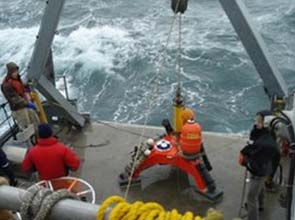
Mr. Polagye and his colleagues monitor the project in order to devise ways to best site tidal turbines. For two years, they have been measuring currents continuously at the site, using a monitoring tripod that tracks water quality, ambient noise, currents, temperature and salinity. The instrument also records marine mammal calls and electronic tags on passing fish.
So far, the data shows the Admiralty Inlet is well-suited for a tidal energy installation. Once the turbines are in the water, researchers will monitor their environmental effects.
Meanwhile, Teymour Javaherchi, a mechanical engineering doctoral student at the university developed models stimulating the possible environmental effects of tidal turbines, which can be vital for the development of tidal energy technology.
“We are aware that the limiting factor for the development of these technologies is the perception by the public that they might have a big environmental impact,” said Alberto Alised, an assistant professor of mechanical engineering.
Mr. Javaherchi explained that one of his models shows pressure changes that occur when fish swim past tidal power turbines. The models use windmill-style turbines that spin in fast-moving tidal channels, creating a low pressure region on one side of the blade. A fish swimming past the turbine will be pulled along with the current to avoid hitting the blade, but it might experience a sudden change in pressure.
The model shows these pressure changes would occur in less than 0.2 seconds, which could be too fast for the fish to adapt. If this pressure change happens too quickly, the fish would be unable to control their buoyancy and would either sink or float. This would disorient them and make them vulnerable to predators.
The existing models use the blade geometry from a wind turbine so it is too early to say whether tidal turbines could harm fish in this way. However, this highlights a consideration that tidal turbine manufacturers should design around.
Another model looked at whether changes in speed of water flow could affect the sedimentation in tidal channel. Scientists once thought that slower water speeds behind a turbine would allow more particles to sink to the bottom rather than be carried along by the current.
The model suggests that this is the case, especially for mid-sized particles. This would mean the rocky bottoms near a tidal turbine might become sandier, affecting marine life.
Scientists suggest that further research must be done to determine which tidal turbine design can extract a reasonable amount of energy while minimizing such environmental effects such as fish kill and excessive sedimentation.