
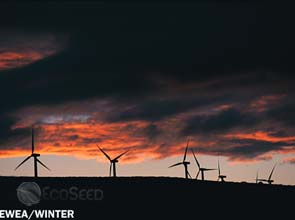
The European Wind Energy Association said Hungary lost 42 million euros ($60.4 million) worth of investments last year for failing to develop new wind farm projects.
Hungary was supposed to have of 330 megawatts’ worth of generating capacity from wind energy last year but only ended up producing 295 MW.
The wind energy group said the loss could be attributed to the “unambitious” targets of Hungary’s National Renewable Energy Action Plan.
It also blamed delays in grid connection tenders and a lack of clarity on laws related wind projects.
“The lack of ambition and all the legislative uncertainty and delays are making investors much more cautious,» said Pierre Tardieu, the association’s regulatory affairs advisor.
Among the E.U.-27 countries, Hungary is said to have among the lowest renewable energy targets.
The association reported that Hungary is aiming for 750 MW worth of wind-generated power by 2020. This is said to be far below the 2.02-gigawatt potential projected by the Hungarian Windpower Association, or even the 1.2 GW that both the E.W.E.A. and the Hungarian wind group believes can be easily connected in the country.
E.W.E.A. warned that the country’s performance in 2010 can continue this year, resulting in it missing out on wind energy investments worth 450 million euros over the next nine years.
Hungarian Environmental Economics Center’s director Jozsef Fucsko stressed that proper government action would be helpful in attracting an influx of investments.
«If we have the right feed-in tariff and a timely call for tender, capital will flow in, provided efforts are made to cut red tape and ensure the necessary regulatory stability,” Mr. Fucsko said.
Currently, Spain’s Iberdrola Renovables is the most active wind developer in Hungary.
The company claims to have a 50 percent share of the Hungarian wind energy market, with five projects and total capacity of 158 MW. This includes the 50-MW Kigismand wind farm, known as the country’s largest.
Latest projects include the 36-MW Scott plant, the 26-MW Amundsen plant and the 8-MW Csoma II completed in February. (Angelo Nonato P. Cabrera)