
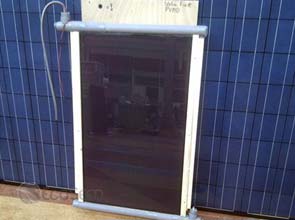
A graduate student at the Delft University of Technology in the Netherlands developed a new type of hybrid solar collector that has a higher efficiency and longer life span than current systems.
What Stefan Roest developed was a hybrid solar collector that combines photovoltaic solar and solar thermal collector technologies to convert sunlight to electricity and to heat water, respectively.
A hybrid solar collector uses residual heat from the PV solar panel to heat water that flows through a system of pipes. This usually requires a great deal of heat.
The issue with conventional hybrid solar collectors is that the materials used in the PV solar cell degrade quickly under temperatures of around 120 degrees, reducing efficiency by 20 percent.
Instead of using copper tubing and copper sheet, materials used in traditional hybrid solar collectors, Mr. Roest’s device makes use of a large number of small aluminum channels directly under the solar panel.
He also did away with the transparent cover which helps retain heat in traditional designs, thereby limiting heat to around 80 degrees only.
In addition, he opted to use a thin-film solar panel instead of a crystalline silicon PV solar panel, saying that it is easier to draw heat from thin-film solar cells. Using thin-film solar panels would translate to an efficiency loss of around 10 percent, instead of the crystalline silicon solar panel’s 20 percent.
He estimated that his device would have a life span of 15 to 20 years, rather than the five to ten years that traditional designs have.
“This innovative design could play an important role in the development of affordable and efficient hybrid systems for household use,” said Miro Zeman, professor of photovoltaic materials and devices at the university.
Just this May, researchers from Boston College and the Massachusetts Institute of Technology also developed a device with the same nature as that of the Delft University’s.
Using nanostructuring methods, researchers produced a hybrid by combining high-performance thermoelectric materials with spectrally-selective absorbers in a vacuum-sealed flat panel, thereby boosting its energy conversion efficiency.