
Scientists in the United States are developing a new technique to store carbon dioxide underground that will not just reduce the level of atmospheric carbon but also generate electricity.
The researchers, led by Lawrence Berkeley National Laboratory, aim to integrate geothermal energy production with carbon capture and storage. They were the recipients of $5 million from the Department of Energy in June to design and test the system.
“This is the first project intended to convert geothermally heated carbon dioxide into useful electricity,” said Barry Freifeld, a mechanical engineer in Berkeley Lab’s Earth Sciences Division and the project’s lead researcher.
The technology also has the added benefit of removing carbon dioxide from the atmosphere cost effectively by offsetting the expense of geologic carbon storage.
Geologic carbon storage is a climate change mitigation strategy that involves capturing carbon dioxide from large emitters and pumping it underground. While this enables the burning of fossil fuels without releasing the greenhouse gas into the atmosphere, the technique can be costly.
“Carbon storage takes a lot of power – large pumps and compressors are needed. We may be able to bring down its costs by generating electricity on the side,” says Mr. Freifeld.
Using and trapping carbon dioxide
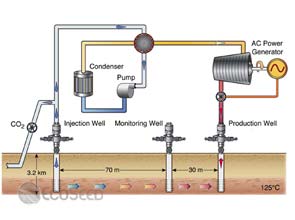
The idea is to inject carbon dioxide three kilometres into the ground into a sedimentary layer that is 125 degrees Celsius. The heated carbon dioxide will be pulled back into the surface and fed into a turbine that will convert it into electricity.
It will then be injected again into the ground repeating the cycle.
The technology will also take advantage of a problem common to conventional geothermal energy. Conventional geothermal energy pumps water through the earth and around 5 to 10 percent of this is “lost”, seeping into pores in the ground.
This means water must constantly be added to the system.
The researchers believe that the carbon dioxide they pump through the earth will also incur some loss, but that would be a good thing as the gradual loss would result in carbon dioxide being stored underground and prevented from being emitted into the atmosphere.
“We actually want some of the carbon dioxide to become trapped,” said Mr. Freifeld.
Waste heat to power conversion company Echogen Power Systems, is part of the team working on this technology. They will be designing the turbine to handle carbon dioxide with hydrocarbons and water that will be accrued during its journey under and above ground.
Scientists from the University of Texas in Austin will also be involved and will be analyzing the environmental impacts of the entire process over its life span.
A pilot test for the technology is planned at the Southeast Regional Carbon Sequestration Partnership’s site in Cransfield, Mississippi. The site is where a Department of Energy-funded carbon dioxide injection project has been underway since 2009.
Much of the infrastructure needed to test the technology is already in place.
The team members also include scientists from Australia’s Commonwealth Scientific Industrial Research Organization.