
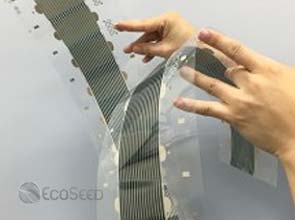
Researchers from North Carolina State University and the Hong Kong University of Science and Technology have developed new materials for more efficient polymer solar cells.
The researchers found that temperature-controlled aggregation in a family of new semi-conducting polymers is the key to create flexible and lightweight organic solar cells that have a high solar efficiency and can be cheaply mass produced.
NC State physicist Harald Ade and postdoctoral researcher Wei Ma had previously studied the morphology of polymer solar cells and found that the size scale of the clumps within the donor layer and the aggregation – or interaction between neighboring molecules within the layers – were the main drivers of solar cell efficiency.
A polymer solar cell is made up of a delicately controlled mixture of a polymer donor and a fullerene acceptor. A solvent is added to the polymer and the fullerene until the mixture becomes a liquid. This liquid is then spread thinly onto a surface. As the solvent evaporates, a thin layer of polymer-fullerene mix solidifies and is left behind. This mix hardens into tiny, highly ordered, clumps that are connected by other, disordered donor molecules, and the acceptor weaving around them.
The new research from Mr. Ade and Mr. Ma and their team shows that the size and scale aggregation of the clumps in the solar cells are strongly temperature dependent. They them experimented with different mixtures, exposed to different temperatures to develop more efficient materials for more efficient solar cells. The team achieved efficiencies of up to 10.8 percent with their new materials. In addition, they were able to create these materials using existing methods of mass production.
“We hope that these findings will allow others to experiment with different polymer-fullerene blends, further increasing the efficiency of solar cells, decreasing their production costs and leading to a commercially viable alternative source of energy,” said Mr. Ade. – EcoSeed Staff