I.B.M. (NYSE:IBM) will work to allow distributed generation and provide smart metering and demand management services to the Smart Grid, Smart City demonstration program.
The three-year project announced around June, the country’s first commercial-scale smart grid plan, will cover five sites in Sydney and the Hunter region, which includes Newcastle, Scone, Sydney central business district, Ku-ring-gai and Newington.
The project will give residents access to real-time analysis of their household electricity usage, which in turn will allow them to make improved decisions towards energy efficiency and their environmental impact, proponents suggest.
The project will also be used to assess real-time information about grid performance and discover ways to enhance network control for Australian energy transmission and distribution companies.
This will be possible through smart grid infrastructure that use sensors, meters, digital devices and analytic tools that allow the automation, monitor and control of the two-way flow of energy operations – from the power plant to the plug.
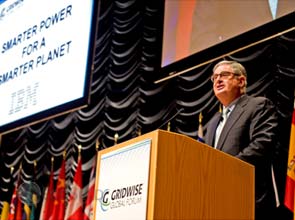
“One of I.B.M.’s key priorities is to help utility companies transform energy, environmental and sustainability issues into opportunities that positively impact the world,” said Glen Boreham, managing director of I.B.M. in Australia and New Zealand.
“Being a member of the consortium that will carry out this project is a reflection of I.B.M.’s commitment to the energy industry and our vision for a smarter planet,” Mr. Boreham said.
The EnergyAustralia consortium includes technology companies General Electric Energy Australia, AGL Energy, Sydney Water, Hunter Water and Newcastle City Council.
In July, market intelligence company ABI Research forecasted the smart grid industry will attract more than $45 billion in investments by 2015 primarily from governments and utilities as a response to the need to upgrade the current power infrastructure and to the rise in renewable energy demand.
For instance, China’s State Grid Corporation and South Korea’s Korea Electric Power Corporation have both revealed huge smart grid projects to be implemented by 2020.