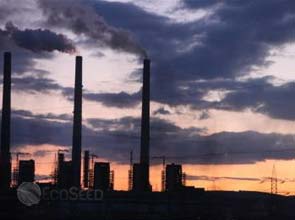
According to University of California-Irvine and Princeton University scientists, existing power plants are and will continue to be a major cause of increasing levels of carbon dioxide in the atmosphere.
Existing power plants around the world are expected to pump out more than 300 billion tons of carbon dioxide over their lifetime.
According to University of California-Irvine and Princeton University scientists, existing power plants are and will continue to be a major cause of increasing levels of carbon dioxide in the atmosphere.
Assuming these existing power plants will operate for 40 years, the power plants constructed globally in 2012 alone will produce about 19 billion tons of carbon dioxide during their lifetime.
«Bringing down carbon emissions means retiring more fossil fuel-burning facilities than we build,» said Steven Davis, assistant professor of Earth system science at UCI and the study’s lead author. «But worldwide, we’ve built more coal-burning power plants in the past decade than in any previous decade, and closures of old plants aren’t keeping pace with this expansion.»
The study found that carbon dioxide emissions that come from existing power plants represent a substantial portion of the emissions budget that would keep global temperatures from warming more than 2 degrees Celsius relative to the preindustrial eras.
Two-thirds of the emissions from the power sector are due to coal-burning plants, while natural gas-fired generators have increased their emission commitments from 15 percent in 1980 to 27 percent in 2012.
Currently, power plants operating in the United States alone account for about 11 percent of these committee emissions, while Europe accounts for 9 percent. However, these commitments have been steady or declining in recent years.
Increasing worldwide commitments can be traced to the rapid growth of China’s power sector since 1995 as well as new facilities found in developing countries such as India, Indonesia, Saudi Arabia and Iran.
Plants in China and India represent around 42 percent and 8 percent of committed future emissions, respectively. – EcoSeed Staff