NASA (from Goddard Space Flight Center and Technical Reports Server), Princeton University and University of Pennsylvania, and an international team of scientists recently captured the first image of a baby universe… and the result is a stunning window into the most distant past we’ve ever seen. A time before stars, planets, or any galaxies even existed. But this isn’t just an ordinary image; what was captured isn’t just a beautiful snapshot of the cosmos, but an unprecedented scientific record, revealing clues about how it all began.
The first light, finally in focus: A baby picture of the universe
For hundreds of thousands of years after the Big Bang, the universe was practically opaque: a boiling mixture of particles, essentially a dense soup of hot plasma, which prevented light from traveling freely. Everything was chaos, and nothing yet had form. It was only about 380,000 years after the beginning of everything that light managed to break free. In other words, it is the “first light” of the universe – a kind of luminous echo of the Big Bang that still travels through the cosmos.
However, for a long time, this radiation could only be observed at low resolution. The real breakthrough came with the Atacama Cosmology Telescope (ACT), installed in the Chilean Andes. And now, with the project’s final data, science has gained one of the sharpest images ever taken of the primordial universe, a true snapshot of the newborn universe.
We’re surrounded by a 50-billion light-year echo
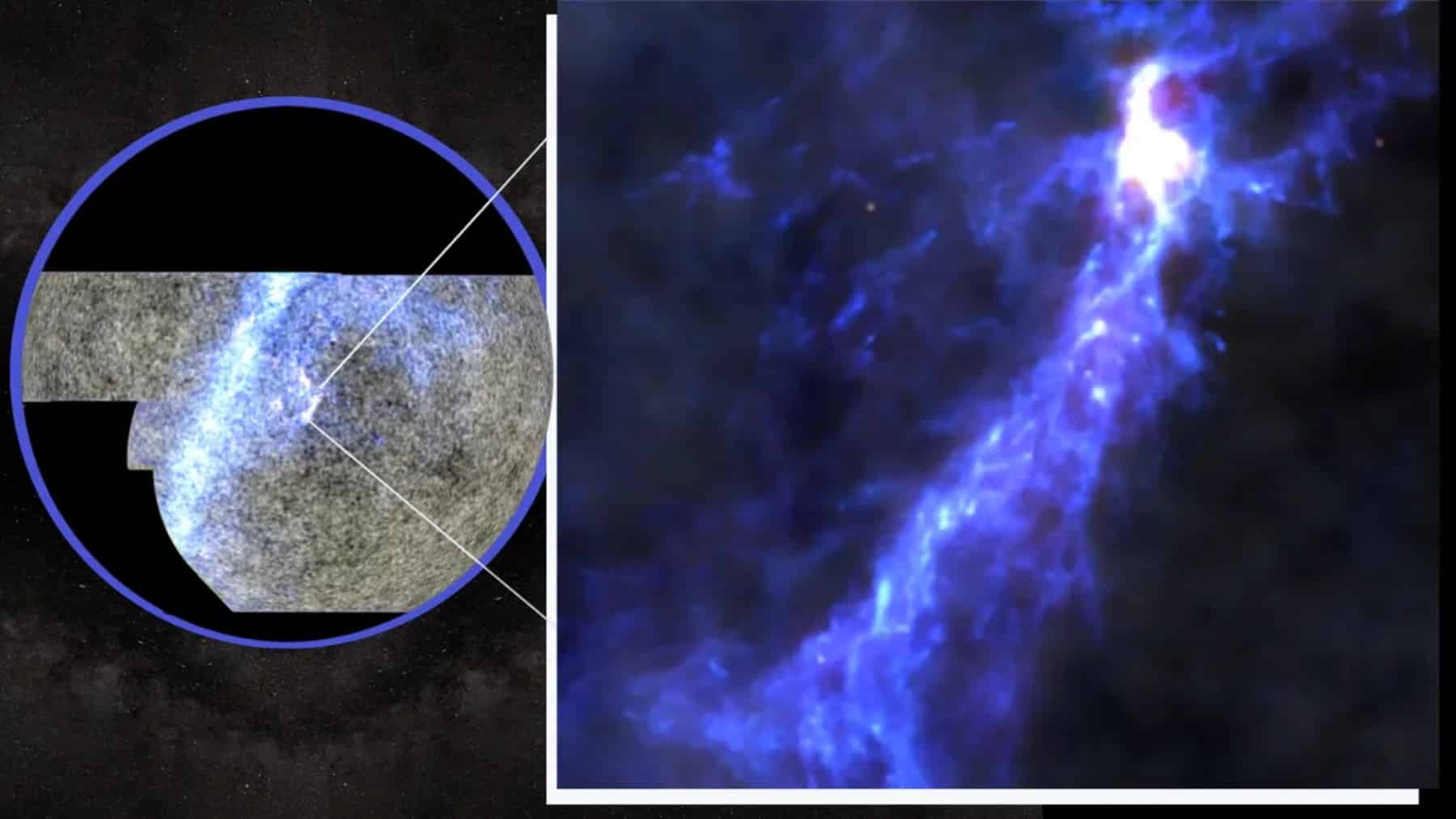
The baby universe in question is called the Cosmic Microwave Background. This radiation is the oldest relic we can observe, and ACT was able to capture it in extremely high definition. More than just a diffuse glow, the image reveals patterns of light polarisation — the direction in which it vibrates, which indicates how the primordial gases were moving at that time.
The orange areas indicate dense regions of gases circulating, and the blue areas show the direct collapse of these gases due to the force of gravity. To better understand, these movements are like waves in the ocean, revealing the presence of invisible forces that would have shaped the earliest structures of the universe.
And it doesn’t stop there: data shows that the observable universe stretches for nearly 50 billion light-years in all directions. And all this vastness carries a mass equivalent to nearly 2 trilliontrillion suns. Yet, only a small fraction of this is made of ordinary matter; the rest is dark matter (something that represents 85% of the universe) and, mainly, dark energy.
The answer was right — and that makes the new questions even bigger
Now, the inevitable question: does this discovery change everything? Yes and no. This is because, despite the impressive precision of the new images, the most surprising result is precisely the confirmation that the current cosmological model (the famous Lambda-CDM) still holds up. After all, no major anomalies were found, nor were there any new physical phenomena that would overturn what we knew until now.
“Through their sweeping breadth, depth and attention to detail, the latest ACT results are a testament to the surprising durability of the standard model of cosmology and the power of the CMB measurements to probe everything from the birth of the universe to stellar outbursts,” said the principal investigator, Lyman Page
The ACT ended its operations in 2022, but the work is far from over. Its successor, the Simons Observatory, is already operating in the same location and promises to take this search for answers to a new level, with even greater sensitivity and depth. Perhaps it’s even time to call on the Rubin Observatory for help, as it performs nearly 10 million alerts per night.