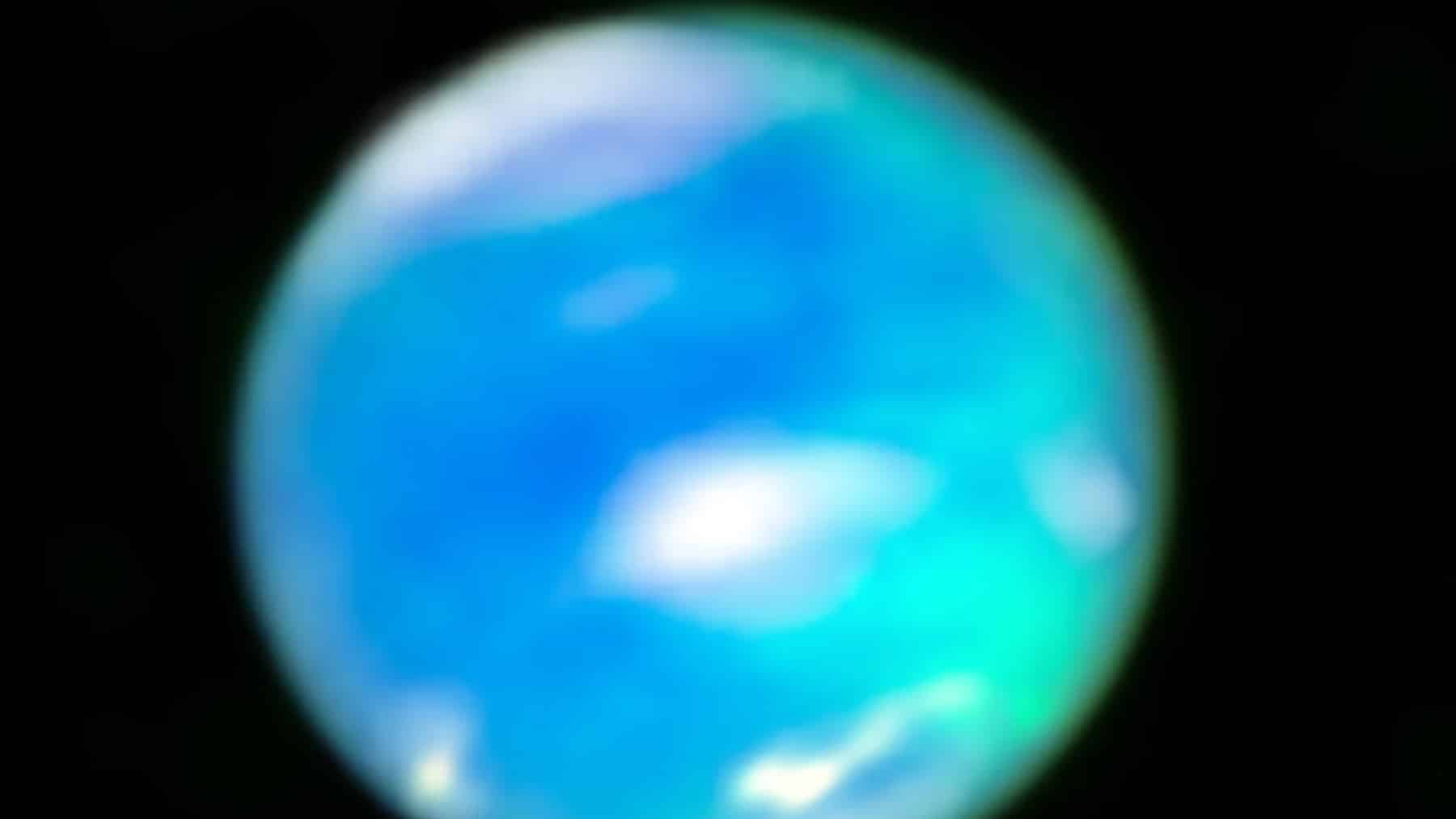
Some cosmic surprises are so strange they feel like plot twists from a sci-fi movie. That’s what happened when the James Webb Space Telescope (JWST) turned its gaze toward Neptune, the most distant planet from the Sun. What began as a routine observation turned into the reveal of a shimmering light show that left astronomers both amazed and scratching their heads — and eager to understand every detail behind such an unexpected display in the far reaches of our solar system.
Neptune’s “impossible colors” finally revealed after decades of mystery
For years, researchers suspected Neptune had auroras, but the proof kept slipping away. Even Voyager 2’s historic flyby in 1989 offered only fragments of evidence, never the whole picture. That changed in June 2023, when the James Webb Space Telescope — with its unmatched infrared vision — finally brought those elusive lights into focus.
The phenomenon earned the nickname “impossible colors” because the hues simply don’t exist in the range our eyes can detect. They appear thanks to a marriage of Hubble’s visible-light imagery and Webb’s spectral data, mapping invisible wavelengths into colors we can actually see.
“Turns out, actually imaging the auroral activity on Neptune was only possible with James Webb’s near-infrared sensitivity” said Henrik Melin, the lead researcher on the study.
How can auroras dance far from Neptune’s poles?
The strangest twist wasn’t just the color — it was where the lights appeared. On Earth, Jupiter, and Saturn, auroras crown the poles, following the path of the planet’s magnetic field lines. Neptune breaks the rules: its auroras glow at mid-latitudes, like they were draped over South America instead of the polar caps.
The culprit is an unusually tilted and offset magnetic field — skewed about 47 degrees from Neptune’s rotation axis and shifted away from its center. It’s as if the planet’s “magnetic heart” had been knocked off-balance, funneling charged particles to unexpected places and igniting a glow where it simply shouldn’t be — a cosmic quirk that continues to puzzle even the most experienced planetary scientists.
Why Neptune’s auroras stayed invisible for so long
James Webb used its Near-Infrared Spectrograph (NIRSpec) to identify the presence of the H₃⁺ ion, a charged molecule that is practically a “seal of authenticity” for auroras on giant planets. And the reason this discovery took so long is directly linked to Neptune’s extreme conditions.
That’s because its upper atmosphere is hundreds of degrees colder today than it was when Voyager 2 flew past in 1989. This cooling diminishes the auroras’ brightness, making them virtually invisible to less sensitive telescopes. That’s why it was only with James Webb’s technology that scientists were able to clearly record the phenomenon (just as he did when he discovered more than 800,000 galaxies in the darkness).
Could Neptune’s strange auroras rewrite what we know about magnetic fields?
This isn’t just a pretty light show — it’s a scientific turning point. The discovery gives researchers a chance to study how tilted magnetic fields interact with the solar wind, track how the 11-year solar cycle plays out on far-flung worlds, and compare Neptune’s quirks to Uranus, another planet with an equally skewed field. Looking ahead, scientists aim to watch Neptune through an entire solar cycle, mapping shifts in auroral activity as the Sun’s magnetism changes.
These insights will help shape future deep-space missions, since any probe bound for Neptune or Uranus will need infrared-tuned instruments to catch similar phenomena. And the findings may force an overhaul of existing magnetic-field models, which rarely account for such extreme, unconventional alignments — after all, the missing matter has finally been found floating in space.