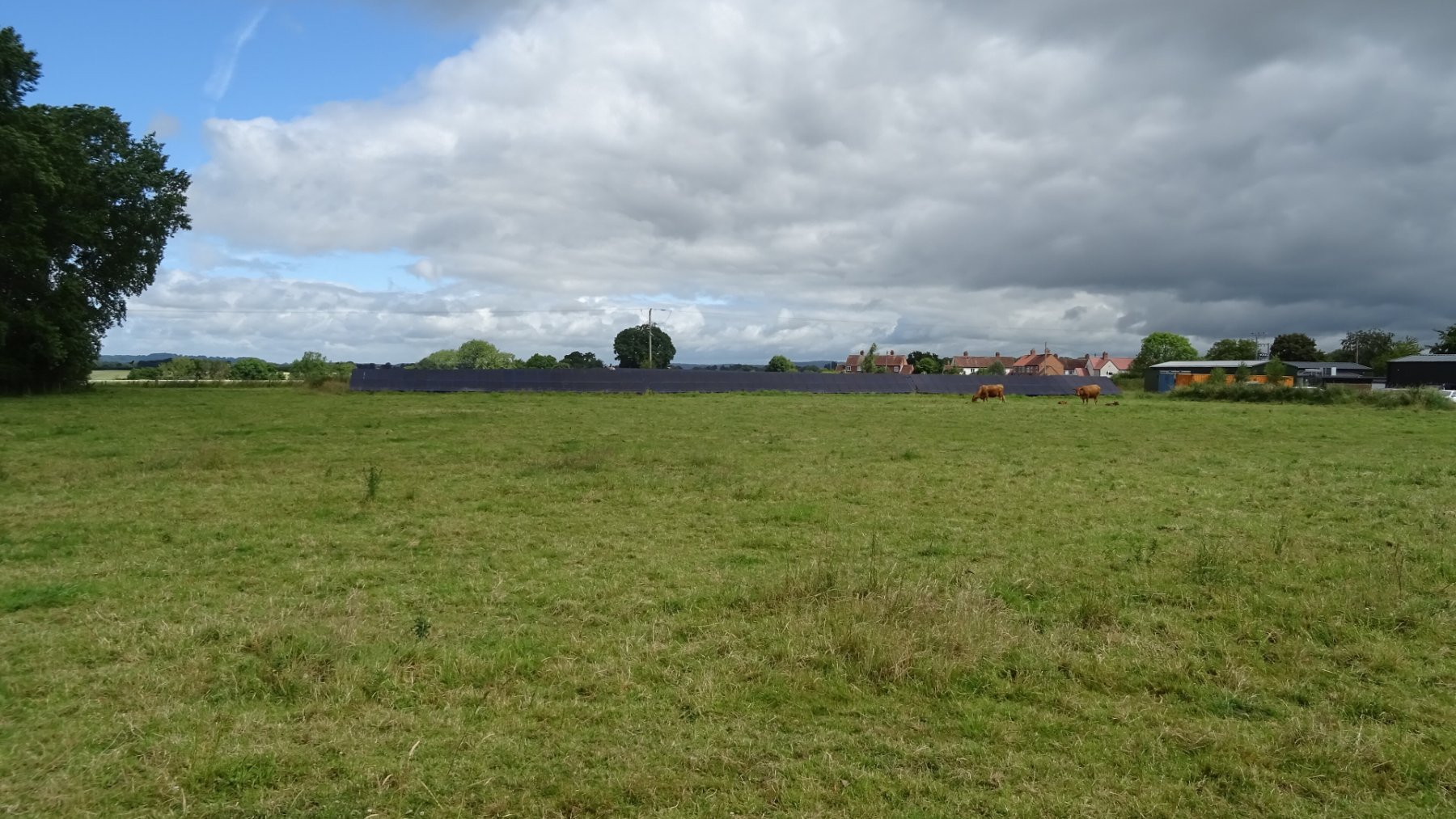
Ten cows and their calves helped put a different kind of solar farm in the spotlight this spring in Christiana, Tennessee. At the 40-acre site, cattle graze beneath adjustable panels rather than being fenced away from the land producing electricity.
Silicon Ranch officially launched its patented CattleTracker system there on April 30, 2026, marking its first commercial deployment. The aim is to keep pasture productive alongside renewable power, without asking farmers or electricity customers to accept a system that only works on paper. This shared use of land for agriculture and solar generation is known as agrivoltaics.
How the panels make room
How do you make moving solar equipment safe around a herd? Silicon Ranch’s official announcement points to a specially designed “grazing mode.” Its patent describes limiting panel tilt over areas occupied by livestock to preserve clearance below.
The important movement is toward a flatter position, not straight up into the air. Silicon Ranch’s patent describes one configuration that keeps panels within 20 degrees of parallel to the ground, compared with a much wider range during normal sun tracking. Restricting that movement can reduce electricity output, which makes coordinating panel settings with herd rotation important.
Workers move the herd between paddocks, or smaller grazing areas, every few days, according to Associated Press reporting from the site. The patent allows operators to select grazing mode for an occupied paddock while other areas continue normal tracking, so the entire farm need not make the same adjustment.
Why cattle need a different design
Sheep have had a head start in solar grazing for a practical reason. The Department of Energy (DOE) notes that they generally fit beneath standard utility-scale arrays, while cattle usually require taller installations. The local electric cooperative also identifies cattle’s greater weight and height as risks to the equipment.
But simply lifting everything higher is not a complete solution. Silicon Ranch says a commercially useful design must balance structural strength, panel height, construction costs, maintenance, durability, and energy production, all while meeting animal-welfare needs. The challenge is making room without making the electricity too expensive.
Clearance is only part of the safety check. DOE recommends properly enclosing wiring for all grazing animals, so a clever panel angle cannot substitute for protecting cables. Animal access has to shape the whole installation, not just its moving parts.
Electricity still has to pay its way
Christiana’s electricity goes to Middle Tennessee Electric (MTE) under an exclusive purchasing agreement. The cooperative projects annual generation of about 7,200 megawatt-hours, enough to replace the wholesale electricity used by roughly 500 member homes.
That does not mean an immediate drop in anyone’s electric bill. MTE says the deal supplies power below its usual wholesale cost and can help keep rates stable, while Silicon Ranch funds, owns, and operates the facility.
The environmental benefits need measuring
The environmental appeal starts with the grass. DOE says sheep grazing can reduce mowing and herbicide use at solar sites, a benefit that helps explain interest in extending the approach to cattle. Less machinery could also mean less fuel use and noise, though those savings need site-specific evidence.
Researchers studying agrivoltaic grazing also point to the role of large livestock in nutrient and water cycling. Solar shade can reduce animals’ exposure to radiant heat, another potential advantage when summer afternoons get uncomfortable.
For Christiana, Silicon Ranch lists improved water infiltration, more vegetation and biodiversity, and greater carbon storage among its expected outcomes. Those are research goals, not a published guarantee that every benefit has already arrived. The project timeline includes ecological and animal-welfare fieldwork through 2028.
Keeping agriculture on the same acres
The bigger question is whether solar development can leave agriculture with a lasting place on the land. American Farmland Trust argues that farming needs to be designed into these projects from the beginning, rather than added afterward, and that grazing contracts can open acreage to producers who otherwise struggle to access it.
“We know it works,” Silicon Ranch’s Nick de Vries told the Associated Press. “But you need to prove it to other people.” For Christiana, that means demonstrating more than cattle fitting beneath panels, with energy, farming, and ecological performance all part of the test.
A working demonstration is an important step, but it is not the final answer for every pasture or solar project.
The official launch announcement was published on Silicon Ranch.