We could say the internet seems infinite. We talk about streaming services, social media, email, online games… and it all seems to work with the same magical fluidity as always. But behind this sense of abundance lies an uncomfortable truth: the digital backbone that sustains our connected lives is already showing signs of exhaustion. And what many haven’t yet realized is that it’s not about submarine cables or your Wi-Fi bandwidth. The threat is much deeper: it lies at the heart of the artificial intelligence revolution.
The looming collapse behind the digital world
For the past few decades, we believed that technology would always advance linearly—that is, faster computers, smaller chips, cheaper storage. But the arrival of artificial intelligence has changed this equation. This is because each new model doesn’t just increase consumption a little: it requires many times more energy and computing power than the previous one.
And therein lies the problem. As a Forbes article pointed out, AI models are collapsing under their own weight. The datasets that feed these models are finite, the cost of training is scaling faster than Moore’s Law, and the most critical factor, energy, has become an impossible bottleneck to ignore. Therefore, when we say that “the internet is about to collapse in America,” we’re not referring to the end of social media or the crash of servers.
In fact, the collapse is energy-related. It is precisely in this scenario that the boldest proposal ever seen arises: Data City, in Texas. A 50,000-acre megaproject that promises to deliver 5 GW of dedicated data center power, isolated from the national grid and focused on solving the biggest bottleneck of the digital age.
Data City in Texas is changing the energy game with a futuristic project
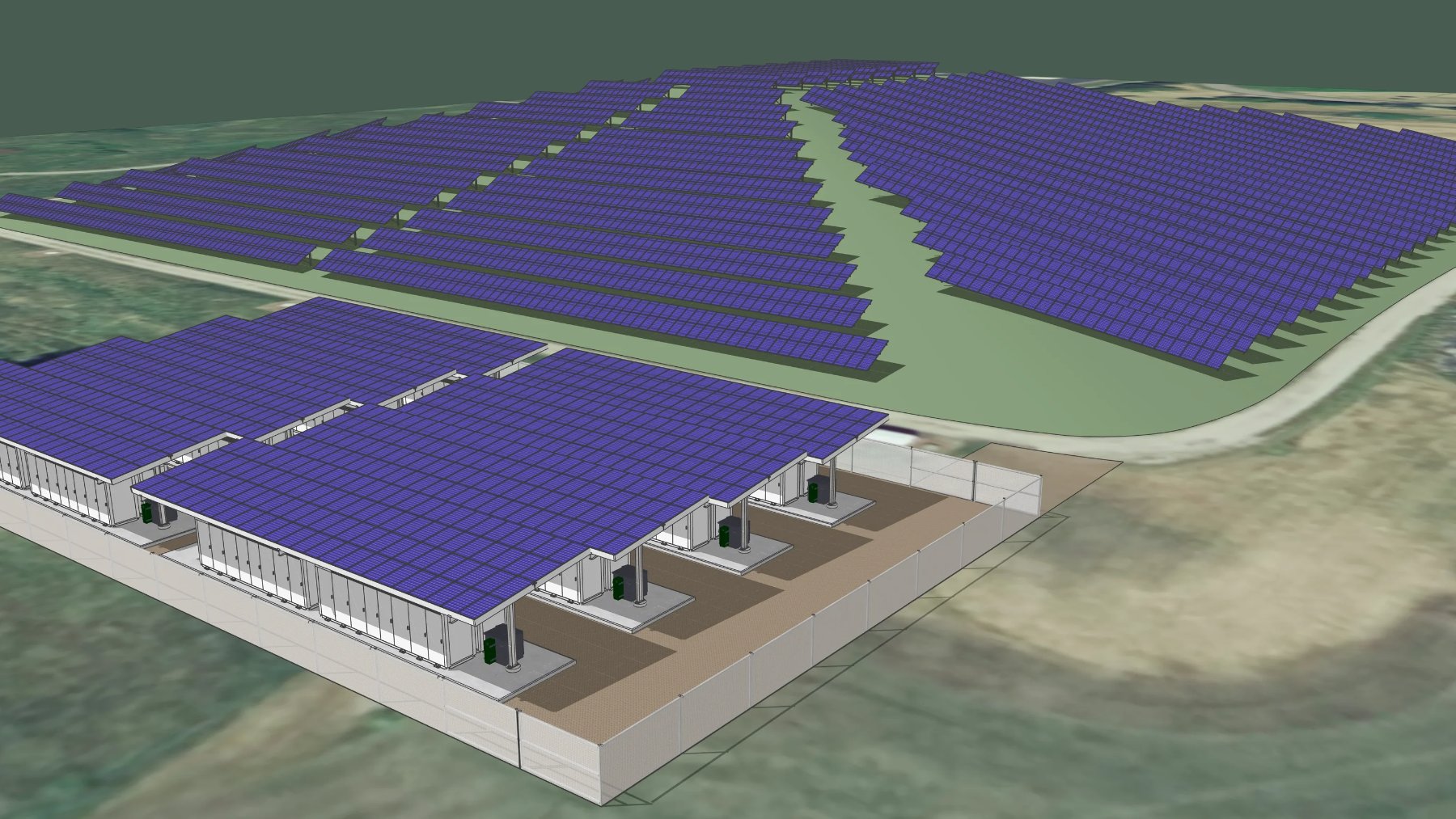
To address this crisis, the Energy Abundance Development Corporation announced the creation of Data City, Texas, a data center hub that will be 100% “behind-the-meter.” In other words, energy generation and consumption will be in the same location, without relying on the state grid. The entire infrastructure will be designed for AI workloads, with ultra-high-density racks and direct-to-chip liquid cooling — essential technology for new NVIDIA chips like Blackwell and Rubin.
But what really stands out is the energy strategy. The initial phase will be fueled by natural gas produced in Texas itself, but the project is already being designed with a planned transition to green hydrogen in mind (which, if green in America, already has blue hydrogen in Europe). The energy will come from an adjacent underground salt cavern storage complex with a capacity of 2 TWh, an innovation that could redefine the concept of energy resilience.
Texas rises as AI’s power capital
It’s also worth remembering that Data City isn’t an isolated case. Texas is already emerging as the epicenter of the energy race for data centers. Other ongoing initiatives include:
- Corpus Christi: Energy Abundance’s own green energy hub, with an estimated annual production of 280,000 tons of hydrogen and 1 million tons of green ammonia (operation starting in 2029).
- Last Energy: Plans to install 30 micro-nuclear reactors in Haskell County, responding to the explosion in demand from data centers.
- Goal (Facebook, Instagram, WhatsApp): Contract with Spanish company Zelestra to enable 595 MW of solar energy in the state alone.
This all becomes important because AI feeds not only on data, but also on energy. In other words, every advance in generative models, every click on a more “intelligent” search, depends on a massive volume of electricity. Concentrating this infrastructure in dedicated projects, like Data City, means growth without overloading the national electricity system. This also reminds us of the first AI wind turbine.