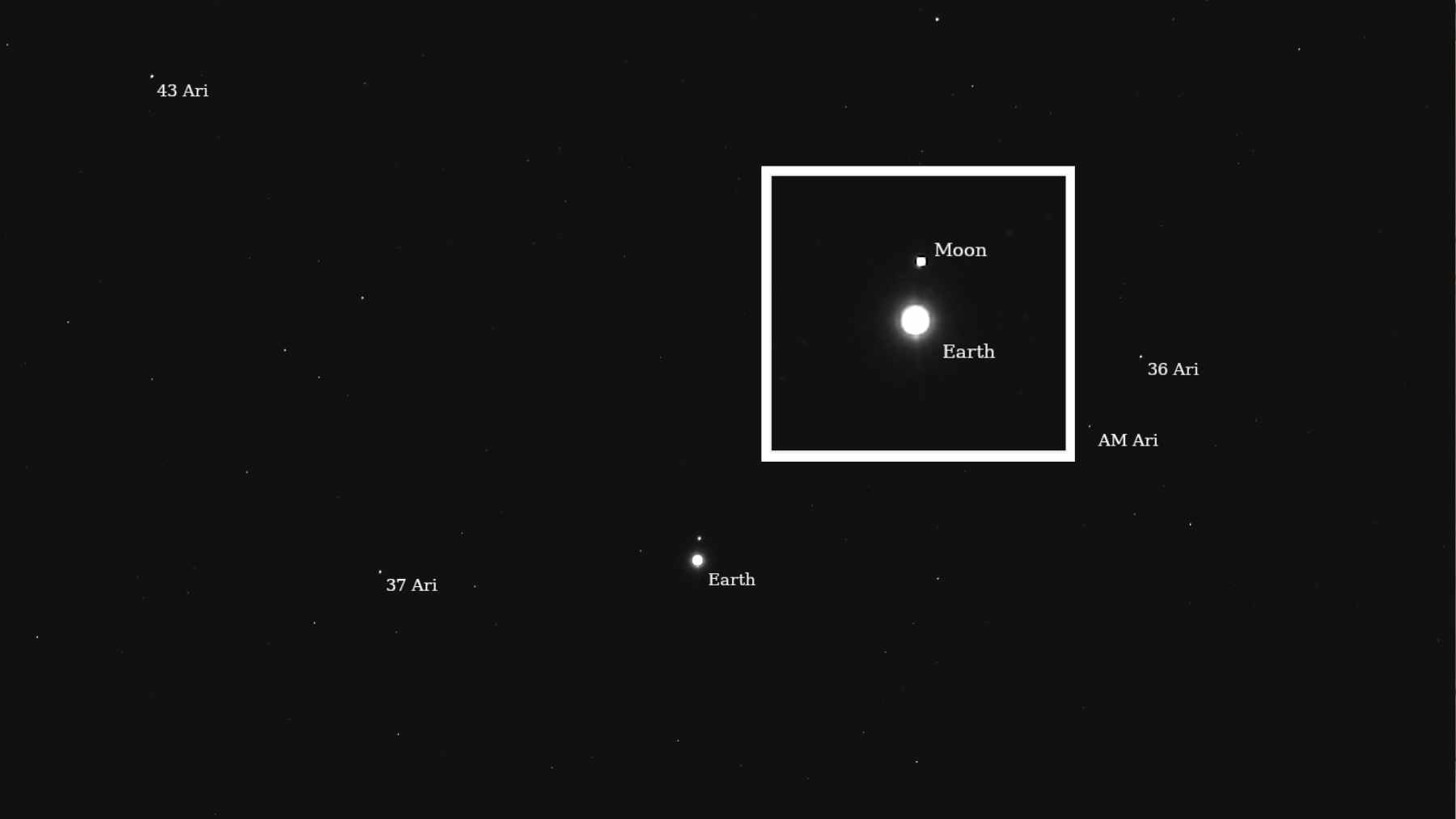
The view came as the probe cruised toward a metal rich asteroid named Psyche. It is NASA’s first visit to such a world.
Why the tiny dot matters
The work was led by Jim Bell, a planetary scientist at Arizona State University (ASU) who leads the Psyche imager. His research focuses on planetary surfaces and spectroscopy.
This was a trial run for the multispectral imager, a camera system that measures light in several colors to identify materials. It must prove it can see faint targets before the main show.
Scientists read a spectrum, a plot of brightness by wavelength, to infer composition. Those curves change with metal, rock, and sulfide rich mixes.
The mission heads for a body that is unusually metal rich. Whether it is a stripped core or a mixed object, it can still teach how rocky planets form.
What the cameras were proving
The team took long exposure shots that set Earth and the Moon against Aries. In a mission update, they explained the test and showed the raw performance.
The mission team indicated that the next tests may focus on Saturn or Vesta to continue checking the imagers. They explained that using familiar targets allows them to compare the instrument’s readings against known values.
The brightness of Earth and the Moon came from reflected sunlight. Stars in the frame gave additional points for tracking and focus checks.
The long exposure, a setting that keeps the shutter open for several seconds to gather light, helped the small dots stand out. That technique also reveals how stable the spacecraft holds its aim.
From dots to data at Psyche
A peer reviewed study outlines how the imager turns color and brightness into geologic clues. It describes filter choices, optics, and the plan to build global maps.
Engineers built redundancy, duplicate hardware kept in reserve for reliability, into the two camera heads. If one has an issue, the second can carry the load.
Those cameras will produce topography, the shape and elevation of surface features, by taking paired looks at the same terrain. The result is a detailed map that ties composition to landscape.
Metal rich patches, mixed layers, and possible sulfides will stand out in color ratios. That is the type of evidence needed to test ideas about how metal bodies assemble.
Milestones between here and 2029
Before the asteroid work begins, other instruments must prove themselves. The team is tracking how each unit behaves during the cruise.
“We’re on target to fly by Mars in May 2026, and we are accomplishing all of our planned activities for cruise,” said Bob Mase, the mission’s project manager at NASA’s Jet Propulsion Laboratory in Southern California. That date sets up the next big course change toward the main belt.
The Mars flyby is a gravity assist, a flyby that uses a planet’s gravity to change course. It adds speed without burning extra propellant.
After that swing past Mars, the spacecraft lines up for arrival in 2029. The primary mapping phase runs for about two years.
A quiet test with a loud message
The July picture shows Earth and the Moon as points in a sea of stars. It is science first, but it also underscores the distance already covered.
Regular tests keep the instrument honest by checking it against known targets. That is calibration, a process that confirms an instrument reads values correctly.
Preparing for mapping at Psyche
The imager will eventually sort metal from rock on Psyche with careful color ratios. Each success in cruise makes those later measurements more trustworthy.
When the mapping begins, the cameras will produce global mosaics, color parameter maps, and terrain models. Those products will guide everything from gravity measurements to higher resolution follow ups.
The Psyche team will compare results against lab spectra of meteorites and previous telescope data. That context tightens the case for any metal rich layers they find.
Building a toolkit for arrival
Every detail supports a larger goal. Understanding a metal rich world helps explain how cores grow inside rocky planets.
The calibration data sets a baseline for the entire instrument suite. The same approach keeps the magnetometer and the gamma ray and neutron spectrometer ready for the main job.
A magnetometer, a sensor that measures magnetic fields, can reveal whether Psyche holds remnant magnetism. That would point to past core-like activity.
A gamma ray and neutron spectrometer, a device that senses high energy particles from the surface, can estimate elements near the top layer. Together, the instruments cross check one another.
The next months will bring more checkouts and occasional looks at bright targets. Each one adds confidence that the tools will perform on arrival.
If the imager, the field sensor, and the particle detector keep hitting their marks, the team enters orbit ready to work. The tiny dot will give way to a full world.