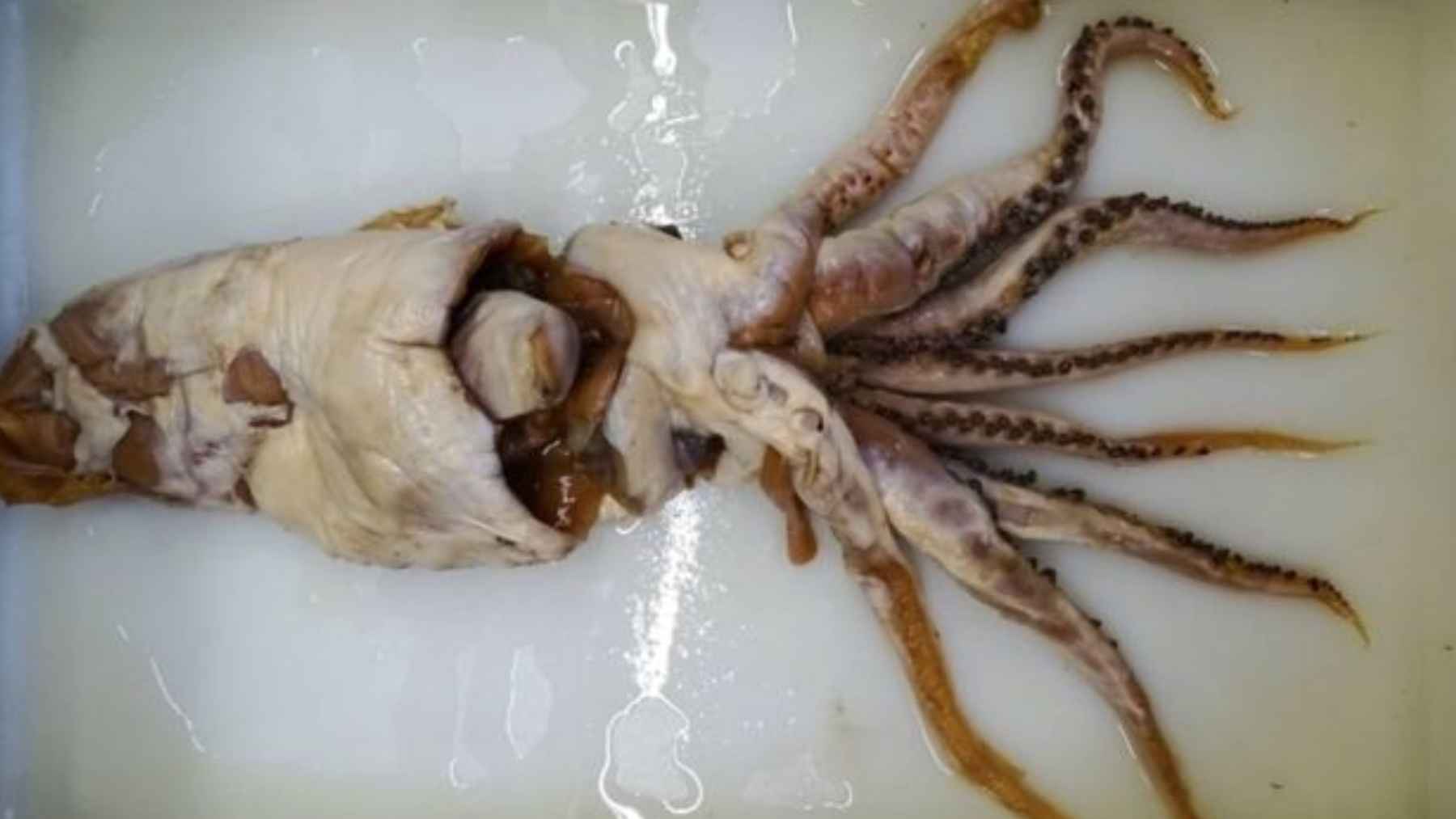
If you picture a new species discovery, you might imagine a submarine camera or a deep-sea net coming up from the dark. This one began with a preserved lump of squid pulled from a sperm whale’s stomach in the mid-1950s. It sat for decades, mislabeled and easy to overlook, like a forgotten file in the back of a cabinet.
Now the animal has a name, Mobydickia poseidonii, and it is not just a new species. It is different enough to earn its own squid family and a spot on the World Register of Marine Species “Top Ten Remarkable Marine Species of 2025” list released on March 19, 2026, part of a year when the registry logged almost 2,600 newly described marine species.
A jar that changed the squid family tree
The recheck was led by Sam Arnold and Fernando Ángel Fernández-Álvarez at the Institute of Marine Sciences of Spain’s National Research Council in Barcelona, where the team works with preserved marine specimens. The researchers traced the squid back to material collected between 1955 and 1956, a period when commercial whaling operations still removed sperm whales from the ocean.
The specimen spent years in the reference collection of the late cephalopod researcher Malcolm Clarke before it was deposited at the Natural History Museum in London and treated as part of the sharp-ear enope squid, Ancistrocheirus lesueurii. The team said, “The morphology of this specimen was so radically different from any previously described squid that the creation of a new family was inevitable.”
What makes Poseidon’s squid stand out
When scientists describe an animal, they often start with morphology, meaning its visible structure and body parts. In this case, the preserved squid showed a pale, gelatin-like body with little to no pigment, plus arm hooks shaped in a way that reminds researchers of a trident.
It also lacks the glowing light organs many people associate with deep-sea creatures, which makes it stand out even more in its group. So far, it is known from just a single individual linked to Antarctic waters, which is part of why its “real” identity stayed hidden for so long.
A new species and a new family
Biologists sort life into nested groups, and the word “family” is higher up than “genus” and “species.” Creating a new family is a signal that a creature is not simply a new version of something familiar, but a separate branch with its own deep history.
For this squid, that new family name is Mobydickidae, built around the newly described genus and species. In plain terms, it is like realizing an animal is not just a new kind of cat, but something closer to discovering a whole new cat family.
Why the squid was misclassified for decades
The new research was part of a larger effort to untangle a confusing set of deep-water squids that can look very similar. The paper describes “cryptic species,” meaning separate species that appear almost identical to the eye, which can turn identification into a long game of detective work.
There is also a practical problem. Oceanic squids are soft-bodied, often damaged in nets, and specimens recovered from predator stomachs may be partly digested, so key features can be missing right when scientists need them most.
How a sperm whale helped do the collecting
Sperm whales do not just hunt deep. They hunt where most human tools struggle, and that matters for what ends up in their stomachs.
The U.S. National Oceanic and Atmospheric Administration says these whales routinely dive to around 2,000 feet and can stay down for about 45 minutes while searching for food like squid. In other words, one whale can sample parts of the ocean that a research ship might never reach on a normal day.
What stomach contents can reveal
Scientists have a long history of learning about deep-sea life from what predators eat, especially when the prey is hard to capture intact. Squid beaks are tough, and they can survive digestion long enough for researchers to sort and identify them later.
A 1998 study in the Journal of the Marine Biological Association of the United Kingdom described how beaks from stranded toothed whales can be counted and matched to squid groups to map diets and ecosystems. That approach is not perfect, but for the deep ocean, it can be one of the few windows that regularly opens.
Why this discovery matters now
This find is a reminder that biodiversity research is not only about new expeditions. It is also about rechecking what is already stored, comparing it carefully, and being willing to admit that an old label may be wrong.
It also shows how much of the deep sea is still “off the map” for science, even in groups as well-studied as squid. What else is sitting in a jar, waiting for a second look?
The main study has been published in the Zoological Journal of the Linnean Society.