A Florida hobbyist has built a small solar-powered cooling system that does something surprisingly simple. It uses sunshine to freeze water during the day, then uses that ice later as a “thermal battery” to cool a small space without pulling power from the grid at that moment.
The prototype is not a replacement for a full-size home air conditioner. Not yet. But it does point to a bigger idea that energy experts are taking seriously as hot weather, rising cooling demand, and painful electric bills collide in more parts of the world. Air conditioners and fans already account for about 10% of global electricity use, according to the International Energy Agency.
A fridge that banks sunlight
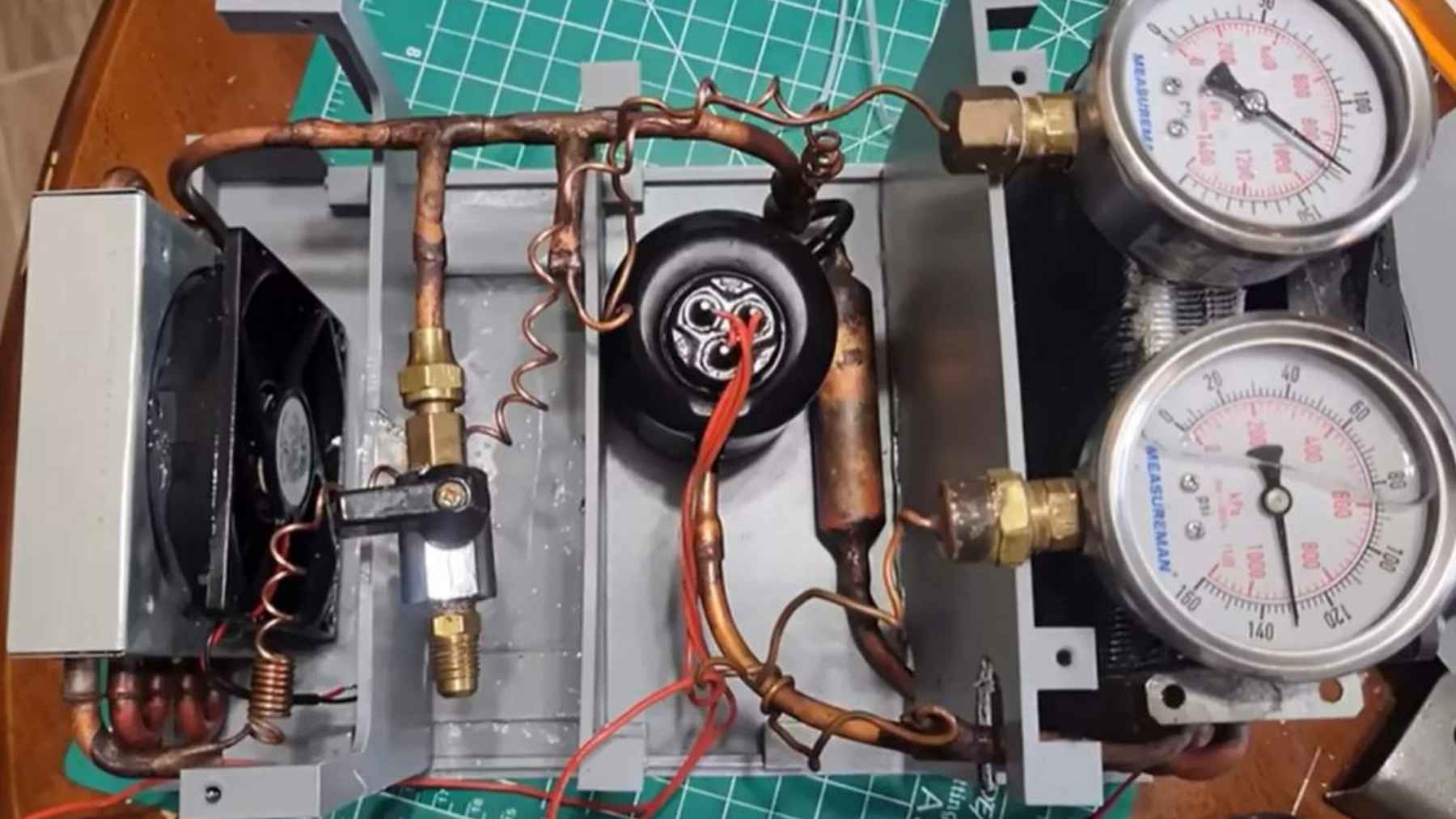
The setup uses three 100-watt solar panels, a compact compressor, copper coils, an insulated tank, a small battery, an inverter, a pump, and a fan. In plain English, it behaves like a little refrigerator that makes ice when solar power is available.
Once the water freezes, a second loop circulates a water-glycol mix through copper tubing buried in the ice. The cold fluid then moves through a small radiator, where a fan pushes cooler air into a tight space such as a vehicle cabin, camper van, shed, or small insulated room.
Why ice makes sense?
Why not just store the solar power in a battery and run an air conditioner later? That can work, of course, but it adds cost, battery wear, and conversion losses. When the job is cooling, storing cold directly can be a cleaner shortcut.
The reported system stores about 2.5 megajoules of cooling energy in the ice. That equals about 0.69 kilowatt-hours, or roughly 2,400 BTU of stored cooling. At its claimed output of up to 700 watts, or about 2,400 BTU per hour, that is modest but useful in the right setting.
Water helps because its phase change does a lot of work. Freezing is not just making water colder. It locks up thermal energy in a solid block that can later absorb heat as it melts, a bit like a slow-motion sponge for warmth.
What the prototype proved
The first lesson is almost boring, but important. Insulation matters. If the tank leaks heat too quickly, the system wastes its cold before it can be useful. With good insulation, the ice can remain partly frozen for hours or even days.
The second lesson is humidity. In sticky Florida heat, the kind that makes a parked car feel like a greenhouse, some early cooling power goes into condensing moisture rather than immediately dropping the air temperature. Anyone who has waited for a room to stop feeling clammy knows that delay.
The third lesson is scale. This is not a magic box that cools a whole house from three small panels. It makes more sense as a proof of concept for targeted cooling, especially where a small, well-insulated space needs relief after the sun fades.
The bigger energy problem
Cooling demand is growing fast, and that is where this little ice box starts to look more serious. The IEA says space cooling is the fastest-growing source of energy demand in buildings under today’s policy settings. By the agency’s own estimates, that growth will keep pressuring power grids during hot days.
That is why thermal storage keeps showing up in official energy research. The U.S. Department of Energy describes thermal energy storage as a way to store heat or cold for later use, helping buildings shift demand and support a more flexible grid. In practical terms, that means making cold when electricity is cheap or solar power is strong, then using it when demand spikes.
ASHRAE has also described cool thermal energy storage as a strong way to reduce peak demand from buildings. This is not just backyard tinkering anymore. Big buildings have used chilled water and ice tanks for years to cut peak cooling costs.
The limits are real
Still, there is no reason to romanticize the prototype. Ice is heavy. Add water, copper tubing, a compressor, a battery, wiring, a tank, and a frame, and “portable” starts to mean something you can move with effort, not something you toss in a backpack.
There is also a safety issue. Reports of the build mention R600, or n-butane, as a refrigerant, which is flammable. A homemade system with refrigerant, pressure, electrical wiring, and improvised connections is not a toy, and any real home or vehicle version would need serious engineering and certification.
Refrigerants are becoming a bigger climate concern as well. The European Union’s 2024 F-gas regulation started applying on March 11, 2024, and tightens rules around fluorinated greenhouse gases used in many cooling systems. That does not make every ice system automatically clean, but it does make efficient cooling and better refrigerant choices more important.
A small system with a big message
At the end of the day, the smartest part of this project may be its timing. The sun is strongest when cooling demand is rising, and in many places, the grid becomes most strained when people come home, traffic hums outside, and air conditioners start fighting the evening heat.
This Florida build does not solve that problem by itself. But it shows a practical path that could complement conventional air conditioning, especially in small spaces, off-grid cabins, emergency cooling, and future hybrid HVAC systems. Sometimes, the most useful “battery” is not a shiny pack of lithium cells. Sometimes, it is a block of ice made at the right time.