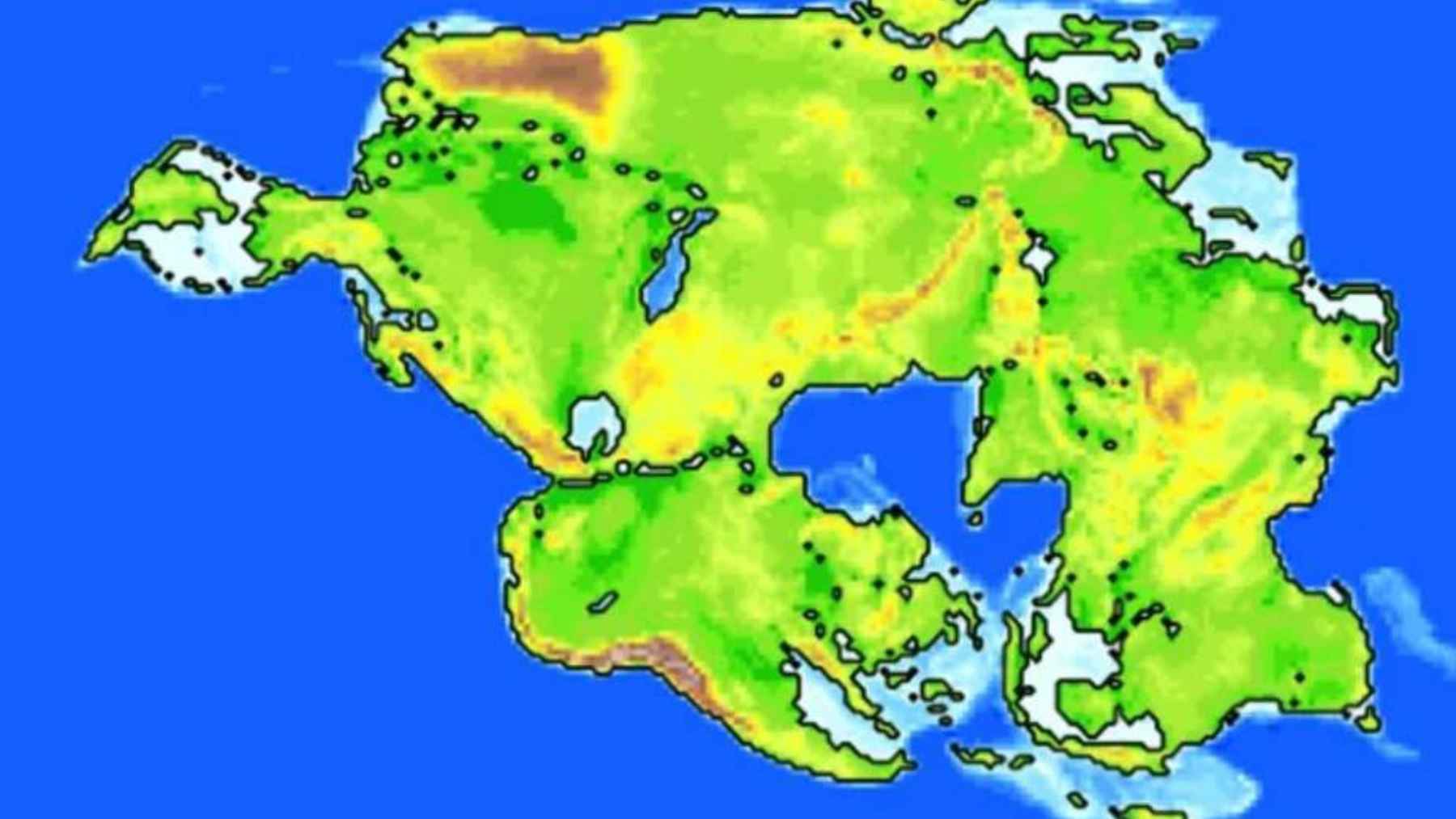
Could the map of Earth someday collapse into a single landmass again? Scientists say that is not only possible, it is part of a long natural cycle, and the next reunion could happen in about 200 million to 250 million years. After Pangaea broke apart, the continents kept drifting, and that slow process is still unfolding now.
An earlier 2018 study by Hannah Sophia Davies, Mattias Green of Bangor University, and João C. Duarte of the University of Lisbon laid out four plausible futures: Novopangea, Pangaea Ultima, Aurica, and Amasia.
Later NASA climate simulations led by Michael J. Way at NASA’s Goddard Institute for Space Studies showed that where this future landmass forms could strongly reshape the planet’s climate.
Why the continents never stay still
Earth’s crust is not one solid shell. It is broken into huge tectonic plates that move at roughly the speed fingernails grow, and over immense spans of time that motion can open oceans, trigger earthquakes, and lift mountain ranges. When one plate sinks under another, a process called subduction, old seafloor is pulled back into Earth’s interior.
The planet, in other words, behaves like a slow-motion puzzle. Researchers say supercontinents tend to come together and break apart over roughly 400 million to 600 million years, with Pangaea forming about 310 million years ago and beginning to split roughly 180 million years ago. That is the deep-time clock behind these forecasts.
The 4 supercontinents scientists think could form
The most likely outcome, for the most part, is Novopangea. In that scenario, the Pacific keeps closing while the Atlantic keeps opening, so the Americas drift farther from Europe and Africa, Antarctica shifts north, and the continents eventually collide on the opposite side of the world from the old Pangaea.
It sounds strange, but it broadly follows the plate motions scientists already see today.
The other routes need bigger changes in the way the plates behave. Pangaea Ultima would require the Atlantic to stop widening and begin closing, pulling the Americas back toward Europe and Africa.
Amasia would gather most of the land around the North Pole, while Aurica, described in a Geological Magazine paper, would close both the Atlantic and Pacific while a new ocean basin opens across Asia.
Why the climate could look very different
So what would that future Earth feel like? NASA-backed modeling tested two end points, Aurica near the equator and Amasia far to the north, and found that average temperatures could differ by several degrees depending on where the land sits and how high it rises.
In practical terms, a high-latitude supercontinent can stay cooler because wider snow cover reflects more sunlight, while a tropical one tends to run hotter across large interior areas.
A 2023 follow-up study led by the University of Bristol focused on Pangaea Ultima and suggested that a hot supercontinent world could leave only about 8 percent to 16 percent of land suitable for mammals. There is no near-term threat here, but the lesson is important.
The layout of continents can shape temperature, rainfall, and how livable a world is, not just on Earth but on distant planets too.
The main research behind this article was published in Geological Magazine.